The Constitution: Rights and Duties of the People
Need for Sufficient National Consensus
Public attention is focused on whether the signal flare for constitutional revision fired by Woo Wonsik, Speaker of the National Assembly, will become a reality.
At a New Year's press conference held on the 5th at Sarangjae of the National Assembly, Speaker Woo urged that a national referendum on constitutional amendment be held simultaneously with the June 3 local elections. In order to hold the local elections and the constitutional referendum at the same time, the National Referendum Act must be revised, and Woo suggested the deadline for revising the law should be around this Lunar New Year holiday.
The Constitution is the most important law, as it defines the rights and obligations of the people and the structure of state governance.
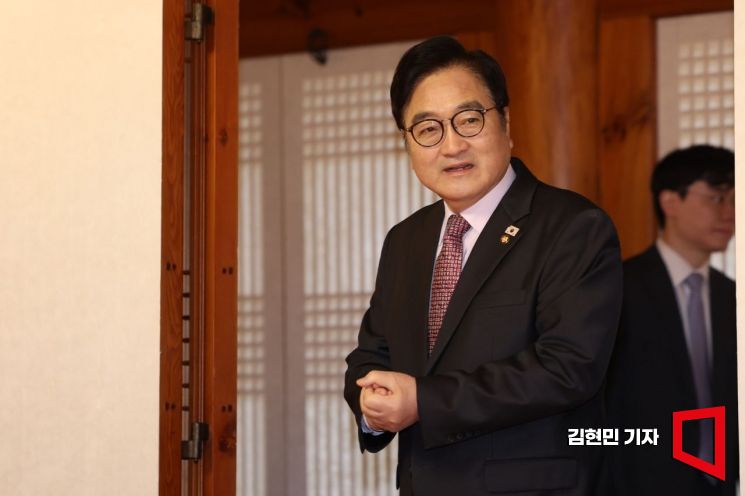 Woo Wonsik, Speaker of the National Assembly, is entering the New Year's press conference held at Sarangjae of the National Assembly on the 5th. Photo by Kim Hyunmin
Constitutional amendment means changing the basic framework of state administration by revising parts of the Constitution or adding new provisions. It has a significant impact on the national system and on people’s lives. It is not a simple revision of clauses, but a legal response aimed at coping with social changes and reflecting the demands of the times. There is a risk that some political forces may attempt to revise the Constitution solely for their own interests. For that reason, constitutional scholars emphasize that, for a constitutional amendment to have legitimacy, a national consensus and sufficient public debate are necessary.
The constitutional amendment procedure proposed by Speaker Woo can be summarized as: proposal by the National Assembly → approval by the National Assembly → national referendum → promulgation of the results. If a constitutional amendment bill is proposed either by a majority of the members of the National Assembly or by the president, it must obtain the approval of at least two-thirds of all lawmakers. Speaker Woo argues that holding the national referendum simultaneously with the local elections can minimize political confusion. Once the referendum result is finalized, the president promulgates it.
Because the current National Referendum Act restricts the voting rights of overseas Koreans, it was ruled inconsistent with the Constitution, and therefore the law must first be revised before any constitutional amendment can proceed. The amendment bill is pending at the Second Subcommittee on Bill Review of the Public Administration and Security Committee of the National Assembly. The problem is that the chair of this committee is Representative Seo Beomsoo of the People Power Party. The People Power Party has not responded to the request to push ahead with holding the June 3 local elections and the constitutional referendum at the same time.
The Democratic Party also, at least on the surface, agrees on the need for constitutional revision, but is hesitant to handle the National Referendum Act amendment bill on its own.
If the constitutional referendum cannot be pursued in conjunction with the local elections, it can be held at the 23rd general election, which will take place in about 2 years and 2 months. However, the Constitution stipulates that when the president deems it necessary, important policies concerning national security may be submitted to a national referendum.
© The Asia Business Daily(www.asiae.co.kr). All rights reserved.
![Clutching a Stolen Dior Bag, Saying "I Hate Being Poor but Real"... The Grotesque Con of a "Human Knockoff" [Slate]](https://cwcontent.asiae.co.kr/asiaresize/183/2026021902243444107_1771435474.jpg)















