Suspension of Restrictions on Sales of Chinese Telecom Equipment and Electric Vehicles
The Donald Trump administration in the United States has put on hold a large number of key technology-security measures intended to contain China. This appears to be an attempt to ease heightened trade tensions ahead of the U.S.-China summit in Beijing scheduled for April.
According to Reuters on the 12th (local time), the Trump administration has suspended technology-security measures such as banning the U.S. operations of Chinese telecom company China Telecom and restricting the sale of China-made equipment for U.S. data centers.
Reuters also reported that measures including a ban on the sale in the United States of routers made by Chinese-affiliated company TP-Link, restrictions on the U.S. internet operations of China Unicom and China Mobile, and a ban on the sale in the United States of Chinese-made electric trucks and buses have all been halted.
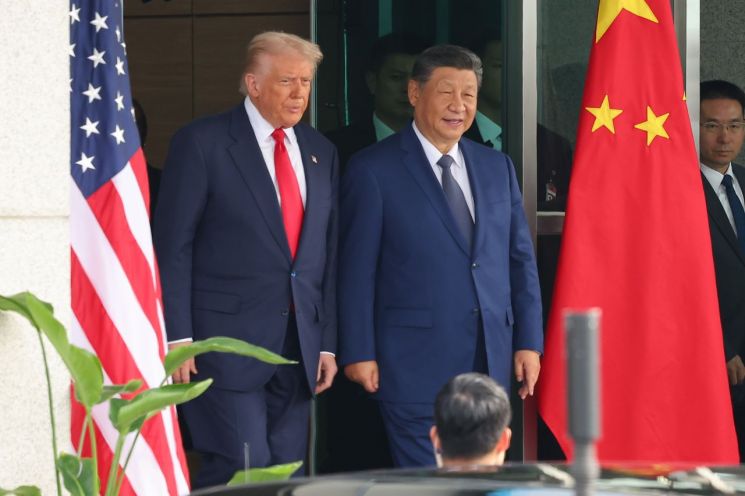
The measures now on hold were originally devised to prevent China from stealing data or disrupting critical infrastructure. This appears to reflect an effort to refrain from hard-line steps that could provoke China following the "trade truce" that President Trump agreed to with Chinese President Xi Jinping in Busan, South Korea, in October last year.
The agreement at that time is also known to have included a pledge by China to postpone export-control measures on rare earth minerals, which are key materials for the global tech manufacturing industry.
The U.S. Department of Commerce offered no detailed explanation for the suspension of these technology-security measures, stating only in principle that it "is actively using its authorities to address national security risks arising from foreign technologies and will continue to do so."
Since the "trade truce" between the United States and China in October last year, U.S. government departments overseeing foreign technology threats are reported to have received instructions to "focus on Iran and Russia."
While this move is interpreted as President Trump’s attempt to ease trade tensions heightened by the tariff war with China, concerns are also being raised that it could threaten U.S. security at a time when the construction of data centers is surging due to exploding demand for artificial intelligence (AI).
Matthew Pottinger, who served as deputy national security adviser at the White House during Trump’s first term, pointed out, "At a time when we are striving to reduce China’s influence in the rare earth supply chain, we are in the ironic situation of allowing China to exert new influence over the U.S. economy in the areas of telecommunications infrastructure, data centers, AI, and electric vehicles."
David Feith, who served in both Trump’s first and second administrations, likewise warned that "U.S. data centers could degenerate into islands remotely controlled by China’s 'digital sovereignty'."
The Chinese Embassy in the United States, by contrast, stated that it opposes the politicization of trade and technology issues and expressed hope that this year will become a year of mutual respect and cooperation between the two countries.
© The Asia Business Daily(www.asiae.co.kr). All rights reserved.