Teenagers Hooked on "Free Cosmetic Surgery"
Another Layer of Appearance Obsession Created by SNS Filters
You slim down the lower face and reduce the square jaw. You shrink the cheekbones, refine the nostrils, then enlarge the eyes. Add a pale, pinkish filter, and you get a smooth, polished face shape like a piece of comb-patterned pottery. All of this happens within seconds on a smartphone screen. This is so-called "free digital plastic surgery." In an era when plastic surgery is no longer special, a culture of performing real-time "plastic surgery" with social media filters and photo-editing applications (apps) is spreading. As both photos and even videos are naturally retouched, there are growing concerns, especially around teenagers, about an "over-immersion in digital cosmetic edits."
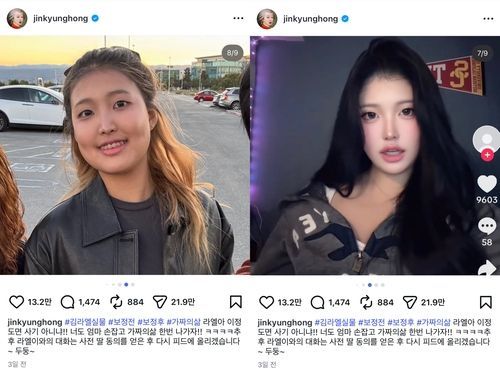 Hong Jinkyung posted photos of her daughter before (left) and after retouching. Hong Jinkyung Instagram
On February 12, Yonhap News reported that recent social media posts by Hong Jinkyung and her daughter, Kim Rael, have sparked controversy over teenagers' "digital plastic surgery." Earlier, Hong Jinkyung posted before-and-after edited photos of her daughter on social media and explained, "They're all edited." The post was intended to dispel plastic surgery allegations that had surfaced online.
To her daughter, she sent messages like, "Your whole life is fake right now," and "You have to accept your bare face as it is." In response, Rael playfully replied, "This is the only way I can protect my mental health. A victory of the human spirit." She added, "Please show a little respect for all the Meitu (editing app) users in this world." Comments on the post were divided between people asking her to "share the filter" and others saying, "You're more than pretty enough just the way you are." In other words, both the view of it as a playful culture and the worries about it surfaced at the same time.
"I like the edited face more than my real one" Real-time facial reshaping with TikTok and Instagram filters
In reality, many teenagers use photo-editing apps most of the time. When asked why they use these apps, teenagers cited reasons such as, "When I take selfies, my face looks long because of the 'cucumber effect,' so editing is basic," "Eyes, nose, and jaw are the first things I tweak," and "If my jaw looks angular, I don't want to upload the picture. Honestly, I like my edited face more than my real face."
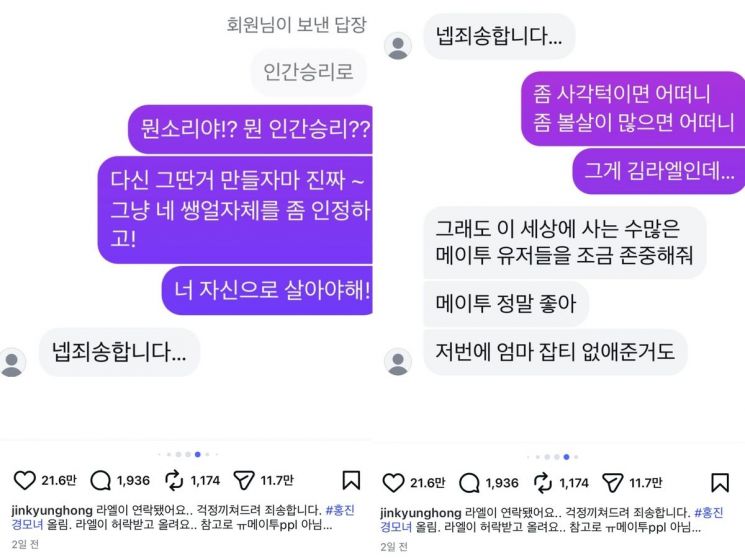 Earlier, Hong Jinkyung posted before-and-after photos of her daughter on social media and explained, "They're all edited." The post was intended to dispel online plastic surgery allegations. Hong Jinkyung's Instagram
Recently, as TikTok and Instagram filter functions have become more advanced, real-time editing is possible even without separate apps. They are applied so naturally to moving videos that it is hardly noticeable. Among teenagers, an excessive obsession with appearance is sometimes called "oe-mo jeongbyeong" (appearance neurosis), and a phase of feeling bored or dissatisfied with one's face is referred to as "eoltaegi" (face fatigue). These may sound like trendy expressions to laugh off, but beneath them lies self-esteem that is shaken by constant comparison and competition.
"This is the only way to protect my mental health" Just play, or a self-esteem crisis?
Amid this, there are many posts on social media saying, "After deleting Instagram, my appearance neurosis got better." Some teenagers do say that their worries about their looks ease when they cut back on social media use. However, there are also opposite reactions such as, "If you take away the edits, that's not me." The "edited me" in the digital space has taken root as another self.
 In an era when plastic surgery is no longer special, a culture of performing real-time 'plastic surgery' with social media filters and photo-editing apps is spreading. The photo is not related to any specific content of the article. Pixabay
Digital cosmetic edits have expanded beyond simple appearance retouching into a form of playful culture. People create a particular mood with Ghibli-style profile pictures, and there is an active culture of friends sharing "sagi filters." However, experts argue that rather than imposing blanket bans on such practices, there is a need for media literacy education. They stress the importance of helping young people recognize that a face created by filters is not the "standard."
© The Asia Business Daily(www.asiae.co.kr). All rights reserved.
![Clutching a Stolen Dior Bag, Saying "I Hate Being Poor but Real"... The Grotesque Con of a "Human Knockoff" [Slate]](https://cwcontent.asiae.co.kr/asiaresize/183/2026021902243444107_1771435474.jpg)


















