Industrial Landscape Shifts Amid Custom Memory Competition
"Government-Led Support Programs Are Essential"
There is growing consensus that the future dominance of the artificial intelligence (AI) semiconductor market will hinge on competition in custom memory. To surpass the stronghold of NVIDIA, which currently leads the AI ecosystem, domestic companies are being urged to move beyond simple semiconductor contract manufacturing and transform themselves into "designers" that proactively identify and provide what their customers need.
Lee Kangwook, Vice President in charge of Package Development at SK Hynix, said during a discussion session at the "SEMICON Korea 2026" AI Summit held on the 11th at COEX in Gangnam-gu, Seoul, "The HBM market is now shifting from a 'commodity' produced simply according to industry-standard specifications to a customer-tailored custom business," adding, "SK Group, from the standpoint of a supplier, is also trying to identify the problems that our customers are experiencing."
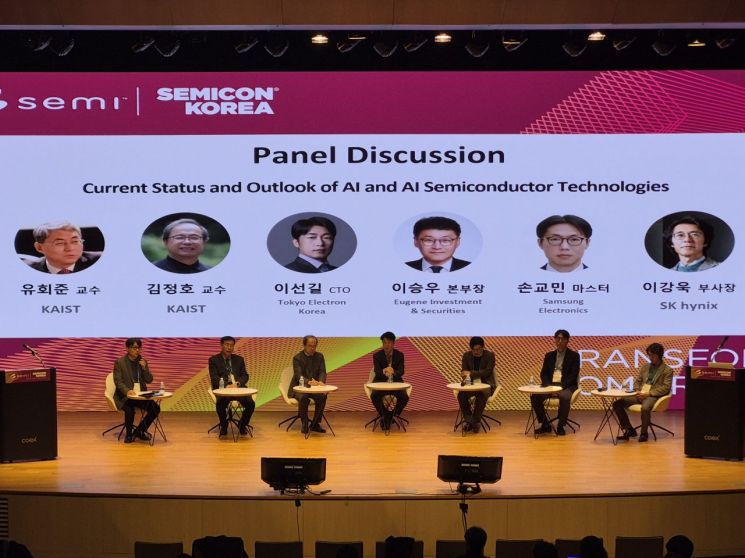 Panelists participating in the discussion session of the "Semicon Korea 2026" AI Summit held on the 11th at COEX in Gangnam-gu, Seoul. From the second left: Yoo Hwejun, KAIST professor; Kim Joungho, KAIST professor; Lee Seonggil, CTO of Tokyo Electron Korea; Lee Seungwoo, Head of Research Center at Eugene Investment & Securities; Son Gyomin, Master, Memory Business Division at Samsung Electronics; Lee Gangwook, Vice President in charge of Package Development at SK Hynix. Photo by Kim Jinyoung
The card SK Hynix has drawn in the "custom High Bandwidth Memory" (cHBM) market is HBM "BTS." It refers to HBM products tailored to customer preferences, with each variant specialized in performance, power efficiency, or integration density: B (Bandwidth), T (Thermal), and S (Space efficiency). Vice President Lee said, "Customers are demanding highly specialized HBM in each of these areas," and added, "Through advanced packaging technology, we intend to prepare multiple platforms and respond proactively to customer needs."
cHBM is also a market that competitor Samsung Electronics is focusing on. In his keynote speech at SEMICON Korea on the same day, Song Jae-hyuk, Chief Technology Officer (CTO) of Samsung Electronics, said, "We are preparing custom HBM that can secure more bandwidth by proactively adopting die-to-die interface IP," and announced, "We are also considering 'Samsung Custom HBM,' in which the base die will take on a certain portion of the work currently handled by the graphics processing unit (GPU)."
However, Vice President Lee cautioned, "From the perspective of a memory manufacturer, shifting from an existing small-portfolio, mass-production system to a multi-portfolio, small-batch production system entails significant risk," predicting, "It will take time for the entire series of processes - from operations capable of handling custom memory, to product planning and development - to change in lockstep."
Son Gyomin, Master in the DRAM Design Team at Samsung Electronics, also pointed out, "The more we individualize memory semiconductors, the greater the risk becomes, because we may end up relying entirely on only a few customers," and added, "Custom memory is clearly a trend and there is every possibility that it will accelerate going forward, but a range of prerequisites must be in place before it can become firmly established."
Experts agreed that full-scale government support is essential for South Korea to reemerge as a powerhouse in AI. Yoo Hoejun, Dean of the KAIST AI Semiconductor Graduate School, said, "China is the best example of what role a government should play in advanced industries such as semiconductors," and argued, "Our government must likewise take the lead in systematically nurturing specialized talent and start-ups, and in providing subsidies to markets and companies." He particularly emphasized the need for research and development (R&D) funding support to prevent leading scholars and industry experts from being lured overseas.
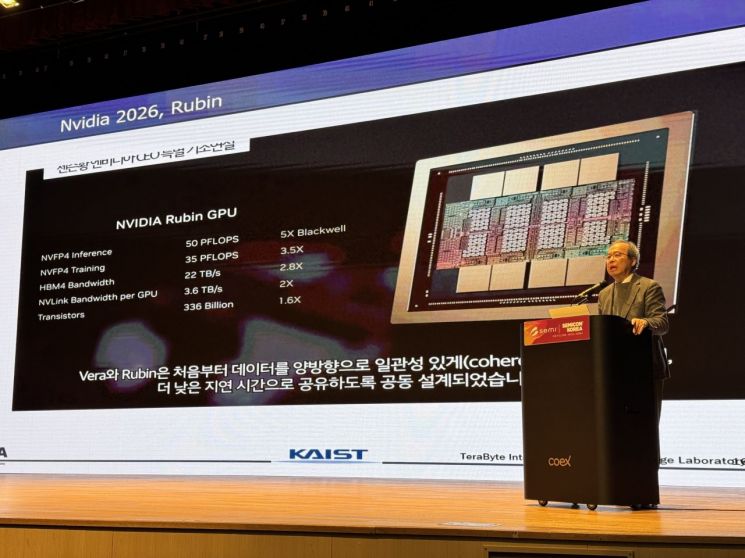 At the Semicon Korea 2026 AI Summit, Professor Kim Jeongho of KAIST is explaining the relationship between HBM and NVIDIA's next-generation GPU, Vera Rubin. Photo by Paek Jongmin, Tech Specialist
Lee Seonggil, Chief Technology Officer (CTO) of Tokyo Electron Korea, said, "Within the domestic semiconductor ecosystem, outstanding talent has flocked to Samsung Electronics and SK Hynix, which has allowed the memory segment to grow well, but there are other areas where growth has been comparatively sluggish," and stressed, "At least in universities, instead of focusing too narrowly on specific semiconductor fields, there needs to be policy-driven education that broadly teaches the direction and roles that society and technology should pursue."
Kim Jungho, Professor in the School of Electrical Engineering at KAIST, said, "If you look at global companies, most are pursuing multimodal, agentic AI, whereas most domestic AI companies remain focused on generative AI based on large language models (LLMs)," and warned, "As Google accelerates its push into agentic AI, domestic companies may find themselves without a place in the market in one to two years. Investment in AI service domains such as culture, shopping, and education must be on par with the investment going into AI semiconductors."
© The Asia Business Daily(www.asiae.co.kr). All rights reserved.
![Clutching a Stolen Dior Bag, Saying "I Hate Being Poor but Real"... The Grotesque Con of a "Human Knockoff" [Slate]](https://cwcontent.asiae.co.kr/asiaresize/183/2026021902243444107_1771435474.jpg)
















