Court: "The person responsible is the CEO"...All eyes on the prosecution's response
Sampyo Group chairman Jeong Dowon, who was indicted over the Yangju quarry collapse, was acquitted in the first trial on charges of violating the Serious Accidents Punishment Act. The accident, in which three people were killed, was the first case to occur just two days after the Act took effect.
On the 10th, the 3rd Single Criminal Division of the Uijeongbu District Court (Presiding Judge Lee Young-eun) stated in relation to Chairman Jeong, who was indicted for violating the Serious Accidents Punishment Act, "It is acknowledged that the defendant sometimes attended regular briefings for each group division, and at times received direct reports or gave instructions to representatives or responsible executives," but added, "It is difficult to conclude that these various reports or meetings constituted a procedure in which, as the person in charge of management at Sampyo Industrial and others, he received briefings on key management issues and comprehensively oversaw the business, including safety and health work, to make management decisions."
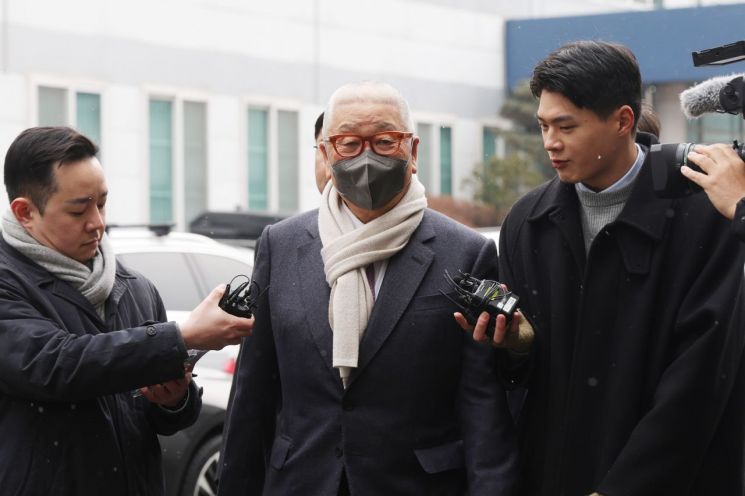 Sampyo Group Chairman Jung Dowon (center) is moving to the courtroom at Uijeongbu District Court in Ganeung-dong, Uijeongbu, Gyeonggi Province, on the afternoon of the 10th to attend the sentencing hearing. In January 2022, at the Yangju site of Sampyo Industries, a collapse of earth at a quarry killed three workers. It was the first accident to occur two days after the Serious Accidents Punishment Act went into effect. Photo by Yonhap News
The court went on to say, "Given the size and organization of Sampyo Group, it cannot be definitively stated that the defendant falls under the category of a person who is in a position to concretely and substantively fulfill the obligations stipulated in the Serious Accidents Punishment Act," and explained the grounds for acquittal by noting, "There is insufficient basis to recognize that the defendant corresponds to the 'management responsible person' as defined by the Act, namely a person who represents the business and has the authority and responsibility to comprehensively oversee the business."
Former Sampyo Industrial CEO Lee Jongshin was also acquitted. The court held, "There is insufficient evidence to recognize that he ordered work to be carried out at the Yangju facility stockyard without taking safety measures required by law, or that he was aware that work was proceeding without such measures."
As for the corporate entity Sampyo Industrial, it was found not guilty on the charge of violating the Serious Accidents Punishment Act, but part of the charges of violating the Industrial Safety and Health Act were accepted, and it was fined 100 million won.
By contrast, four on-site officials from the headquarters and the Yangju facility, who were indicted on charges of occupational negligence resulting in death, were found guilty. The court determined that "they failed to take proactive safety measures in consideration of the particular characteristics of the site," and sentenced the person in charge of safety at the headquarters to two years in prison with a suspended sentence, and each of the three officials at the Yangju facility to suspended sentences of imprisonment.
They were indicted on charges of failing to comply with safety obligations in connection with the accident on January 29, 2022, in which three workers who were working at Sampyo Industrial's Yangju facility were buried in soil and killed. Prosecutors determined that, under the provisions of the Serious Accidents Punishment Act, Chairman Jeong was the management responsible person exercising substantial and final authority in relation to the accident, and indicted him accordingly. The first hearing began in April 2024, and the trial continued into its second year due to changes in the judicial panel and other factors.
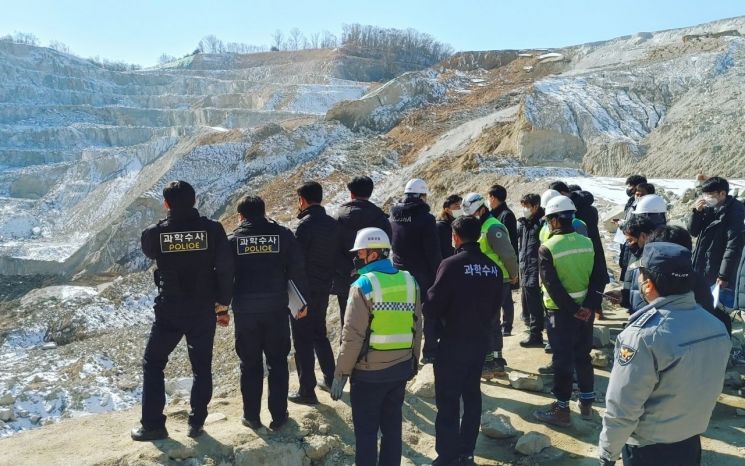 On the afternoon of February 3, 2022, police and other officials from related agencies are conducting a joint on-site inspection at the Sampyo Industry quarry collapse and entrapment incident in Yangju, Gyeonggi Province. Gyeonggi Northern Provincial Police Agency
Meanwhile, after Chairman Jeong was acquitted in the first trial, labor groups protested, saying the ruling "neutralized the purpose of the law and granted business owners a free pass."
The Korean Confederation of Trade Unions (KCTU) stated in a declaration that day, "The Sampyo case was the first case to occur after the implementation of the Serious Accidents Punishment Act and was a symbolic trial in which at least a basic principle had to be established that the top person in charge cannot walk away from a worker's death." It went on to criticize, "Even in the 'first trial' under the Act, the court did not hold the owner and top decision-maker accountable," adding, "This is not merely a ruling, but an attempt to deny the very reason for the law's existence."
The KCTU further stated, "We define this ruling as one that has neutralized the Serious Accidents Punishment Act and collectively granted a free pass to de facto management responsible persons and business owners, and we strongly condemn it," and urged, "The prosecution must immediately appeal and correct this dangerous ruling."
The Federation of Korean Trade Unions (FKTU) also said that day, "We express deep concern over this ruling, which failed to recognize the criminal liability of the top management responsible person in a serious industrial accident in which three workers lost their lives." It added, "Given that industrial accident prevention is directly connected to a company's overall decision-making structure and resource allocation system, the core purpose of the law is to clearly establish the responsibility of top management," and asserted, "This decision does not conform to the legislative intent of the Serious Accidents Punishment Act."
It also noted, "If, within the complex governance structures of large corporations, the responsibility of the top decision-maker is interpreted narrowly, the likelihood increases that companies will intentionally disperse or evade responsibility through their organizational structures," and argued, "This ruling will find it difficult to avoid criticism that it has nullified the purpose of the Serious Accidents Punishment Act."
© The Asia Business Daily(www.asiae.co.kr). All rights reserved.
![Clutching a Stolen Dior Bag, Saying "I Hate Being Poor but Real"... The Grotesque Con of a "Human Knockoff" [Slate]](https://cwcontent.asiae.co.kr/asiaresize/183/2026021902243444107_1771435474.jpg)
















