613 More Students in 2028-2029, 813 More in 2030-2031 in Phased Increases
The Additional Quotas Will Be Allocated to 32 Medical Schools Outside Seoul Through a "Regional Admission Track"
The government has finalized next year's medical school enrollment quota at 3,548 students, an increase of 490 compared to the period before the conflict between the government and the medical community. Starting in the 2028 academic year, an additional 613 students will be added each year for two years, and from the 2030 academic year, a further 813 students will be added each year for two years. The increased quota will be allocated to 32 medical schools outside Seoul, and students will be selected under the regional doctor track.
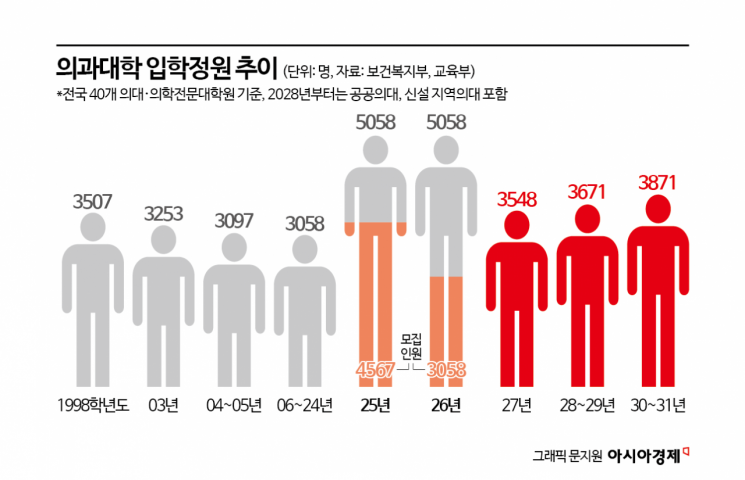
The Ministry of Health and Welfare held the 7th Health and Medical Policy Deliberation Committee (HMPDC) meeting at the Government Complex Seoul on the 10th and decided to increase the annual average number of medical students to be trained at 32 medical schools outside Seoul by 668 from 2027 to 2031.
Accordingly, based on the 3,058-student quota for the 2024 academic year, the medical school quota will be 3,548 students in the 2027 academic year, and 3,671 students in both the 2028 and 2029 academic years. In addition, once a public medical school and a regional medical school are established from the 2030 academic year and each recruits 100 new students, the total medical school enrollment quota after 2030 will reach 3,871 students. In sum, the additional number of doctors to be trained over the next five years will average 668 per year. All of the increased quota will be allocated to regional doctor positions.
The Ministry of Health and Welfare decided to apply different upper limits on the increase by type and size of university, taking into account the regional distribution of medical schools and the situation in which students from the 2024 and 2025 cohorts will be taking classes together.
Accordingly, for national university medical schools with a quota of 50 students or more, the increase rate compared to the 2024 academic year enrollment quota must not exceed 30%. However, for small national university medical schools with fewer than 50 students, an upper limit of 100% will be applied so that they can play a key role in training medical personnel within their respective regions. In the case of private universities, an upper limit of 20% will be applied to schools with 50 students or more, and 30% to small medical schools with fewer than 50 students.
The increased quota will apply to 32 universities outside Seoul. The specific quota for each university will be finalized in April after deliberation by the allocation committee under the Ministry of Education.
The national medical school enrollment quota started at 1,040 students in the 1950s and steadily increased to 3,507 in 1998, but was reduced to 3,058 in 2006 due to the separation of prescribing and dispensing, and then frozen at that level until 2024. Under the previous administration, the enrollment quota for the 2025 academic year was to be increased by 2,000 to 5,058 students, but as some universities adjusted their intake out of concern about the side effects of a rapid increase, the total number of students actually recruited by all medical schools nationwide was 4,567. For the 2026 academic year, the official quota was kept unchanged, and the number of students to be recruited was frozen at 3,058, the level before the increase.
© The Asia Business Daily(www.asiae.co.kr). All rights reserved.
![Clutching a Stolen Dior Bag, Saying "I Hate Being Poor but Real"... The Grotesque Con of a "Human Knockoff" [Slate]](https://cwcontent.asiae.co.kr/asiaresize/183/2026021902243444107_1771435474.jpg)















