S&P Sees New Home Sales This Year
Falling 10% to 14% From 2024
Potential Downgrades for Developers’ Credit Ratings
In China, oversupply in the housing market is causing unsold homes to keep piling up, prompting international credit rating agency Standard & Poor’s (S&P) to lower its outlook for this year even further. The agency also warned that if sluggish home sales persist, it could downgrade the credit ratings of 4 out of 10 rated developers.
According to U.S. business news channel CNBC on the 9th (local time), S&P said in a report that it expects China’s primary-market (first-sale) residential transactions this year to decline by 10% to 14% from last year. This is worse than the 5% to 8% drop it projected in October last year, and more than three times the forecast it made in May last year (-3%).
S&P explained, “The downturn has become structurally entrenched, leaving the government as the only entity capable of absorbing the excess inventory,” adding, “There has been discussion of the government purchasing unsold homes and converting them into public and low-cost housing, but for now such efforts remain sporadic.”
It pointed out that, despite continued weak sales, developers have kept building, leading to a buildup of newly constructed but unsold homes for six consecutive years.
The report projected that the oversupply will translate into downward pressure on prices, with home prices potentially falling an additional 2% to 4% this year. This would mark a second consecutive year of decline.
S&P also noted that, in practice, the downward trend in major city home prices steepened in the fourth quarter of last year. Home prices in Beijing, Guangzhou, and Shenzhen fell by at least 3% last year, while only Shanghai saw an increase, rising 5.7% over the course of 2025.
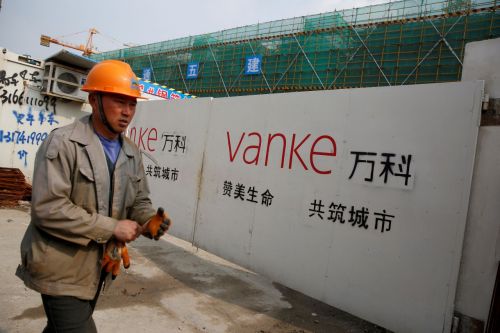
The real estate slowdown is also weighing on corporate creditworthiness. S&P stated that if sales weaken further beyond its baseline projections, 4 out of 10 Chinese developers it rates could come under downward pressure on their credit ratings. This figure excludes major Chinese property developer Vanke, which recently requested extensions on some of its debt repayments.
Other international rating agencies, Moody’s and Fitch, also highlighted the structural problems facing China’s real estate sector in reports published in January, assessing that the downturn is likely to persist for the time being.
CNBC noted that even under these circumstances, Chinese authorities are focusing their policy efforts more on nurturing high-tech industries than on supporting the property market. U.S. research firm Podium Group said in a recent report, “The development of high-tech industries is not sufficient to offset the real estate downturn,” and analyzed that “as a result, China’s economy could become more dependent on exports and more vulnerable to trade conflicts.”
Meanwhile, the Chinese government is preparing for the National People’s Congress (NPC) in March. At this year’s NPC, it will unveil the blueprint for the 15th Five-Year Plan, along with the annual economic growth target and policy priorities. Last year’s target for gross domestic product (GDP) growth was “around 5%.”
© The Asia Business Daily(www.asiae.co.kr). All rights reserved.
![Clutching a Stolen Dior Bag, Saying "I Hate Being Poor but Real"... The Grotesque Con of a "Human Knockoff" [Slate]](https://cwcontent.asiae.co.kr/asiaresize/183/2026021902243444107_1771435474.jpg)















