Emergency Roundtable by the Korea Corporate Governance Forum
"There is no such concept as 'management control' in any country in the world. Introducing management-control defense mechanisms would mean scrapping the Commercial Act amendment altogether. The KOSPI, which has surpassed the 5,000 mark, could fall back to 2,500."
On February 9, at an emergency roundtable titled "Why Management-Control Safety Devices Are Nonsense?" held at the Conrad Hotel in Yeouido, Lee Namwoo, Chairman of the Korea Corporate Governance Forum, stated, "We have now achieved KOSPI 5,000, but if governance reform backtracks, stock prices will return to square one."
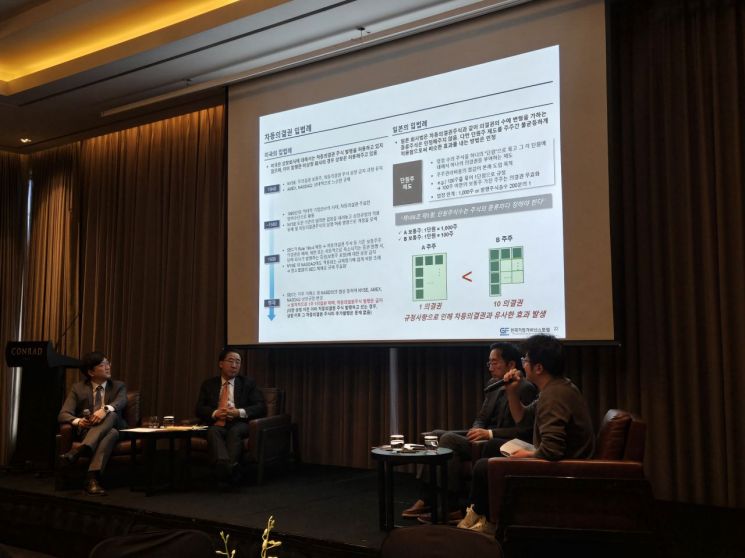
The roundtable was urgently convened in response to arguments from the business community that poison pills and dual-class shares are needed to defend management control, at a time when the National Assembly is discussing the third amendment to the Commercial Act, which centers on mandating the cancellation of treasury shares. A poison pill refers to a mechanism that, in the event of a hostile merger and acquisition (M&A) or an attempt to infringe on management control, grants existing shareholders in advance the right to purchase shares at a price far below market value. Dual-class shares are a system that grants more voting rights to shares held by founders or management than to ordinary shares.
Explaining that in major global capital markets the term "management rights" is used only for specific matters such as the company's rights in collective bargaining between labor and management, Lee warned that, if the management-control defense mechanisms advocated by the business community are introduced, many listed companies could turn into "monsters" like Coupang. Citing an interview with Park Yukyung, former Emerging Markets Head at the Dutch pension fund APG, he added, "The management control referred to by the business community means control that allows the controlling shareholder to exercise overarching control over the listed company regardless of their ownership stake," and warned, "The appropriate valuation of a market where such companies are listed would fall to a price-to-book ratio (PBR) of 0.3 times."
Other roundtable participants also unanimously stated that nowhere in the world is management control asserted as a "right" and used as a line of defense. Kim Kyusik, Portfolio Manager at Vista Global Asset Management, said, "Management control is a responsibility whereby directors serve all shareholders; it cannot become a right to protect private interests," adding that defending the private interests of controlling shareholders is "inevitably a breach of fiduciary duty."
In particular, they argued that attempting to introduce a poison pill without first satisfying the preconditions of Supreme Court precedents and fair judicial review regarding board independence and directors' duty of loyalty, as in the United States, is akin to introducing a "Trojan horse" aimed at dismantling directors' duty of loyalty to shareholders.
Accordingly, Kim stressed that introducing a poison pill in Korea can only be discussed after three preconditions are fulfilled: the establishment of case law on the duty of loyalty and the entire fairness doctrine, special review by an independent committee centered on independent directors, and the exclusion of conflict-of-interest parties. In reality, however, he pointed out that 80% of outside directors in Korea simply rubber-stamp decisions and cannot guarantee substantive independence, that controlling shareholders directly exercise voting rights in transactions involving their own conflicts of interest, and that they even create exceptions to evade provisions requiring actions such as the cancellation of treasury shares to enhance shareholder value.
Lee Changhwan, CEO of Align Partners Asset Management, citing a paper by Song Okryul, professor at Seoul National University School of Law, pointed out that the business community's call for management-control defense mechanisms contains theoretical and practical contradictions. He noted, "There has not yet been any attempt in our country that can truly be called a hostile corporate takeover (M&A)," and said this is closely related to the ownership structure of companies.
He said that, at most, only the 2006 dispute between Carl Icahn and KT&G and the 2020 management-control dispute between KCGI and Hanjin KAL can be described as attempts at hostile M&A, and that beyond these, the very existence of controlling shareholders itself serves as a defense of management control. "Ninety-three percent of KOSPI 200-listed companies have controlling shareholders, and their average ownership stake is 42%," he said, adding, "Even the business associations calling for the introduction of management-control defense mechanisms are, in reality, unable to present any concrete basis for the alleged threat of management control being seized."
In particular, regarding the introduction of dual-class shares, Lee argued, "They should only be allowed in unlisted companies and should be limited to serving as an incentive for listing at the IPO stage," and criticized, "In legal systems where investor protection is weak, there is a higher likelihood of private-benefit extraction through a divergence between cash-flow rights and control rights. In Korea's case, there is a strong possibility that dual-class shares will be used as a tool for succession of management control." In the United States, the issuance of dual-class shares is not allowed for listed companies, but listing is permitted for companies that have already issued such shares while unlisted.
Furthermore, Lee assessed that in Korea, "by allowing controlling shareholders to leverage their control through multiple listings, we already have something akin to a dual-class share system." He asked rhetorically, "If there is absolutely no risk of having (management control) stripped away, no matter how much performance and stock prices decline due to management failure, is it not obvious whether that management will truly fear shareholders and work harder?" and added, "Is this akin to saying that we should introduce a hereditary mechanism to defend the governing power of a president with an approval rating of 10%?"
© The Asia Business Daily(www.asiae.co.kr). All rights reserved.
![Clutching a Stolen Dior Bag, Saying "I Hate Being Poor but Real"... The Grotesque Con of a "Human Knockoff" [Slate]](https://cwcontent.asiae.co.kr/asiaresize/183/2026021902243444107_1771435474.jpg)
















