Ruling and opposition parties submit special bills on administrative integration...Standing committee review ahead
"There are problems with the bill's content," opposition local government heads say
Democratic Party seeks passage at full Public Administration and Security Committee meeting on the 12th
As bills to promote administrative integration of Gwangju and Jeonnam, Daejeon and Chungnam, and Daegu and Gyeongbuk are being proposed one after another, full-fledged discussions will begin at the National Assembly next week. The Democratic Party of Korea is aiming for a resolution by the Public Administration and Security Committee on the 12th, but resistance from opposition parties is strong.
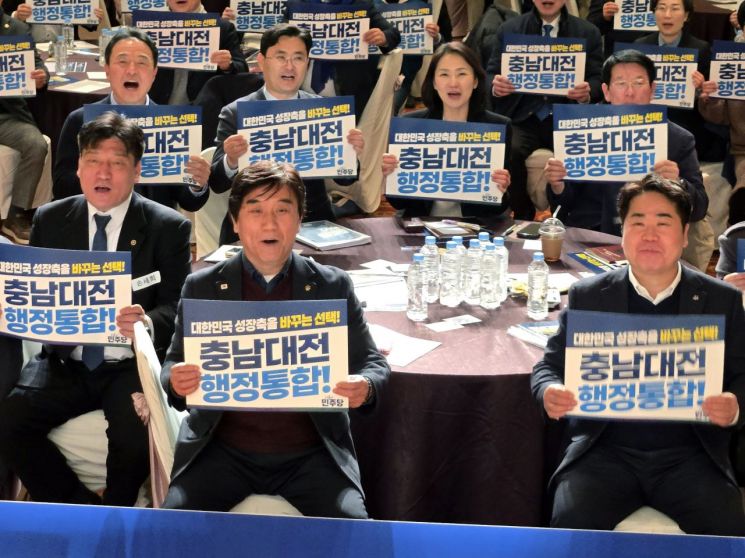 Town hall meeting on administrative integration of Daejeon and Chungnam held on the 6th by the Democratic Party of Korea. Yonhap News
According to the National Assembly on the 8th, the Democratic Party recently submitted special bills on administrative integration of Gwangju and Jeonnam, and of Daejeon and Chungnam as party-sponsored bills, while submitting the special bill on administrative integration of Daegu and Gyeongbuk in the form of a member-sponsored bill. Opposition parties, including the People Power Party, have also introduced their own special bills and plan to conduct an integrated review at the Public Administration and Security Committee.
Administrative integration is being pursued as a measure to address regional imbalances caused by overconcentration in the Seoul metropolitan area and to resolve the crisis of local extinction. It also reflects the intention to create larger economic zones through integrated local governments and to enhance global competitiveness and the ability to attract investment.
A closer look at the Democratic Party’s bills shows that, first, Gwangju and Jeonnam would be integrated to establish the “Jeonnam-Gwangju Integrated Special City” (abbreviated as Gwangju Special City), which would serve as a hub for global future high-tech industries such as artificial intelligence (AI), energy, and semiconductors.
In Gwangju Special City, an AI mega cluster is to be created using only national funds, including a National AI Computing Center and next-generation AI semiconductor infrastructure. The plan also includes the designation of a regulation-free mega sandbox to overcome the limitations of existing AI data utilization.
A future mobility mega cluster, including autonomous driving, can also be designated in Gwangju Special City. The idea is to significantly ease regulations related to autonomous vehicles and to allow demonstration projects for urban air mobility (UAM) and drones.
The special bill on administrative integration of Daejeon and Chungnam proposed by the Democratic Party aims to turn the “Chungnam-Daejeon Integrated Special City” (hereinafter Daejeon Special City) into what is called an “economic, science, and defense-centered city.”
Daejeon Special City will promote policies needed for research industries so that it can be reborn as a science-centered city, and will establish a comprehensive plan every five years to lay the foundation as a carbon-neutral city. In particular, it grants favorable conditions for fostering new industries for carbon neutrality, such as distributed energy, renewable energy, the hydrogen industry, and carbon capture, utilization, and storage (CCUS).
The state will be able to provide administrative and financial support on a priority basis so that Daejeon Special City can foster advanced industries such as aerospace, AI, robotics, biohealth, and quantum technologies.
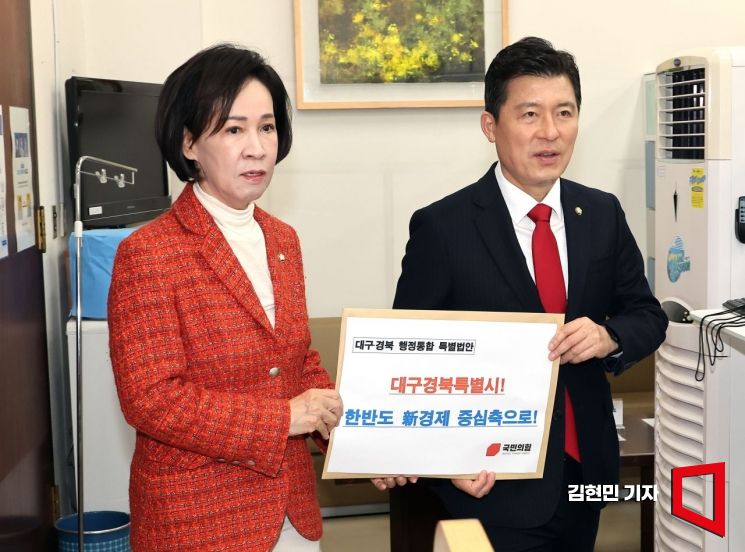 Lee Inseon and Koo Jageun, lawmakers of the People Power Party, are submitting a special bill on administrative integration of Daegu and Gyeongbuk to the Bills Office of the National Assembly in Yeouido, Seoul on the 30th of last month. Photo by Kim Hyunmin
The special bill on administrative integration of Daegu and Gyeongbuk, for which Democratic Party lawmaker Lim Mi-ae is the lead sponsor, is centered on developing “Daegu-Gyeongbuk Special City” into a hub for advanced science and technology innovation and the cultivation of future new industries.
The bill establishes a legal basis for the state to set up a National AI Convergence Research Institute and a Quantum Science and Technology Research Center in Daegu-Gyeongbuk Special City. It also allows the implementation of projects to reduce greenhouse gases and increase energy self-sufficiency so that the city can be reborn as an eco-friendly, carbon-neutral city.
However, the content of the bills has drawn opposition from the other side of the aisle. Daejeon Mayor Lee Jangwoo criticized, “In the Gwangju-Jeonnam special bill submitted by the Democratic Party, the government is stipulated as ‘shall’ provide fiscal support, whereas for Daejeon and Chungnam it is written as ‘may’ provide support. How are the people of the Chungcheong region supposed to accept such a law?”
Chungnam Governor Kim Taehim, in a meeting with the ruling and opposition party leadership on the 5th, called for revisions to the bill, pointing out, “If fiscal transfers are made according to the ruling party’s proposal, the ratio of national taxes to local taxes will be 71 to 29, which falls short of the 65 to 35 ratio promised by President Lee Jaemyung at his New Year’s press conference.”
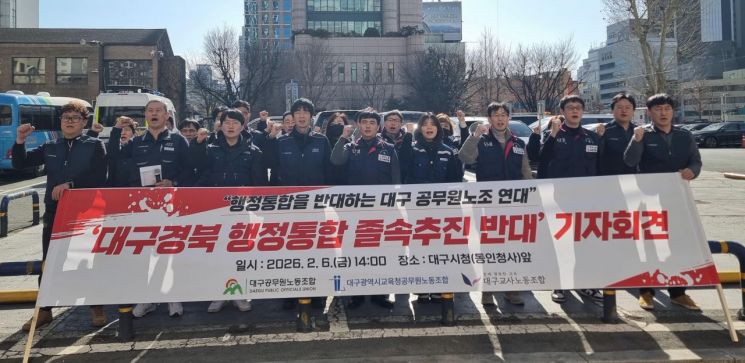
Some local public officials have also raised objections. The Daegu regional government employees’ union criticized the Daegu-Gyeongbuk integration bill proposed by the People Power Party as a bill that drives workers into low-wage conditions. This is because it includes a clause stipulating that Article 6 of the Minimum Wage Act, which guarantees the minimum wage, does not apply to the Global Future Special Zone to be created in Daegu-Gyeongbuk Special City.
Meanwhile, the administrative integration-related bills proposed by both the ruling and opposition parties are scheduled to go through a legislative public hearing on the 9th, followed by review at the Bill Review Subcommittee of the Public Administration and Security Committee from the 10th to the 11th. The Democratic Party is targeting a schedule in which the bills are put to a vote at the full meeting of the Public Administration and Security Committee on the 12th, before the Lunar New Year holiday.
© The Asia Business Daily(www.asiae.co.kr). All rights reserved.