Pursuing Verification of Space-Optimized AI Payloads
by Combining High-Performance, Low-Power NPUs
Cooperation has begun to move the "brain" of space experiments from the ground into space. Spacelintech, a space medicine specialist, announced on February 6 that it has signed a memorandum of understanding (MOU) with AI semiconductor company Mobilint, and will jointly develop AI-based space payloads and advance high-performance, low-power AI semiconductor solutions optimized for the space environment.
Through this agreement, the two companies plan to jointly develop AI space payloads using Mobilint's neural processing unit (NPU) and to optimize AI semiconductor solutions that can be operated stably even in the space environment, where there are severe constraints on power, heat, and communications. They also plan to gradually expand the scope of their cooperation to the broader space industry in the future.
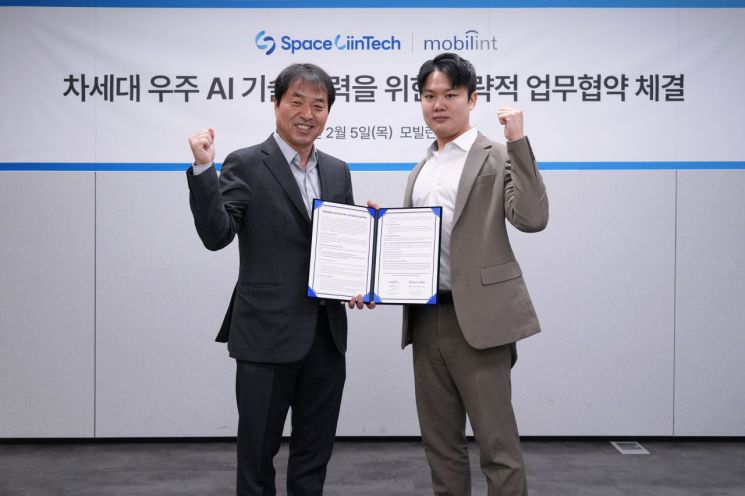 Yoon Haksun, CEO of Seupeiseurintek (left), and Shin Dongju, CEO of Mobillinteu, signed a strategic business agreement for cooperation on next-generation space AI technology. Provided by Seupeiseurintek
Spacelintech has been developing experimental platforms and payload technologies that automate pharmaceutical experiments in the space environment, and has recently been expanding its verification scope with next-generation space medicine experiment modules incorporating AI. The company expects that, through this collaboration, it will be able to enhance the data processing and autonomous operation capabilities of AI-based payloads, thereby improving the efficiency and reliability of space experiment operations.
Mobilint has NPU-based semiconductor solutions optimized for edge AI environments and is expanding their application across various industrial sectors based on high-performance, low-power AI computing technology. The two companies plan to work together to address the technical requirements of implementing AI computation under the power, heat, and communication constraints inherent in the space environment, and to gradually verify the practical applicability of these solutions.
Yoon Haksun, CEO of Spacelintech, said, "Through the joint development of AI-based space payloads, we will strengthen our verification capabilities in the space environment and expand into a next-generation space bio research platform." Shin Dongju, CEO of Mobilint, said, "We will verify the strengths of high-performance, low-power NPUs in the space environment and broaden the application scope of our AI semiconductor solutions."
Meanwhile, Spacelintech has conducted verification of its space medicine research module "BEE-PC1" on the International Space Station (ISS), and has also established a satellite-based protein crystallization research system through the space bio research satellite "BEE-1000." The company has designated this year as the first year of "AI-based space medicine" and plans to accelerate the advancement of related technologies.
© The Asia Business Daily(www.asiae.co.kr). All rights reserved.
![Clutching a Stolen Dior Bag, Saying "I Hate Being Poor but Real"... The Grotesque Con of a "Human Knockoff" [Slate]](https://cwcontent.asiae.co.kr/asiaresize/183/2026021902243444107_1771435474.jpg)















