329 Wooden Tablets Unearthed at Gwanbuk-ri in Buyeo
Evidence of a Sophisticated Bureaucracy Recording Even Lower-Ranking Officials
Piles of “Sakseol,” Wood Shavings Used Instead of Paper
Testimony to an Intensely Busy Administrative Site
It has been revealed that Baekje functioned as a highly developed "systematic state," driven by rigorous performance-based evaluation and sophisticated written administration. On February 5, the Buyeo National Research Institute of Cultural Heritage under the National Heritage Administration made public 329 wooden tablets excavated from the Gwanbuk-ri site in Buyeo, South Chungcheong Province, which is presumed to be the royal palace of the Sabi period.
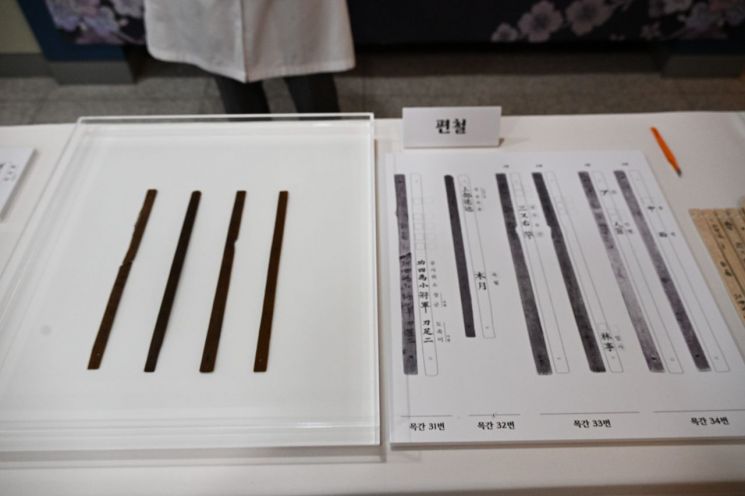
They are a massive "black box" that demonstrates the meticulousness of Baekje's administration in the 6th century. The wooden tablet that has drawn the most attention in academic circles is a 1,500-year-old "personnel appointment document." On a bound wooden tablet (No. 31), which had been tied together with a string for filing, researchers identified the phrase "Gongsaui Sojangundojogi (功四爲小將軍刀足二)."
Oh Hyundeok, head of the Curatorial Research Division at the Buyeo National Research Institute of Cultural Heritage, explained, "It is a personnel-related document stating that a person named Dojogi, who has four recorded merits, is to be appointed as a junior general (Sojanggun)." He added, "This shows that a system was in operation in which official positions were granted not on vague evaluations, but on quantified performance outcomes."
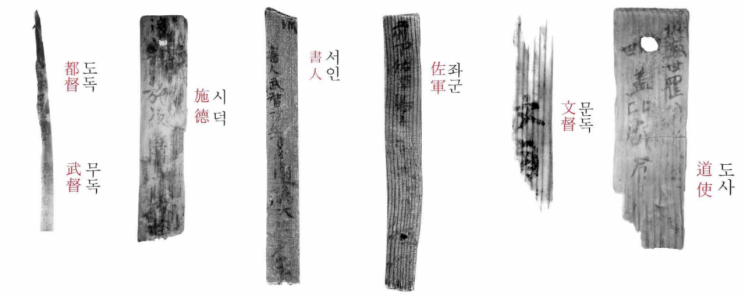
Another wooden tablet revealed a notation method in which the official rank was written first, followed by the name. In the record "Mudok Munsa Gwi Mun (武督汶斯貴文)," "Mudok" is a lower rank corresponding to the 13th grade out of 16 official ranks.
Bang Gukhwa, senior researcher in charge of ancient written materials at the Buyeo National Research Institute of Cultural Heritage, said, "It is a good example of the narrative style of Baekje wooden tablets, in which the title of rank is written first and the name is written afterward," and added, "The fact that even the names of working-level officials in the middle and lower ranks were recorded in documents means that this place was where substantive administrative work was carried out."
The fact that this was an intense administrative workplace is also testified by the "sakseol" scattered all over the floor. Sakseol refers to thin wood shavings produced when the surface of a wooden tablet is shaved with a knife to erase the characters and write again.
Researcher Bang explained, "At that time, paper was extremely expensive, so middle- and lower-ranking officials mainly used wooden tablets," and continued, "Sakseol was created in the process of writing characters on the tablets and then shaving the surface with a knife to correct or reuse them." She added, "Sakseol bearing month-by-month records shows that officials of the time continuously managed documents by drafting and revising ledgers."
The sexagenary year designations "Gyeongsin year (540)" and "Gyehae year (543)" that appear on the wooden tablets date to shortly after King Seong moved the capital from Ungjin to Sabi (Buyeo) in 538. Oh stressed, "The capital was divided into five districts-Upper, Front, Middle, Lower, and Rear-and administered accordingly, and this is the first time that wooden tablets from all five districts have been found together in a single location."
This suggests that the relocation to Sabi was not a simple move, but an occupation of a carefully planned new capital city. Oh evaluated, "The wooden tablet referring to Ungjin-gun shows that Ungjin, Baekje's former capital, was reorganized into a 'gun' (county) unit immediately after the relocation to Sabi," and added, "It is an important source that requires us to reexamine how the local administrative system actually operated."
© The Asia Business Daily(www.asiae.co.kr). All rights reserved.