"No reason to introduce variables before the local elections"
"The essence of the one-person, one-vote system is fairness and conflict of interest"
"'Myeongcheong War' at the start of the president's term? Abnormal"
Tensions are rising within the ruling Democratic Party of Korea. After the term "Myeongcheong War" began circulating, there have even been direct arguments exchanged during Supreme Council meetings. Some Supreme Council members have even boycotted meetings. The power struggle ahead of the party convention in August is gradually intensifying. Eonju Lee, Senior Supreme Council Member of the Democratic Party of Korea, is at the center of it all. I recently interviewed Senior Supreme Council Member Lee twice. On the 21st, she appeared on "Soh Jongsup's Current Affairs Show" for a one-hour interview, and on the 27th, I conducted a follow-up interview by phone.
Senior Supreme Council Member Lee argued, "If the Democratic Party of Korea merges with the Cho Kuk Innovation Party, it will be a negative factor for the local elections," adding, "There is no reason to introduce new variables right before an election." She made it clear that she opposes the merger being spearheaded by Party Leader Jeong Cheongrae. She strongly criticized the leader, calling it "an act that is difficult to forgive."
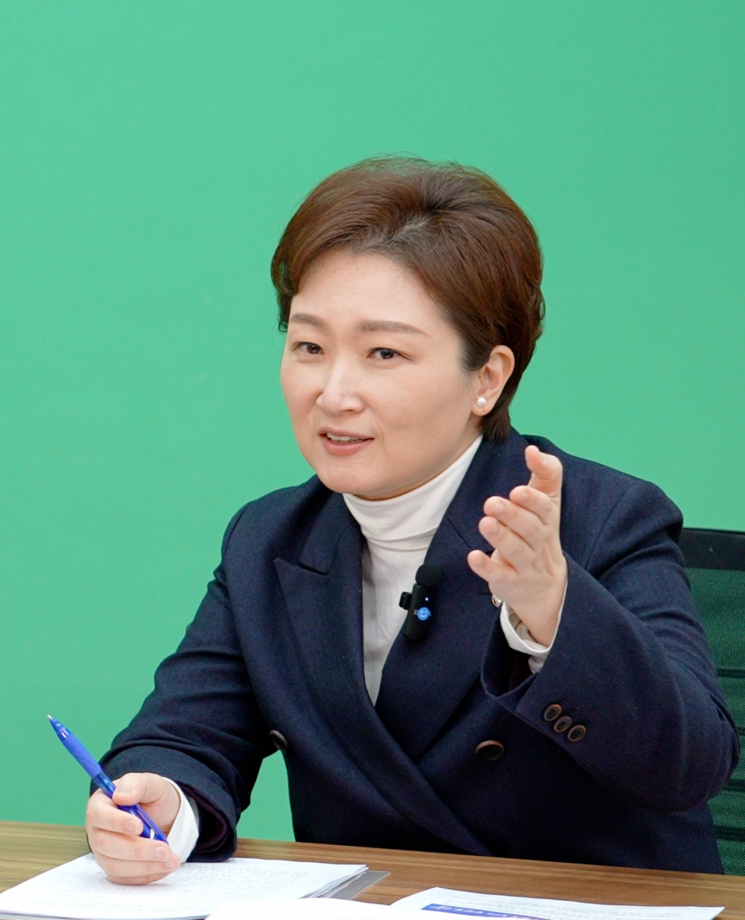 Eonju Lee, Senior Supreme Council Member of the Democratic Party of Korea, appeared on "So Jongseop's Current Affairs Show" on the 21st.
Let's start with the President's New Year's press conference. What is your overall assessment?
Wasn't it an occasion to explain the direction of growth under the Lee Jaemyung administration? It's not just about growth; there is a certain philosophy behind it. What stood out was the emphasis on region-led growth. There are ongoing issues regarding the integration of Jeonnam-Gwangju and Daejeon-Chungnam, which are noteworthy. I'm curious to see how these experiments will turn out...
Do you think the integration will be completed before the local elections?
Yes. The economic impact of integration will be far greater for Jeonnam-Gwangju. Gwangju is a consumption-oriented city, while Jeonnam is a production-oriented region. Gwangju and Jeonnam are somewhat underdeveloped, but from an industrial perspective, this integration is expected to bring significant economic benefits. Some might think only Gwangju will benefit, but in fact, Jeonnam's income levels will also rise considerably. Living standards and income-these are the key points.
What is your view on the exchange rate? During the New Year's press conference, President Lee predicted that it would fall to around 1,400 won in a month or two.
We missed the opportunity when the United States raised interest rates. Or rather, we chose not to act. Raising interest rates makes economic stimulus difficult. That was during the Yoon Sukyeol administration, and I believe it was for political reasons. As a result, the interest rate gap has become chronic. Now, we are holding rates steady while the US is cutting, so the gap is narrowing. We need to narrow it further. Since the US will likely cut rates more, we should maintain our rates and further reduce the gap. If we do that, the exchange rate will likely stabilize.
Isn't there a need for special measures?
When it comes to special measures, there isn't really a silver bullet... Special measures would mean raising interest rates. But with the economy struggling, raising rates now would be a major shock. I'm cautiously optimistic things will improve, as the KOSPI is performing well, so overseas investors may be contemplating whether to return.
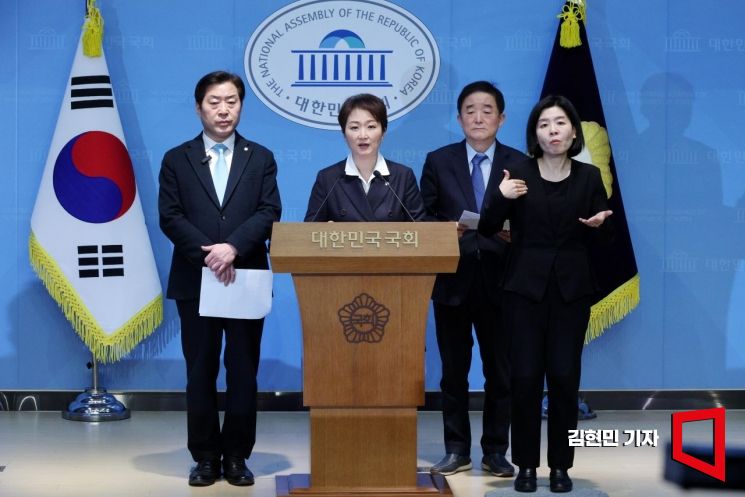 Eonju Lee, Myungseon Hwang, and Deukgu Kang, Supreme Council Members of the Democratic Party of Korea, held an urgent press conference at the National Assembly Communication Office on the 23rd. They strongly condemned the party leader's arrogance and undemocratic behavior, demanding an official apology and a thorough investigation. Photo by Hyunmin Kim
Lee Haechan, Senior Vice Chair of the National Unification Advisory Council and regarded as a leading figure in the progressive camp, has passed away.
A giant of the democratization era has fallen. We must reflect on his legacy and, based on that, consider how the generation after democratization will open a new era for Korea under Lee Jaemyung. I believe we need to reinterpret his life and elevate it to fit the current era.
Party Leader Jeong Cheongrae's announcement of a merger with the Cho Kuk Innovation Party is causing controversy.
The party's official stance is that there have been no discussions with the president regarding the merger. I have confirmed that there was no prior communication with the president. This is an issue that requires careful deliberation, but the leader is making decisions unilaterally. It is an act that is difficult to forgive. This is a much more significant issue than the push for a one-person, one-vote system. The party is a large ruling party, and the president's approval rating is soaring, so there is no reason to introduce variables right before an election.
The president's centrist and pragmatic approach is gradually earning the trust of moderates, but pushing for a merger could undermine the stability of state affairs. If confusion arises after the merger, it could negatively impact government operations. There are ways to form alliances or cooperate, but at this point before the election, is there any reason to push for a merger and galvanize the opposition? In particular, it will not help the elections in Seoul, Busan, Ulsan, and Gyeongnam. The merger will be a negative factor for the elections.
Party Leader Jeong is also pushing to amend the party constitution to reintroduce the one-person, one-vote system.
I have supported it from the beginning. The problem is that the push has been too abrupt, which has led to misunderstandings. I'm not sure whether these are misunderstandings or not... People are asking why things are being pushed so aggressively. When major changes are made to party convention rules, it is customary for candidates to gather in the Party Convention Preparation Committee and deliberate together to ensure fairness.
It is almost certain that he will run, and he has not denied it. Yet, as the current leader, he is driving these changes and abolishing everything unilaterally? This is unfair and raises concerns about conflicts of interest. This is not just about supporting or opposing the one-person, one-vote system; at this moment, it is a highly sensitive issue that could influence the direction of power, so fairness is essential. If he is going to be subject to the new rules, he should not be the one to change them. Therefore, there is a suggestion to implement the changes starting from the next convention, not this one.
Do you agree with that?
I wasn't the one who suggested it, but it makes sense and is a good idea. Wouldn't that prevent misunderstandings? The essence of this issue is not about supporting or opposing the one-person, one-vote system, but about fairness and conflicts of interest. Otherwise, shouldn't it be handled by the Party Convention Preparation Committee, where all stakeholders who intend to run can coordinate together?
Whether the new rules will be applied starting from the August convention will be decided by the Central Committee. Will that be the first battleground?
It could become a preliminary battle for the party convention. That's not ideal. There are still several months left until the convention, and already there are fierce fights over the rules. This won't benefit the leader (Jeong) either.
If it doesn't pass this time, the leader will likely suffer a significant blow.
That's why he will probably give it his all. But that's not desirable. There are many pressing issues, and it is not good for party members to be embroiled in internal disputes. That's why I suggest that these discussions take place in the Party Convention Preparation Committee when the convention draws closer.
It's been a while since terms like pro-Myeong, pro-Cheong, and Myeongcheong War have been circulating.
This is abnormal. The situation itself is not normal. The fact that there is so much controversy is not desirable. It is deeply concerning. The president has not even completed the first year of the term, yet there are disputes over the direction of power and the rules to achieve it, and now even conflicts of interest are being raised. The timing is also inappropriate. If I were the leader, I wouldn't do this even if it benefited me, because I would consider the party and the country first. It's unfortunate.The president must be uncomfortable with this situation. In any case, it is unusual for the ruling party leader to reveal personal ambitions so early in the president's term.
On the 16th, you sponsored a resolution regarding the Iran situation.
Seventy-seven lawmakers from both parties joined. This is not about taking sides but about universal human rights. There have been many casualties, with some reports suggesting as many as 20,000 people. We cannot remain silent. Considering diplomatic relations, I felt the National Assembly had no choice but to speak out, so I sponsored the resolution to prevent further casualties. After submitting it, I was contacted by the Iranian side. I met with them and listened, but their perspective was very different. I said, "We cannot tolerate further casualties. Depending on the situation, the National Assembly may pass this resolution more quickly or monitor the situation further."
© The Asia Business Daily(www.asiae.co.kr). All rights reserved.
![Clutching a Stolen Dior Bag, Saying "I Hate Being Poor but Real"... The Grotesque Con of a "Human Knockoff" [Slate]](https://cwcontent.asiae.co.kr/asiaresize/183/2026021902243444107_1771435474.jpg)

















