Nine out of ten apartment sale contracts fall within the “loan-eligible” price range
As the government has announced that it will gradually roll back tax benefits for housing held for purposes other than owner-occupation, the number of apartment listings in Seoul is rapidly piling up. However, transactions are not keeping pace with the growing supply of properties. Market watchers attribute this to limited purchasing power due to loan regulations, as well as growing wait-and-see sentiment based on expectations that more properties will come onto the market and prices may fall further as the end date of the temporary suspension of heavier capital gains taxation for multi-homeowners draws nearer.
According to real estate big data firm Asil on the 18th, the number of apartments listed for sale in Seoul as of the previous day stood at 64,231. This is a 14.2% increase compared with January 23, when President Lee Jaemyung announced via social media that he would end the temporary suspension of heavier capital gains tax on multi-homeowners. Over just the past 10 days, listings have surged by 7.5%, indicating that inventory is increasingly building up in the market.
The pace at which properties are being put on the market has quickened by another notch following the government’s supplementary measures. On February 10, the government temporarily suspended the owner-occupation requirement within land transaction permit zones and extended the deadlines for final payment and registration, in order to provide an exit route for multi-homeowners. Over the subsequent five days (February 10-15), 5,833 properties were listed, accounting for more than half of the total increase in listings since January 23. Given that it typically takes 15-20 days to review a land transaction permit, the practical deadline for signing contracts is around mid-April, meaning selling pressure is expected to intensify as time goes by.
High-end listings are piling up, while deals are happening on the outskirts
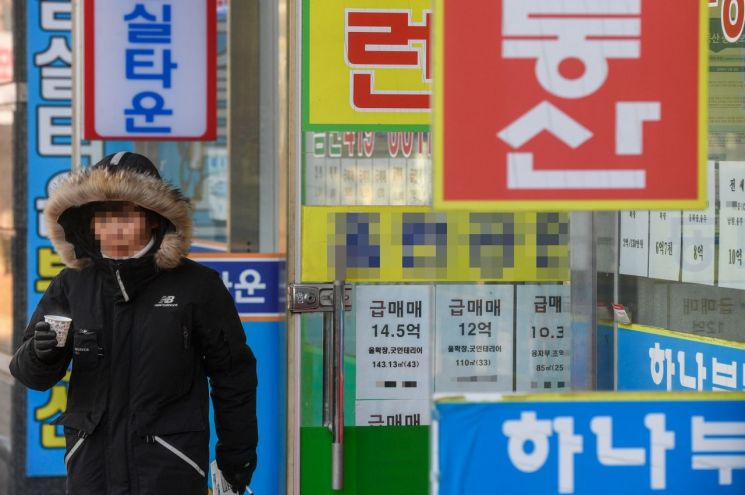 Real estate sale prices are posted at a shopping area crowded with real estate agencies in Seoul. Kang Jinhyung, Reporter
The increase in listings is particularly pronounced along the Han River belt, where high-end apartments are concentrated. According to Asil, from January 23 through February 17, the rate of increase in listings by district was 36.5% in Seongdong-gu, 33.7% in Songpa-gu, 26.6% in Dongjak-gu, 26.4% in Gwangjin-gu, 24.3% in Gangdong-gu, 23.1% in Mapo-gu, and 18.9% each in Seocho-gu and Yongsan-gu. In contrast, listings actually declined in Gangbuk-gu (-3.9%) and Geumcheon-gu (-1.8%), while the increase was marginal in Guro-gu (0.6%) and Dobong-gu (2.4%). Analysts believe owners of high-priced homes were the first to react, as concerns over higher property holding taxes have mounted.
On the ground, an expansion in selling pressure is also being detected. According to KB Real Estate, the Buyer Preference Index for Seoul apartments in the second week of February was 85.3, the lowest level so far this year. This index, compiled by KB Kookmin Bank through surveys of front-line real estate agencies, indicates that the lower it is below 100, the more “sellers” there are relative to “buyers.” In other words, listings are increasing, but the number of buyers willing or able to absorb them is shrinking.
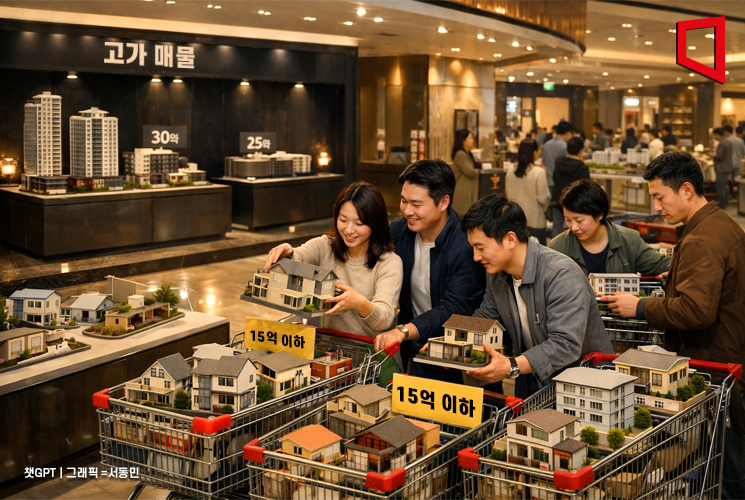
While listings are piling up in high-end residential areas, actual transactions are taking place elsewhere. An analysis of the Ministry of Land, Infrastructure and Transport’s actual transaction price system shows that, as of the previous day, 850 out of 975 Seoul apartment sale contracts signed in February, or 87.2%, were for properties priced at 1.5 billion won or less, where buyers can take full advantage of mortgage limits. This share has steadily risen from 64.6% during October 16-31 last year, right after the October 15 measures, to 73.2% in November, 81.5% in December, and 80.2% in January this year. By district, this year’s apartment sales in Seoul have also been concentrated in relatively affordable outer areas, led by Nowon-gu (671 transactions), Seongbuk-gu (395), Gangseo-gu (373), and Guro-gu (355).
The 1.5 billion won threshold is the dividing line for transactions because of loan regulations. In the regulated areas of the Seoul metropolitan region, the maximum mortgage limit for homes priced at 1.5 billion won or less is 600 million won, but for homes priced above 1.5 billion won, the limit drops to 200-400 million won. Ham Youngjin, head of Woori Bank’s Real Estate Research Lab, said, “Even the 600 million won limit is difficult to fully utilize in practice when you factor in the Debt Service Ratio (DSR) rules,” adding, “Buying demand will likely flow into listings in the 600 million to 1 billion won range, particularly among buyers who already hold large lump-sum jeonse deposits.”
This has created a mismatch in which listings are coming out in high-priced areas, but buyers are only seeking mid- to lower-priced homes. Seo Jinhyung, a professor at Kwangwoon University’s Department of Real Estate Law and Policy, said, “Under current conditions, only a small number of cash-rich buyers can purchase top-tier homes in Seoul without taking out loans,” and pointed out, “The government is also maintaining its loan regulation stance as part of household debt management, so in reality it is difficult for the market to absorb the increased number of high-priced listings, even though they are driven by genuine demand.”
“Spike in listings may be an optical illusion”... Calls for caution
Experts agree that the latest measures have helped ease the lockup of listings in the market, but they also say there are clear limits to how much they can normalize transaction activity.
Lee Hyunseok, a professor in the Department of Real Estate at Konkuk University, said, “It is clear that the government’s move to open an exit route has had a calming effect on the market, as seen in the increase in listings,” but added, “Whether an increase in listings translates into an increase in transactions is a different question.” He went on, “For transactions to rise, there would need to be accompanying easing of demand-side regulations or loan regulations, but given current market conditions, the likelihood of deregulation going that far appears low.”
Professor Seo said, “In the end, this will remain largely at the level of a declaratory move that ‘an exit route has been opened,’ while the market still lacks the purchasing capacity needed to turn it into a meaningful increase in actual transactions,” adding, “If expectations for asset price appreciation outweigh tax burdens, some prime-location properties could even be pulled back from the market.”
Some also suggest that the scale of the increase in listings may be overstated. Professor Seo noted, “In Korea, there are no official government statistics on listings,” and explained, “If a single homeowner lists the same property with multiple agencies at the same time, the volume can be double-counted in private platform data, making the increase look larger than it actually is.”
Sales listings up 14%, while jeonse and monthly rental listings down 11%
The blind spot in government policy is the jeonse market. As multi-homeowners shift from ‘hanging on with jeonse tenants in place’ to ‘throwing properties onto the market,’ the volume of properties available for lease is declining.
According to Asil, the number of Seoul apartment listings for jeonse and monthly rentals fell 11.09%, from 42,784 on January 23 to 37,698 on February 17. This contrasts with the 14.2% increase in sale listings over the same period.
Professor Lee said, “The stance of strengthening property holding taxes and ramping up pressure on multi-homeowners raises the cost of holding housing, and this cost can be passed on to jeonse and monthly rental prices,” adding, “If the supply of rental properties shrinks, there is a risk of higher rents and growing instability in the jeonse market.” Professor Seo likewise warned, “In a situation where inflation and liquidity injections continue, trying to suppress prices through regulations alone will ultimately shift the burden onto the weakest link in the chain, namely the jeonse market.”
© The Asia Business Daily(www.asiae.co.kr). All rights reserved.
![Clutching a Stolen Dior Bag, Saying "I Hate Being Poor but Real"... The Grotesque Con of a "Human Knockoff" [Slate]](https://cwcontent.asiae.co.kr/asiaresize/183/2026021902243444107_1771435474.jpg)


















