Application of AI- and Robot-Specialized Complex Design...Highlighting Its Value as a New Hub of the Fourth Industrial Revolution
Following Work-Type and Manufacturing-Type Units, March Sale Schedule for "Independent" Units at "Bando Ivy Planet" Draws Attention
As AI and robots continue to dominate the headlines, Busan Eco Delta City, which is emerging as a new advanced industrial hub equipped with large-scale data centers for the Fourth Industrial Revolution, is being transformed into a robot-friendly AI smart city that has incorporated robots as core infrastructure from the urban design stage.
Smart City Busan, the special purpose company leading the development of Busan Eco Delta City, recently signed a land purchase agreement with Korea Water Resources Corporation and then reflected robot-friendly architectural specialization design as a key element in its request for proposals for selecting an architectural design firm.
In addition, it signed a business agreement with the Human-Centered Robot-Friendly Architecture Research Group at Kyung Hee University to realize a robot-friendly smart city. Under this agreement, the parties will closely cooperate in three areas: jointly reviewing guidelines for robot-friendly architectural design; collaborating on demonstration of core technologies for Smart+ buildings; and linking robot services such as delivery, patrol, parking, and electric vehicle charging with urban infrastructure.
Amid this transformation of Busan Eco Delta City into a hub of the Fourth Industrial Revolution, the knowledge industry center Bando Ivy Planet, the largest within the complex, is drawing attention.
On December 30 last year, Bando Construction held a ceremony to sign an agreement with the Gaduk New Airport Construction Corporation on relocating and moving into the Bando Ivy Planet office building. Through this agreement, the corporation will be based in Bando Ivy Planet, with full-scale occupancy scheduled for the second half of 2026. As the corporation has confirmed its move, the likelihood that its affiliated organizations and numerous partner companies will move in together has increased, and the industrial ecosystem within the complex is expected to become even more solid.
Infrastructure expansion within Busan Eco Delta City is also accelerating. Construction has recently begun on The Hyundai Busan, a large-scale mixed-use shopping mall the size of 15 soccer fields, with completion targeted for the second half of next year.
Transport network improvements are also remarkable. The Eco Delta City Station (planned) on the Bujeon-Masan double-track railway and the Eomgung Bridge connecting to Sasang-gu are gaining momentum in their respective projects, and Gaduk New Airport is aiming for an early opening in 2029, raising expectations that it will fully serve as a logistics and business transportation hub. On February 2, a groundbreaking ceremony was held for a construction project that will connect Gaduk Bridge with the elevated road to Songjeong Interchange (IC), with completion targeted for 2030. Once completed, Gaduk New Airport and Busan New Port, as well as Noksan National Industrial Complex, Myeongji, Eco Delta City, and the western Busan living area, are expected to be connected into a single zone.
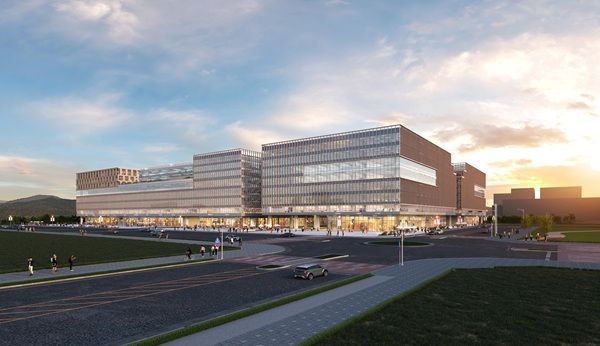
Bando Ivy Planet, which will be built on Urban Support Blocks 5-1 and 5-2 in Eco Delta City, Myeongji-dong, Gangseo-gu, Busan, will boast a total floor area of approximately 166,292 square meters and a scale of two basement levels and eight above-ground floors. Consisting of 1,128 units in the knowledge industry center and 82 neighborhood living facility units, it will be the largest in Busan.
In particular, following the announcement expanding the range of eligible industries for knowledge industry centers in Gangseo-gu, Busan, a total of 15 additional sectors, including smart farms, video and audio production, and professional services, are now allowed to move in, improving the diversity of tenant business types.
Against this backdrop, the "independent" units scheduled to go on sale in March are expected to be the optimal choice for startups and venture companies that prefer a private work environment. Furthermore, as Busan Eco Delta City has been newly designated this month as an Opportunity Development Special Zone, tenant companies are expected to receive added benefits such as reductions in corporate tax, acquisition tax, and property tax, as well as additional local investment promotion subsidies. As a result, inquiries from companies across various fields about moving in are expected to continue.
A sales representative said, "By attracting the Gaduk New Airport Construction Corporation, we have proven both the connectivity with national projects and the stability of the complex," adding, "Once sales of the independent units begin in March, following the ongoing sales of manufacturing-type and work-type units, the remaining inventory is expected to be absorbed even more quickly."
Meanwhile, Bando Ivy Planet is currently selling manufacturing-type and work-type units, and will launch sales of independent units in March. The model house is located in Myeongji-dong, Gangseo-gu, Busan, and completion is scheduled for September 2026.
© The Asia Business Daily(www.asiae.co.kr). All rights reserved.
![Clutching a Stolen Dior Bag, Saying "I Hate Being Poor but Real"... The Grotesque Con of a "Human Knockoff" [Slate]](https://cwcontent.asiae.co.kr/asiaresize/183/2026021902243444107_1771435474.jpg)















