Complete Core Infrastructure for Corporate Survival... Securing an Irreplaceable Location Near the Seoul Metropolitan Area
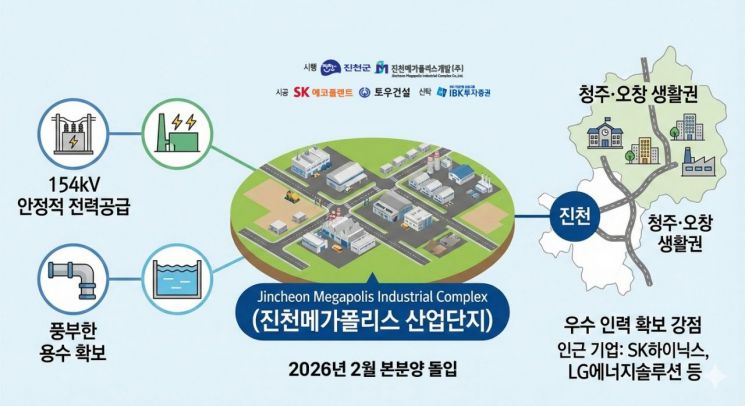
What is the biggest obstacle that domestic semiconductor and secondary battery companies commonly cite when it comes to investing outside the Seoul metropolitan area? It is the three fundamental pieces of infrastructure for manufacturing: "power," "water," and "talent." No matter how generous the tax incentives or how cheap the land, if these three conditions are not met, investment itself becomes impossible from a corporate standpoint. The reason the Jincheon Megapolis Industrial Complex, which is being developed in Munbaek-myeon, Jincheon-gun, Chungcheongbuk-do (approximately 442,000 pyeong), is drawing attention in the industry is that it has perfectly secured these "absolute conditions."
Understanding the characteristics of semiconductor manufacturing processes makes it clear why power supply is so critical. Inside a clean room, temperature and humidity must remain constant 24 hours a day, 365 days a year, and ultra-precision etching and deposition equipment cannot tolerate even a 0.1-second fluctuation in voltage. If a power outage occurs for just one second, all wafers in process must be scrapped, leading to direct losses ranging from hundreds of millions of won to tens of billions of won. The same is true for secondary battery manufacturing. In a battery cell production line, every step from electrode coating to assembly and formation must proceed continuously, so the moment power supply is cut off, the entire production line is paralyzed.
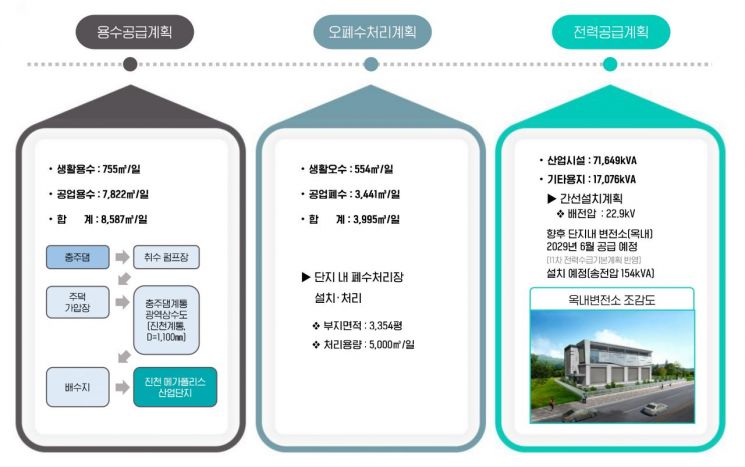
Jincheon Megapolis has fundamentally eliminated these concerns for companies. Korea Electric Power Corporation obtained approval from the Ministry of Trade, Industry and Energy to install a 154kV high-capacity substation within the complex, and this plan has been reflected and announced in the Basic Plan for Long-term Electricity Supply and Demand. This represents a power infrastructure that far surpasses that of a typical industrial complex and provides the physical foundation for large-scale semiconductor fabs and secondary battery giga-factories to operate stably. At a time when even some industrial complexes in the Seoul metropolitan area are increasingly rejecting new tenants due to limits on power supply, Jincheon Megapolis’s preemptive infrastructure build-out is becoming a decisive factor in corporate investment decisions.
Next in importance after power is water. Producing a single semiconductor wafer requires about 2,000 liters of ultra-pure water, and massive amounts of industrial water are also consumed in the manufacturing processes for cathode and anode materials used in secondary batteries. The problem is that many regional industrial complexes fail to secure sufficient water supply capacity, which in turn restricts tenant companies from expanding their production lines.
Jincheon Megapolis has established a system that can stably supply more than 8,000 tons of industrial water per day through a wide-area water supply network connected to nearby water systems. This gives tenant companies the certainty they need to formulate production expansion plans looking 10 or 20 years into the future from the initial investment stage. An official from the industrial complex said, "From the initial design stage, we calculated a generous supply capacity so that production expansion would never be hindered by water issues," adding, "Our goal is to create an environment in which companies can focus solely on production and research."
However, power and water alone are not enough. At the end of the day, the core of advanced manufacturing is "people." No matter how state-of-the-art the equipment, a plant cannot operate properly without skilled engineers and technical personnel who can run the equipment and solve problems. The biggest weakness often pointed out for regional industrial complexes is precisely this issue of securing talent.
Jincheon Megapolis is fundamentally different from other regions at this point. The complex belongs to the Cheongju metropolitan living area, which has a population of 850,000, and is only a 20-minute drive from downtown Cheongju and a mere 5 minutes from the Ochang Science Industrial Complex. More importantly, global leading companies in each industrial field, such as SK hynix, LG Energy Solution, LG Household & Health Care, Ecopro, Orion, CJ CheilJedang, and LS Electric, are already operating large-scale production bases in this area.
This means that there is already a large pool of high-level talent in the region, including engineers with experience in semiconductor processes, experts in secondary battery materials, and precision chemical engineers, all of whom are essential for advanced manufacturing. From a corporate perspective, there is no need to struggle with recruiting in the Seoul metropolitan area or with new hiring, as experienced personnel from nearby areas can be naturally drawn in. On top of this, benefits such as special allocations of private housing (10%) under the Opportunity Development Special Zone designation and support for workplace childcare centers are improving residential conditions, creating an environment where young talent can settle down with their families and remain with their employers for the long term.
To understand the potential of Jincheon Megapolis, it is useful to look at how Hwaseong and Yongin grew into world-class semiconductor hubs. The secret to the rise of southern Gyeonggi Province as a semiconductor powerhouse was not simply the presence of Samsung Electronics and SK hynix. It was the combination of stable power supply infrastructure, abundant water resources, and an excellent talent pool backed by the Seoul metropolitan area.
Jincheon Megapolis has the conditions to replicate this successful formula as is. The 154kV substation and the system capable of supplying 8,000 tons of water per day provide basic infrastructure on par with that of Hwaseong and Yongin, while the Cheongju living area with its population of 850,000 offers ample conditions to substitute for the talent accessibility of the Seoul metropolitan area. In addition, SK hynix and LG Energy Solution are already established in Cheongju and Ochang as anchor companies, fostering an industrial ecosystem in which parts and materials partners can naturally cluster.
The certainty of the project has also been proven. This project, which is being promoted as a public-private joint development involving Jincheon-gun, SK Ecoplant Co., Ltd., Towoo Construction Co., Ltd., and IBK Securities, recently completed project financing (PF) successfully, passing the financial sector’s feasibility review. Land development work, which began in April 2024, is proceeding as planned, and the project will shift to full-scale sales through a sale notice in February 2026. Plant construction is expected to be possible from the second half of 2026.
From a corporate perspective, Jincheon Megapolis is more than just industrial land. It is a place where "electricity" to run factories is guaranteed, "water" to support production expansion is plentiful, and "people" to realize technology can be secured. The bold tax incentives available under the Opportunity Development Special Zone (100% exemption from corporate tax for five years, full exemption from acquisition tax and property tax) are an added bonus. With a current subscription rate of 40%, Jincheon Megapolis is on track and is becoming an irreplaceable option for companies seeking a "successful investment."
Detailed information on the Jincheon Megapolis Industrial Complex is available on its website.
© The Asia Business Daily(www.asiae.co.kr). All rights reserved.
![Clutching a Stolen Dior Bag, Saying "I Hate Being Poor but Real"... The Grotesque Con of a "Human Knockoff" [Slate]](https://cwcontent.asiae.co.kr/asiaresize/183/2026021902243444107_1771435474.jpg)
















