Meetings with Key Figures in the U.S. Administration, Congress, and Industry
Uncertainty Persists over Federal Register Publication as a Key Variable
Possibility of Additional Demands, Including Nuclear Power Cooperation, Also Raised
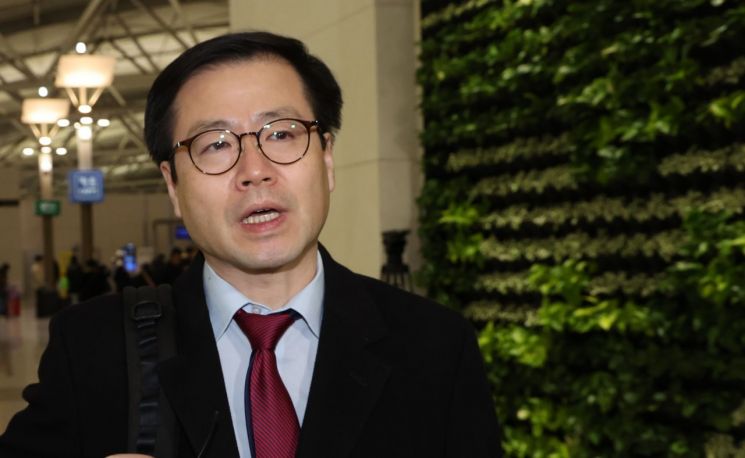
While the United States is still keeping open the possibility of re-raising tariffs on Korean products and is reviewing whether to publish the measure in the Federal Register, Trade Minister for Negotiations Yeo Han-koo has ramped up the response level by launching an all-out outreach campaign targeting the U.S. administration, Congress, and industry figures. Although many observers judge that much of the U.S. side's misunderstanding over the delay in legislation has been cleared up, tension is rising as uncertainty persists over when and in what form any actual measures will be finalized.
According to the Ministry of Trade, Industry and Energy on the 4th, Yeo has been in Washington, D.C. since January 29 to respond to the heightened trade issues following U.S. President Donald Trump's announcement of tariff hikes on South Korea. During the visit, he has held a series of meetings with officials from the U.S. administration and Congress, industry representatives, and major think tanks.
During this visit to the United States, Yeo met with members of the U.S. administration, including officials from the Office of the United States Trade Representative (USTR), to directly ascertain the background of the U.S. announcement on tariff increases, while focusing on explaining that existing agreements between South Korea and the United States are being implemented without disruption. In particular, he highlighted the spillover effects that the measures could have on both countries' industries and economies, and conveyed the need to derive a mutually acceptable solution.
Engagement with the U.S. Congress was also carried out intensively. Yeo held closed-door meetings with about 20 lawmakers from the House and Senate who handle trade matters, explaining not only the progress of the special legislation process but also that existing agreements are being faithfully implemented in non-tariff areas such as digital regulation, in an effort to enhance understanding.
During this trip, discussions were also held in parallel on the National Trade Estimate Report on Foreign Trade Barriers (NTE), which the USTR will publish at the end of March. The talks served to convey the South Korean government's position on key concerns that U.S. industry has raised during the prior consultation process, and to review in advance the issues that may potentially be reflected in the upcoming report.
Amid these developments, there is speculation within and outside the government that the United States may present additional conditions separate from the formal legislative process. In particular, some observers note that the construction of nuclear power plants in the United States is being mentioned as a potential bargaining chip on the U.S. side. In fact, it is known that during his earlier visit to the United States, Industry Minister Kim Jeonggwan met with Energy Secretary Chris Wright to discuss cooperation plans in areas such as energy and resources. While Kim said, "This is not something I can comment on in detail," he also stated that "there were various discussions on cooperation related to nuclear power between South Korea and the United States."
Yeo said, "We will continue consultations with the U.S. government, Congress, and industry to find a reasonable solution that both South Korea and the United States can accept," adding, "We will focus on continuously explaining our commitment to implementing existing agreements and clearing up misunderstandings."
© The Asia Business Daily(www.asiae.co.kr). All rights reserved.
![Clutching a Stolen Dior Bag, Saying "I Hate Being Poor but Real"... The Grotesque Con of a "Human Knockoff" [Slate]](https://cwcontent.asiae.co.kr/asiaresize/183/2026021902243444107_1771435474.jpg)















