Research Center Releases Report
"Challenges of Infrastructure Gaps in Korea"
Korbit Research Center, under Korbit, the nation's first virtual asset exchange, announced on February 2 that it published a report titled "The Rise of Stablecoin-Focused Layer 1 (L1) Blockchains" on January 30, analyzing L1 blockchains specialized for stablecoins, which are emerging as next-generation payment infrastructure.
In the report, Korbit Research Center analyzed that "as the global regulatory environment becomes increasingly clear, conditions have been created for stablecoins to be incorporated into financial infrastructure. However, existing public blockchains have revealed limitations in privacy, transaction finality, and gas fee structures."
The report pointed out that the current Ethereum- and Tron-based stablecoin structures face structural issues such as institutional privacy violations due to full disclosure of transaction information, slow transaction finality unsuitable for real-time payments, and user inconvenience from having to pay gas fees with separate volatile assets. As a result, about 94% of stablecoin circulation is used only within on-chain finance, with just 6% being used for payments in the real economy.
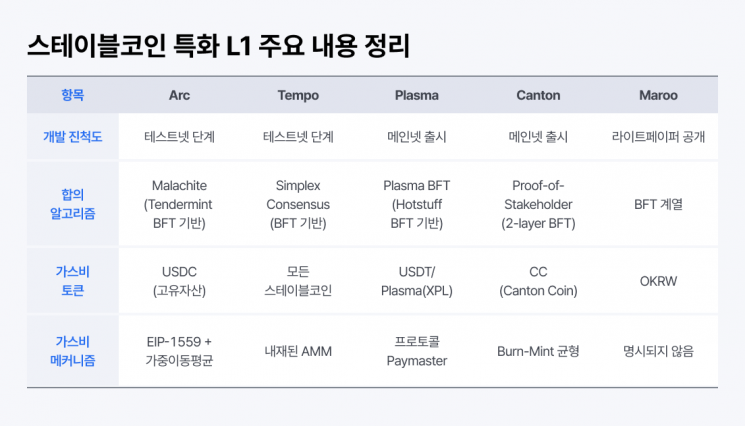
Accordingly, the report analyzed that recently launched stablecoin-focused L1s such as Arc, Tempo, Plasma, Canton, and Maroo are evolving into more suitable infrastructure for institutional and corporate finance by adopting fast finality, selective privacy and regulatory compliance, and stablecoin-centered fee structures.
Korbit Research Center specifically identified the "infrastructure gap" as a strategic challenge for the Korean market. It warned that if Korea does not proactively address selective privacy, regulatory compliance, fast payment finality, and gas fee convenience in the process of introducing a Korean won stablecoin, the domestic on-chain financial infrastructure could become dependent on dollar-denominated stablecoin-focused L1s.
Minseung Kim, Head of Korbit Research Center, said, "Before stablecoin-based L1s become the global standard for financial infrastructure, Korean won stablecoins and the domestic financial system need to respond proactively to these changes." He added, "If Korean won stablecoins also become dependent on U.S. stablecoin-focused L1s, this could become an issue not only of market dominance by certain companies or products but also of financial sovereignty."
© The Asia Business Daily(www.asiae.co.kr). All rights reserved.
![Clutching a Stolen Dior Bag, Saying "I Hate Being Poor but Real"... The Grotesque Con of a "Human Knockoff" [Slate]](https://cwcontent.asiae.co.kr/asiaresize/183/2026021902243444107_1771435474.jpg)















