International credit rating agency Fitch has maintained South Korea’s sovereign credit rating at 'AA-' with a 'Stable' outlook. However, Fitch identified the rising national debt ratio resulting from the Lee Jaemyung administration’s loose fiscal stance as a downward risk factor.
In a report released on January 30, Fitch projected, “South Korea’s GDP growth rate, which was 1.0% last year, will recover to 2.0% this year, underpinned by strong private consumption.”
The report noted, “Exports, particularly those centered on semiconductors, will continue to serve as the main engine of growth by driving net export increases.” However, trade-related issues such as reciprocal tariffs with the United States remain risk factors.
Reflecting the decline in the working-age population, Fitch revised its estimate of South Korea’s potential growth rate downward from 2.1% to 1.9%. Nonetheless, the agency positively assessed the government’s efforts to boost productivity through large-scale investments in artificial intelligence (AI) and advanced industries.
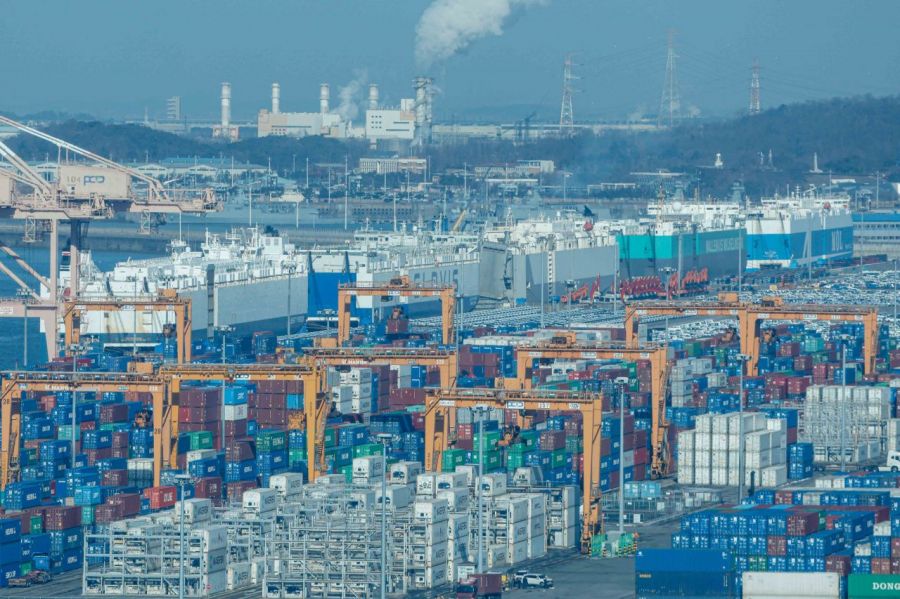 Following President Donald Trump's signing of a proclamation imposing a 25% tariff without exceptions on steel and aluminum products imported into the United States, and his announcement that tariffs on automobiles and semiconductors are also under consideration, export vehicles and containers are waiting to be loaded at Pyeongtaek Port, Gyeonggi Province on February 13, 2025. Photo by Kang Jinhyung
Regarding the political environment, Fitch diagnosed that the phase of political uncertainty-marked by the declaration of martial law and presidential impeachment-was resolved following the launch of the new administration last year. The report also added that the government has secured momentum for policy implementation based on its parliamentary majority.
On fiscal matters, the report stated that this year’s budget has increased by 8.1% compared to last year’s original budget, due to expanded investments in AI, research and development (R&D), and advanced industries. However, with tax revenues expected to rise as the economy recovers, the fiscal deficit ratio is projected to improve from -2.3% of GDP last year to -2.0% this year. Fitch warned that if government debt continues to rise without any effect on growth, it could become a burden on the credit rating.
As for external soundness, Fitch assessed that South Korea maintains its status as a net external creditor nation, with net external assets at 23.3% of GDP, supported by a continued current account surplus. While there was downward pressure on the Korean won last year due to residents’ increased overseas equity investments, Fitch expects the won to appreciate somewhat in 2026-2027.
Although the household debt ratio remains high compared to advanced economies, it is on a gradual downward trend. The report also mentioned that authorities are aiming to manage the growth rate of household debt so that it remains within the nominal GDP growth rate.
Regarding North Korea-related risks, Fitch noted that while the new administration is seeking to ease tensions through expanded exchanges, normalization of relations, and denuclearization, it is unlikely that geopolitical tensions will ease in the short term given the strengthening of North Korea-Russia and North Korea-China relations.
Fitch cited the easing of geopolitical risks and fiscal consolidation measures that can reduce the national debt ratio in the medium term as potential factors for a rating upgrade. Conversely, an expanding fiscal deficit, a rapid increase in national debt due to the realization of contingent liabilities, or a significant escalation of geopolitical risks that would severely weaken security or the economy were cited as downward factors.
The government stated, “We have actively communicated the strengths of the Korean economy through annual consultations, and we will continue to maintain close communication with international credit rating agencies going forward.”
© The Asia Business Daily(www.asiae.co.kr). All rights reserved.
![Clutching a Stolen Dior Bag, Saying "I Hate Being Poor but Real"... The Grotesque Con of a "Human Knockoff" [Slate]](https://cwcontent.asiae.co.kr/asiaresize/183/2026021902243444107_1771435474.jpg)
















