Passed Standing Committee but Stalled in Judiciary Review
US and China Intensify SMR Development Race
Timing of SMR Special Act Passage Is Critical
Concerns are being raised that South Korea, a leading country in nuclear power, may fall behind in the global Small Modular Reactor (SMR) race, as the so-called “SMR Special Act”-which contains essential institutional measures such as permits and approvals required for SMR projects-has failed to pass the National Assembly.
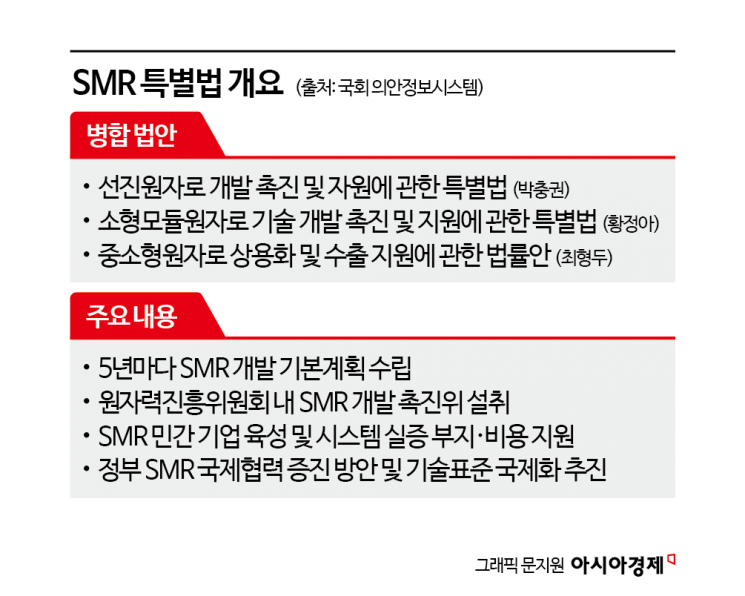
According to the National Assembly on January 31, the SMR Special Act was not included on the agenda at the plenary session held on January 29. The SMR Special Act is a consolidation of bills submitted by Assemblywoman Hwang Jungah of the Democratic Party of Korea, as well as Assemblymen Park Chungkwon and Choi Hyungdoo of the People Power Party, who are members of the National Assembly’s Science, ICT, Broadcasting, and Communications Committee. The main provisions aim to promote SMR technology development and demonstration, simplify the permitting process, designate SMRs as a strategic industry, and provide financial and export support.
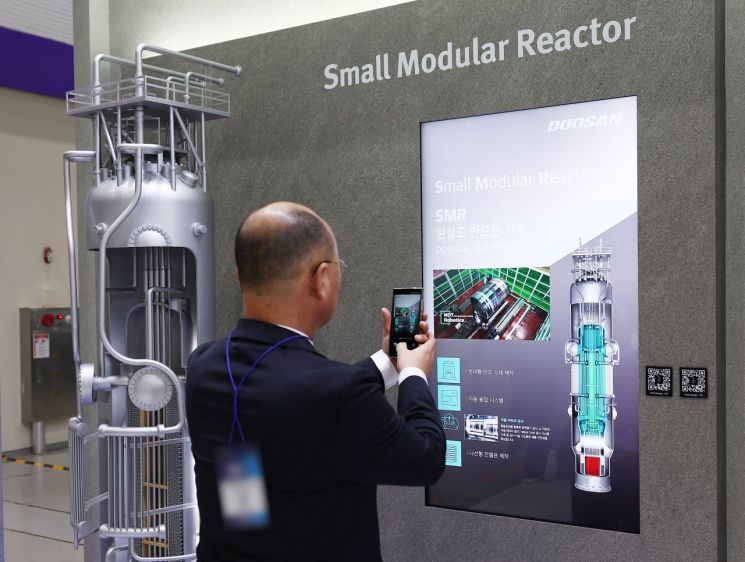 On October 15 last year, visitors are viewing a model of a Small Modular Reactor (SMR) at "Smart Energy Plus 2025" held at COEX in Gangnam-gu, Seoul. Photo by Yonhap News
The Special Act passed the full session of the relevant standing committee, the Science, ICT, Broadcasting, and Communications Committee, in December last year. Currently, the bill is undergoing a review by the Legislation and Judiciary Committee before it can be brought to the plenary session. However, discussions in this process have been prolonged. A National Assembly official stated, “There are difficulties in coordinating certain provisions of the Special Act between the Ministry of Science and ICT and the Ministry of Climate, Energy, and Environment.”
Globally, countries are competing in the SMR market. According to the SMR Dashboard of the Nuclear Energy Agency (NEA) under the Organisation for Economic Co-operation and Development (OECD), 74 SMRs are under development in 18 countries worldwide. The United States leads with 27 projects, followed by France (10), Japan (6), Russia and China (5 each), and South Korea (4).
As China has developed Thorium Molten Salt Reactor (TMSR) technology, a type of SMR, a sense of crisis has grown among South Korean companies. In November last year, the Chinese Academy of Sciences announced that it had successfully conducted the world’s first experiment to convert thorium into uranium nuclear fuel using a fourth-generation reactor, the TMSR, which can operate without water. This marked the world’s first case of operating a reactor by introducing thorium into a molten salt (high-temperature liquid salt) and obtaining experimental data.
The United States is reportedly reviewing internal policy reforms to accelerate reactor design. On January 28, U.S. public radio NPR reported that the Department of Energy (DOE) is considering significantly relaxing existing stringent safety and security guidelines to speed up the construction of next-generation nuclear reactors. The Trump administration set a goal to have at least three next-generation commercial reactors operational by July this year. To achieve this, detailed regulations will be revised to ease the administrative burden on companies involved in nuclear reactor projects.
While countries around the world are racing to secure SMR technology, South Korea’s SMR sector still lacks the institutional foundation, as the Special Act has yet to be passed. Recently, as the Lee Jaemyung administration has accelerated efforts to secure artificial intelligence (AI) infrastructure, there were expectations that the SMR Special Act would be passed soon. However, with the legislative process delayed, the industry-which is pressed for time-remains anxious. An industry official stated, “SMRs have limitations that cannot be addressed by existing nuclear legislation, so improvements are needed. We have to compete with the United States and China, and if legal or institutional reforms are delayed, it will affect our speed as well.”
Assemblywoman Hwang Jungah, who sponsored the Special Act, told The Asia Business Daily, “The SMR Special Act is the minimum institutional foundation needed to achieve carbon neutrality and simultaneously innovate industry. While technology development is necessary, permitting and demonstration projects are also required, so legislative support is essential.” She added, “Since this was a bill jointly supported by the ruling and opposition parties as well as the government, it is now time for the National Assembly to respond responsibly. As we enter the era of the great AI transformation, electricity demand is already increasing, and it may surge even more in the future, making the passage of the Special Act all the more urgent.”
© The Asia Business Daily(www.asiae.co.kr). All rights reserved.













![The Special Connection Between the Statue of Martyr Lee Jun in Jangchungdan Park and Mayor Oh Sehoon ③ [Current Affairs Show]](https://cwcontent.asiae.co.kr/asiaresize/319/2026012110001599450_1768957215.jpg)

