KDCA Announces Korean Cardiopulmonary Resuscitation Guidelines
Established in 2006 and Revised Four Times Since
For female cardiac arrest patients, who have a lower rate of automated external defibrillator (AED) application due to concerns about body exposure, it is recommended to use the AED without removing undergarments such as bras.
On January 29, the Korea Disease Control and Prevention Agency and the Korean Association of Cardiopulmonary Resuscitation announced the 2025 Korean Cardiopulmonary Resuscitation Guidelines, which include these recommendations.
The domestic cardiopulmonary resuscitation guidelines were first established in 2006 and were revised in 2011, 2015, and 2020. The current guidelines are based on the previous "2020 Korean Cardiopulmonary Resuscitation Guidelines."
The guidelines reflect the latest domestic and international research findings. Seven expert committees were formed, covering basic life support, advanced life support, post-resuscitation care, pediatric resuscitation, neonatal resuscitation, education and implementation, and first aid. A total of 16 professional organizations and 73 experts participated.
Each expert committee reviewed the international consensus on cardiopulmonary resuscitation published by the International Liaison Committee on Resuscitation (ILCOR) since 2020, as well as additional research papers published thereafter, to develop the recommendations.
First, in basic life support, to increase the use of AEDs and improve the survival rate of cardiac arrest patients, it was suggested that emergency dispatchers guide callers to secure and use an AED.
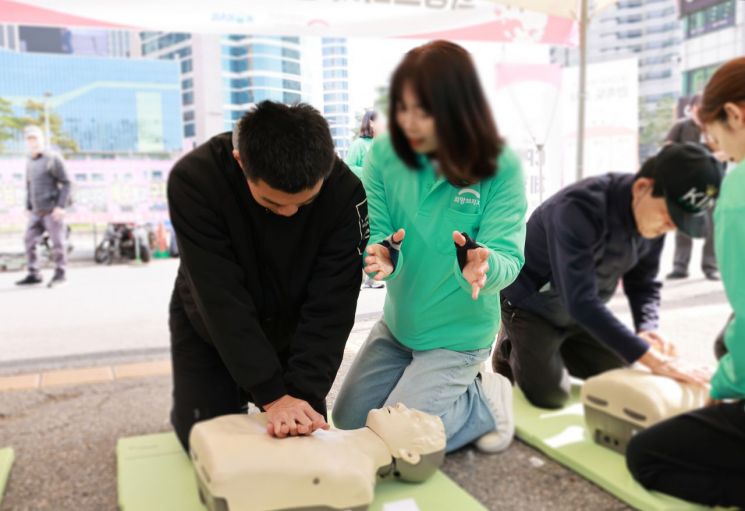
The sequence and method of cardiopulmonary resuscitation remain unchanged from previous guidelines. When performing chest compressions, rescuers are advised to place their dominant (more comfortable) hand at the bottom.
In particular, considering the lower AED application rate for female cardiac arrest patients due to concerns about body exposure and contact, it is recommended to adjust the position of the bra without unfastening or removing it, and to attach the AED pads directly to bare skin, avoiding breast tissue.
For cardiac arrest patients resulting from drowning, standard cardiopulmonary resuscitation including rescue breaths should be performed. If a layperson witness has not been trained in rescue breaths or is reluctant to provide them, chest compression-only resuscitation should be performed. However, trained first responders or emergency medical personnel are advised to begin with rescue breaths.
In advanced life support, for patients who experience cardiac arrest while in the prone position and have already been intubated, if it is difficult or risky to immediately turn the patient onto their back, cardiopulmonary resuscitation may be attempted in the prone position.
Additionally, if an adult cardiac arrest patient does not achieve return of spontaneous circulation with conventional cardiopulmonary resuscitation, extracorporeal cardiopulmonary resuscitation should be considered when possible.
In post-resuscitation care, previous guidelines recommended maintaining a target temperature of 32-36°C for comatose adult patients after return of spontaneous circulation. In this revision, it is recommended to select a slightly higher target temperature of 33-37.5°C for temperature management therapy.
In pediatric basic life support, for infants, previous guidelines recommended the "two-finger compression technique" for single rescuers and the "two-thumb encircling hands technique" for two or more rescuers. The revised guidelines now propose using the "two-thumb encircling hands technique" regardless of the number of rescuers.
This change is based on evidence that the "two-thumb encircling hands technique" maintains more consistent compression depth and force, and is superior in terms of finger pain and fatigue compared to the "two-finger compression technique."
For adults and children over one year old, in cases of airway obstruction by a foreign body, the guidelines remain the same: perform five back blows first, and if these are ineffective, perform five abdominal thrusts (Heimlich maneuver). However, for infants under one year old, abdominal thrusts are not recommended due to the risk of internal organ injury.
Therefore, for infant airway foreign body removal, the revised guidelines recommend alternating five back blows and five chest thrusts until the object is expelled or the infant loses consciousness. The "one-hand heel chest compression technique" was newly added as the method for chest thrusts in this revision.
This revision also introduces a new first aid section, referencing guidelines from the United States and Europe. It covers situations that may lead to cardiac arrest, including chest pain, suspected acute stroke, asthma attacks, anaphylaxis, seizure attacks, shock, and syncope.
Hwang Seongo, Director of the Korean Association of Cardiopulmonary Resuscitation, stated, "The revision of the cardiopulmonary resuscitation guidelines is based on the latest domestic and international scientific evidence. As the process involved clinical evidence and broad expert consensus, I hope these guidelines will be widely utilized in the field and in educational programs."
© The Asia Business Daily(www.asiae.co.kr). All rights reserved.

















