"It is not yet the stage to say whether the tariff hike has been prevented"
Yeon Han-koo also expected to join for a series of follow-up consultations
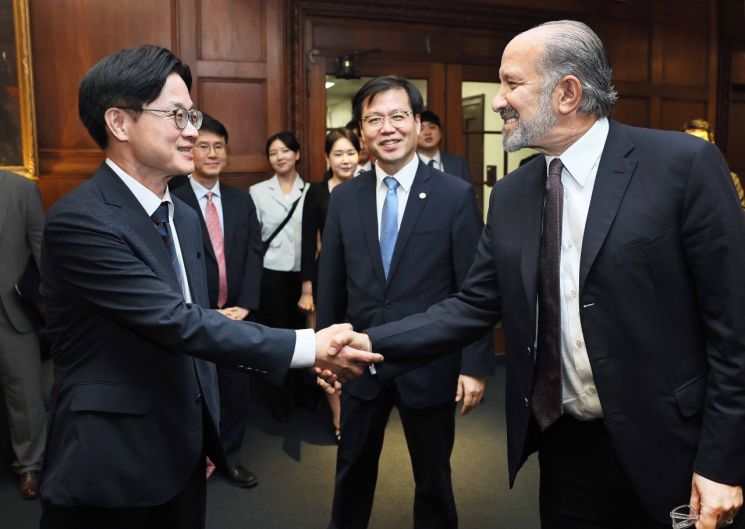
Minister of Trade, Industry and Energy Kim Jeonggwan met with Howard Lutnick on the 29th (local time) in response to U.S. pressure to reimpose tariffs, but was unable to reach an immediate agreement.
On the afternoon of the same day, Minister Kim visited the Department of Commerce building in Washington, D.C., and held talks with Secretary Lutnick. He left the building after about an hour and 20 minutes. Speaking to reporters, he said, "We had a broad discussion," and added, "We agreed to meet again tomorrow morning for further consultations."
When asked about the possibility of a tariff increase, he drew a line, saying, "At this stage, it is not a situation where I can say whether it has been prevented or not." Regarding whether the timing of the official gazette publication was discussed, he stated, "That level of discussion did not take place."
During this meeting, Minister Kim appears to have explained that the Korean government has a firm commitment to fulfilling its investment agreements with the United States, including the Special Act on Investment in the U.S., and sought to persuade the U.S. side not to proceed with a tariff hike.
Upon his arrival in Washington, D.C., Minister Kim had previously stated, "I will make sure to explain the status of domestic legislative progress to avoid any misunderstanding on the part of the U.S., and clearly convey that there is no change in our stance on cooperation and investment in the U.S."
The U.S. pressure to reimpose tariffs is seen as an attempt to determine how Korea's implementation of its investment commitments toward the U.S. will be managed. While the lack of legislation for the Special Act on Investment in the U.S. is the official point of contention, many assess that the real U.S. concern is more about the speed and reliability of implementation than the legal provisions themselves. The fact that the U.S. mentioned a tariff hike even though the original agreement did not specify a deadline for the enactment of the special act is interpreted as an effort to increase pressure and prompt Korea to take action, rather than to break the agreement.
However, there are discussions within and outside the government that the scope of negotiations may not be limited to tariffs. If the U.S. uses tariffs as leverage to raise issues not only about the investment implementation schedule but also about digital regulations, platform policies, and the domestic regulatory environment for U.S. companies, the negotiations could escalate beyond a simple explanation of tariffs.
In fact, the U.S. has approached Korea's data regulations, platform-related policies, and issues involving global big tech as trade issues, and recently has been paying close attention to the domestic regulatory environment for U.S. investors, including the Coupang case. If these issues are brought to the table all at once during the process of blocking tariffs, there are concerns that Korea may have to consider broad concessions in exchange for defending against tariffs.
Minister Kim's refusal to discuss the timing of the official gazette publication is seen as a message aimed at managing the talks and signaling that the negotiations have not yet entered the stage of exchanging conditions. However, if the U.S. demands a specific implementation timeline or additional measures at the next meeting, the discussions could quickly shift into de facto negotiations.
Meanwhile, Yeon Han-koo, Deputy Minister for Trade Negotiations, is also expected to arrive in Washington, D.C. soon to continue discussions on overall trade issues with the Office of the U.S. Trade Representative (USTR) and others. As these high-level talks proceed on two tracks, it is likely that the direction of the tariff issue will be determined through a series of meetings over several days, rather than a single encounter.
© The Asia Business Daily(www.asiae.co.kr). All rights reserved.
![Clutching a Stolen Dior Bag, Saying "I Hate Being Poor but Real"... The Grotesque Con of a "Human Knockoff" [Slate]](https://cwcontent.asiae.co.kr/asiaresize/183/2026021902243444107_1771435474.jpg)















