Kim Youngrok: "The Southwestern Region Will Become a Hub for Renewable Energy"
Kim Daejung: "Securing 1 Trillion Won in Integrated Grants and Teacher Staffing Autonomy"
Haenam, Wando, and Jindo Residents... Fierce Exchange of Sharp Questions
"If we integrate, won't all the budget and people be concentrated in Gwangju? Honestly, I'm afraid that island communities like ours will just be left on the sidelines."
On the afternoon of the 29th, at the public hearing held in Haenam, Wando, and Jindo to discuss the direction of administrative integration between Gwangju and Jeonnam, anticipation and concern were both palpable. Residents of the southwestern region, standing on the brink of demographic extinction, expressed both hope and anxiety for their 'survival,' with sharp questions filling the venue. The public hearing served as both a 'forum for discourse' advocating the administrative necessity and a 'site' where residents' urgent voices erupted.
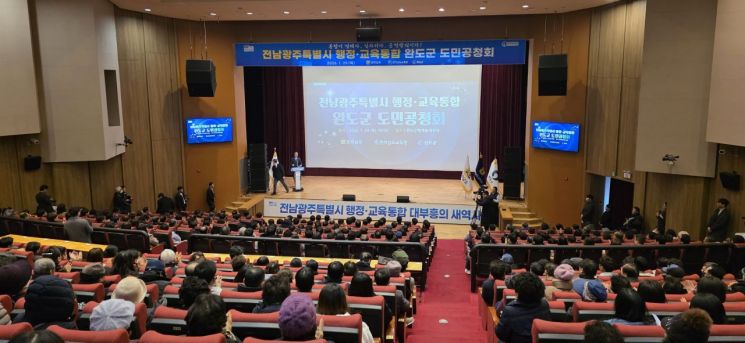 On the 29th, the public hearing on administrative integration of Gwangju, Jeonnam was held in Haenam, Wando, and Jindo, where development plans for the southwestern region were explained. Photo by Lee Jungkyung
◆ Kim Youngrok and Kim Daejung...SOC and Education Special Provisions Proposed
The session was opened by Governor Kim Youngrok. He emphasized, "The administrative integration of Jeonnam and Gwangju is a once-in-a-lifetime opportunity that will never come again," adding, "The government has also promised full support."
Governor Kim first addressed the 'transportation network,' the greatest concern for residents of the southwestern region. He argued, "Only when the status of the integrated special city as a large municipality is secured can major SOC projects such as the second phase of the Gwangju-Wando Expressway, the Jindo extension, and the Haenam railway network easily pass the preliminary feasibility study threshold," presenting the logic of 'integration equals a major SOC transformation.'
He specifically mentioned the RE100 industrial complex in Haenam, the Solaseado corporate city, marine healing in Wando, and the offshore wind power cluster in Jindo, stressing, "The three counties in the southwestern region will become renewable energy and healing hubs of the integrated special city." He asserted, "This is not merely a merger of administrative districts, but an expansion of economic territory."
Governor Kim also suggested the possibility of designating a smart agriculture development zone where AI autonomously manages farming, establishing a seaweed industry promotion zone to enhance the competitiveness of Jeonnam seaweed, and introducing employment special provisions that would allow the number and type of foreign seasonal workers to be adjusted according to local characteristics.
Kim Daejung, Superintendent of the Jeonnam Education Office, highlighted the practical benefits of integrating educational administration. He stated, "Through administrative integration, we will secure integrated grants and receive about 1 trillion won, which is 0.03% of tax revenue," adding, "This can be used for students and will help schools grow into better institutions."
He repeatedly emphasized securing autonomy in teacher staffing and revitalizing small schools. Superintendent Kim pointed out, "The saying 'a dragon rises from the stream' has always referred to Gwangju and Jeonnam," adding, "It meant that even in economically difficult and challenging situations, talented individuals could emerge, but now that is becoming difficult."
He continued, "Through integration, students and parents will receive greater support and have more diverse experiences," adding, "The efficiency of staff work will improve, professionalism in focusing on teaching will expand, and job creation in the local community will also increase."
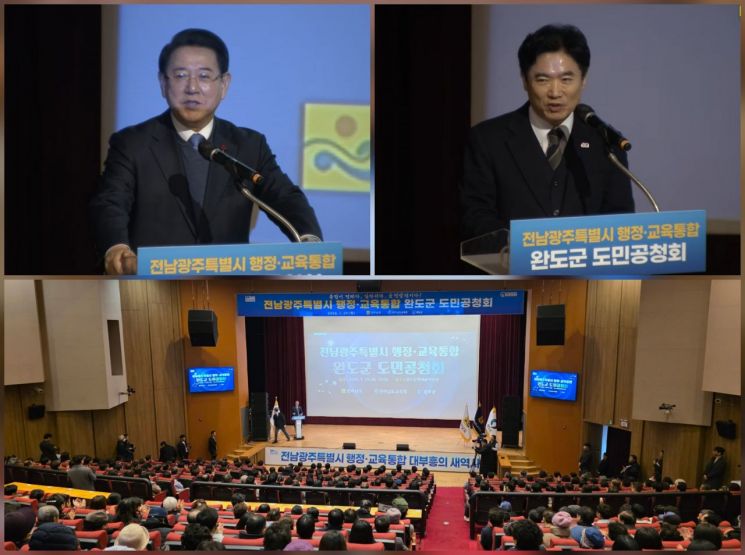 At the public hearing site, Kim Youngrok, Governor of Jeonnam Province, and Kim Daejung, Superintendent of Jeonnam Education Office, are presenting the integration blueprint. Photo by Lee Jungkyung
◆ "Will the farmers' allowance be cut?"... Immediate Benefits Take Priority Over a Rosy Future
However, during the Q&A session, residents' reactions were different. Instead of a rosy future, they asked about 'immediate benefits in their hands.'
Residents of Haenam County prioritized protecting existing welfare benefits such as the farmers' allowance. In response to concerns that "the large urban welfare budget of Gwangju could encroach on the agricultural budget," Governor Kim firmly stated, "We will strictly uphold the 'vested rights protection principle' by including a minimum agricultural budget clause in the special law."
In Wando County, 'island special provisions' were the main topic. Residents demanded the construction of bridges to ensure mobility for island areas and the expansion of the seafood distribution system. Governor Kim responded, "A special provision for island area development will be newly established upon integration," and presented a plan stating, "Through the newly established Agricultural and Fisheries Distribution Corporation, Wando abalone and seaweed will be directly connected to the major urban market of Gwangju."
Another resident asked whether the student education allowance in Jeonnam would become unavailable if integrated with Gwangju. Superintendent Kim replied, "It will never disappear," and assured, "The fundamental principle of administrative integration is that existing welfare benefits enjoyed by each region will remain unchanged. Even after the integrated special city education office is launched, allowances paid to students in depopulated areas will be maintained."
Residents of Jindo County were concerned about losing their cultural identity. They worried, "If we integrate with Gwangju, won't the island culture's identity be overshadowed by the metropolitan city culture?" Governor Kim responded, "While administrations will be integrated, the unique culture and historical identity of each city and county will become powerful content."
While residents and local governments of Haenam, Wando, and Jindo generally agreed on the broad framework of administrative integration, they called for concrete guarantees. There were concerns that, without specific implementation measures, integration could end up as an empty promise, especially regarding how the autonomy and financial authority of county-level local governments would be legally secured.
Based on the detailed suggestions collected from the three counties, Jeonnam Province plans to finalize the special law by March. However, with many hurdles remaining, such as reconciling differences with Gwangju and the transfer of authority from the central government, the process of turning the 'skepticism' of southwestern residents into 'confidence' is expected to be far from smooth.
© The Asia Business Daily(www.asiae.co.kr). All rights reserved.
![Clutching a Stolen Dior Bag, Saying "I Hate Being Poor but Real"... The Grotesque Con of a "Human Knockoff" [Slate]](https://cwcontent.asiae.co.kr/asiaresize/183/2026021902243444107_1771435474.jpg)
















