Renewed Pressure in CNBC Interview
Fed Chair Announcement Timing Undisclosed
U.S.-Japan Currency Intervention Rumors Denied
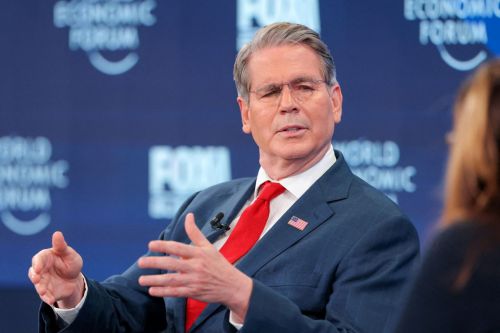 Scott Bessent, U.S. Treasury Secretary, spoke at the World Economic Forum (WEF, Davos Forum) on the 20th (local time). Photo by Reuters Yonhap News
Scott Bessent, U.S. Treasury Secretary, reiterated his call for the Korean National Assembly to pass legislation to fulfill Korea's investment commitments to the United States, stating on the 28th (local time), "There will be no trade agreement with Korea until the Korean National Assembly passes the trade deal."
Regarding the successor to Jerome Powell, the current chair of the U.S. Federal Reserve, which is the market's main focus, Bessent said he had lengthy discussions with President Donald Trump but did not provide any additional clues, such as the timing of the announcement. He firmly denied the possibility of coordinated currency intervention between the U.S. and Japanese governments, which has been cited as a potential cause of this week's yen appreciation and dollar depreciation, saying, "Absolutely not."
"Trump's Message: Sign the Trade Agreement"
In an interview with CNBC, Secretary Bessent was asked whether President Trump is raising tariffs on Korea because Korea has not 'ratified' the trade agreement. He replied as above, emphasizing, "(The Trump administration's message is) to sign the trade agreement."
When asked whether Korea would be subject to a 25% tariff until the agreement is ratified by the Korean legislature, Bessent did not give a clear yes or no answer, stating, "I think this helps move the situation forward."
These remarks can be interpreted as expressing hope that President Trump's announcement of tariff increases will prompt the Korean National Assembly to process the "Special Act on Strategic Investment Management between Korea and the United States (Special Act on Investment in the United States)," which is currently pending in the legislature.
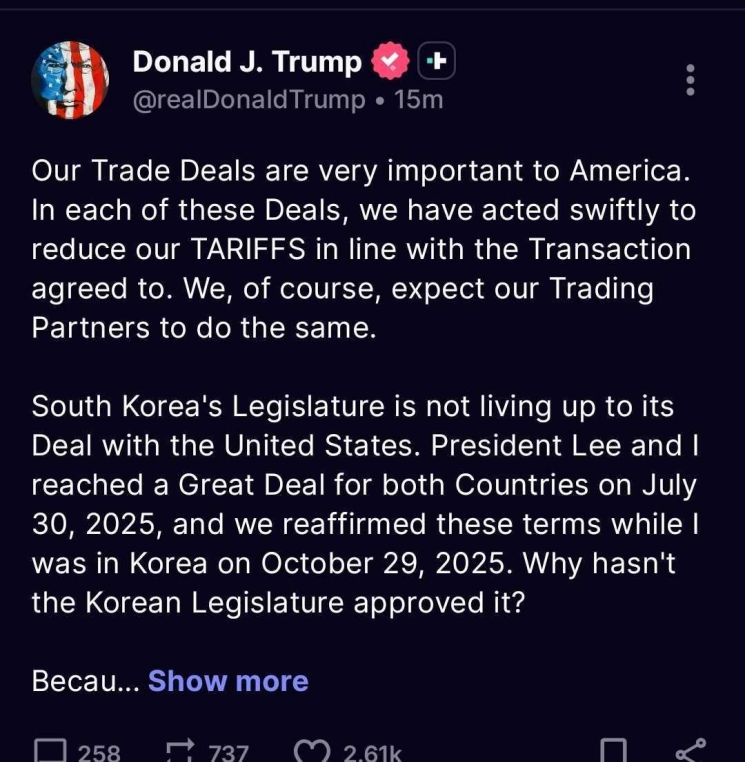 A post by Donald Trump, President of the United States, on Truth Social on the 26th (local time). Trump Truth Social
On the 26th, President Trump posted on his social media platform, Truth Social, stating, "Because the Korean legislature has not enacted our historic trade agreement, I am raising all reciprocal tariffs on automobiles, lumber, pharmaceuticals, and all other goods from 15% to 25%."
However, the next day, President Trump indicated that a solution could be reached with Korea and suggested that the tariff increases could be put on hold depending on the outcome of bilateral discussions. In fact, since President Trump's announcement, there has been no administrative order or official gazette publication to implement the tariff increases. Nevertheless, there are reports that the United States may be preparing for such publication, so the situation remains tense.
Kim Jeonggwan, Minister of Trade, Industry and Energy, is scheduled to travel from Canada to Washington, D.C. tonight to meet with U.S. Secretary of Commerce Howard Lutnick and others to understand the U.S. position and explain Korea's situation. Han Koo, Deputy Minister for Trade Negotiations at the Ministry of Trade, Industry and Energy, also plans to visit the United States soon to hold discussions with Jamison Greer, U.S. Trade Representative (USTR).
The Korean National Assembly is also expected to accelerate the legislative process. Han Jungae, Policy Committee Chair of the Democratic Party of Korea, told reporters after meeting with Deputy Prime Minister and Minister of Economy and Finance Koo Yooncheol the previous day that passage could occur between the end of February and early March. She said, "(Regarding the timing of the special act's passage) since it is a new law, a public hearing is required, but there are ways to handle this at the committee level. If the review proceeds without issues, it may be possible to pass it within the first quarter."
Four Candidates for Next Fed Chair... Timing of Announcement Undisclosed
Regarding the appointment of Powell's successor, Secretary Bessent said he had extensive discussions with President Trump and that there are currently four leading candidates. However, he did not disclose any further details or when President Trump might announce the next chair.
When asked whether he had recommended any particular individual, Bessent replied, "I do not make recommendations. I simply present the president with options and their consequences. The decision is the president's." Regarding the timing of the announcement, he said, "Only the president knows." According to Reuters, the White House did not immediately comment on the timing of the announcement.
President Trump has previously stated several times that he would announce his nominee soon. Last week, he said, "In my mind, I have narrowed it down to one person." However, he also expressed his desire to keep his close economic advisor, Kevin Hassett, Chairman of the White House National Economic Council (NEC), in his current position.
According to prediction markets, the top candidate is Rick Rieder, Global Chief Investment Officer (CIO) of Fixed Income at BlackRock. Former Fed Governor Kevin Warsh and current Fed Governor Christopher Waller are considered the next most likely candidates. As of 4:51 a.m. on the 29th (Korea time), the online betting site Kalshi showed the nomination probabilities for these three at 41%, 27%, and 13%, respectively. Rieder's probability was 50% the previous day but fell by 9 percentage points.
U.S.-Japan Currency Policy Coordination Denied
Secretary Bessent denied recent market rumors that the United States and Japan had coordinated efforts to prevent the depreciation of the yen. When asked whether the United States was intervening in the foreign exchange market to boost the yen's value, he said, "Absolutely not," and added, "The United States has always maintained a strong dollar policy." He also explained that as the U.S. trade deficit narrows, this trend will likely lead to further dollar strength.
Previously, The Wall Street Journal (WSJ) reported on the 23rd that the U.S. Treasury had conducted an unusual "rate check" on the yen exchange rate. This is a procedure in which authorities inquire with market participants about the level and trends of the exchange rate. It is typically interpreted as a signal that precedes actual market intervention. Subsequently, on the 27th, the dollar fell to its lowest level in four years since 2022, and President Trump's comment that he "thinks the current dollar value is very good" added to this speculation.
Immediately after these remarks, the dollar temporarily strengthened. According to MarketWatch, the dollar index, which measures the value of the dollar against the currencies of six major countries, rose 0.4% to 96.60 on the day.
"U.S. Economy Will Continue High Growth Without Inflation"
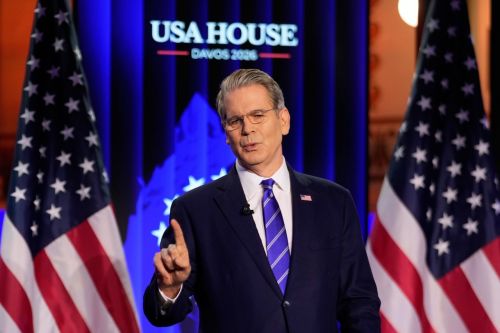 Scott Bessent, U.S. Secretary of the Treasury, spoke at the World Economic Forum (WEF, Davos Forum) on the 20th (local time). Photo by Reuters Yonhap News
Secretary Bessent emphasized that the U.S. economy will continue to experience high growth this year, following last year, stating that "high growth without inflation is possible." He explained, "The cause of inflation is supply constraints, but we are increasing supply through our deregulation policies."
He also noted that "there are quite a few people on the Fed Board who have had misconceptions about inflation," and expressed hope that "Fed Board members will approach the coming months with an open mind."
He added that strong U.S. economic growth and rising wages do not necessarily lead to higher inflation. He particularly emphasized the need to consider the significant decline in rental prices.
Meanwhile, Secretary Bessent predicted that Fed Governor Stephen Miran, known for his pro-Trump stance within the Fed, would likely remain in his position for the time being. Governor Miran is currently serving as a board member while on leave from his position as Chairman of the White House Council of Economic Advisers (CEA). Initially, Governor Miran's term was set to end on January 31.
Last month, Governor Miran stated that he would likely remain on the Fed Board until President Trump nominates the next Fed chair and the Senate confirms the appointment. He joined the Fed to fill a vacancy after Fed Governor Adriana Kugler, appointed by former President Joe Biden, resigned in August last year.
© The Asia Business Daily(www.asiae.co.kr). All rights reserved.
![Clutching a Stolen Dior Bag, Saying "I Hate Being Poor but Real"... The Grotesque Con of a "Human Knockoff" [Slate]](https://cwcontent.asiae.co.kr/asiaresize/183/2026021902243444107_1771435474.jpg)


















