KOSPI Falters Following Trump’s Tariff Hike Remarks
Sharp Declines in Auto Stocks Including Hyundai Motor and Kia
"Trump's Comments Could Trigger a Market Correction After KOSPI’s Surge"
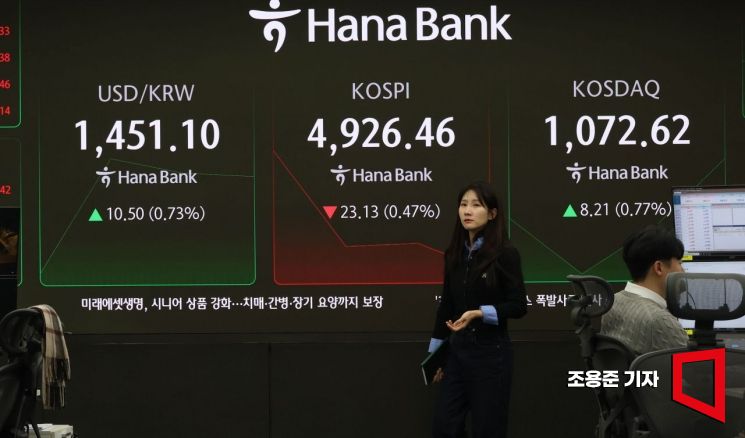 On the 27th, when the Korea Composite Stock Price Index (KOSPI) opened lower following U.S. President Donald Trump's statement to revert tariffs on Korean products to pre-trade agreement levels, an employee at the dealing room of Hana Bank's headquarters in Jung-gu, Seoul, was monitoring the stock market and exchange rates. 2026.1.27 Photo by Yongjun Cho
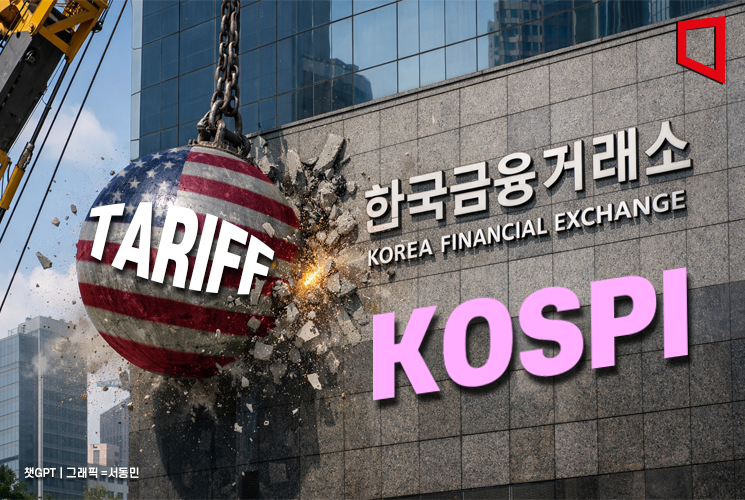
As U.S. President Donald Trump announced plans to raise tariffs on Korean products to pre-trade agreement levels, the KOSPI index faltered just shy of the 5,000-point mark. Experts predicted that the KOSPI, which had risen rapidly, could undergo a correction triggered by this development. However, some analysts noted that if the Korean National Assembly swiftly approves the trade agreement, the impact would likely be short-lived.
KOSPI Falters on Trump’s Tariff Hike Remarks
On the 27th, the KOSPI opened at 4,932.89, down 16.70 points (0.34%) from the previous trading day. After opening, it briefly fell to the 4,890-point level, but as of 9:40 a.m., it had recovered, rising 0.25% from the previous day to 4,962.17, turning upward.
The KOSPI was heavily impacted by President Trump’s tariff announcement. On the 26th (local time), President Trump stated on the social media platform Truth Social, “The Korean National Assembly is not implementing the agreement with the United States,” adding, “Since the Korean legislature has not enacted the historic trade agreement, which is their prerogative, I am raising all reciprocal tariffs on Korea-including automobiles, lumber, pharmaceuticals, and all other products-from 15% to 25%.”
President Trump further said, “President Lee Jaemyung and I reached a great agreement for both countries on July 30, 2025, and I reaffirmed these terms when I was in Korea on October 29, 2025. Why hasn’t the Korean legislature approved the agreement?” This is interpreted as criticism of the National Assembly’s failure to pass the “Special Act for Strategic U.S.-Korea Investment Management” (the U.S. Investment Special Act).
Following Trump’s remarks, declines were particularly pronounced among auto-related stocks, such as Hyundai Motor and Kia. As of 9:32 a.m. that day, Hyundai Motor was trading at 477,500 won, down 3.05% from the previous session. Kia was also down 4.06% at 148,900 won, with Hyundai Mobis (-2.90%) and others also falling.
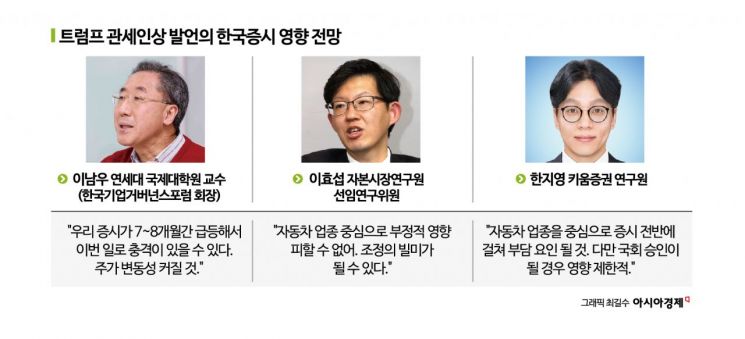
Experts noted that, given the recent surge in the Korean stock market, Trump’s tariff shock could serve as a trigger for a correction. Lee Hyoseop, Senior Research Fellow at the Korea Capital Market Institute, said, “After the KOSPI broke through 5,000, there has been an overall sense of caution about the market’s peak,” adding, “A correction was due, and this situation provides an excuse for it. With many investors having borrowed to invest, Trump’s shock is bound to have a negative impact on the market.”
Lee Namwoo, Professor at Yonsei University’s Graduate School of International Studies and Chairman of the Korea Corporate Governance Forum, also commented, “Our stock market has soared too much over the past 7-8 months, so it could react sensitively to external shocks,” predicting, “Trump’s move will increase stock price volatility.” He further cautioned, “While a KOSPI correction is concerning, if the KOSDAQ is artificially propped up, the aftereffects could be even more severe. With stock prices surging and valuations rising, investors are tempted to sell, and an external shock could provide the justification.”
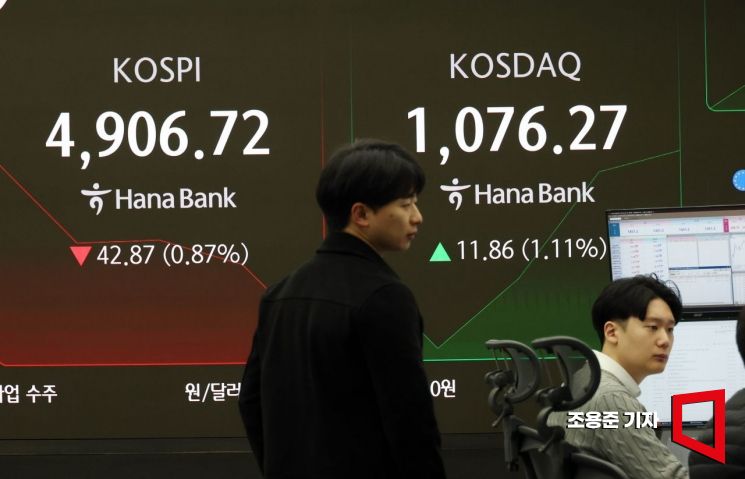 On the 27th, when the Korea Composite Stock Price Index (KOSPI) opened lower following U.S. President Donald Trump's statement to revert tariffs on Korean products to pre-trade agreement levels, an employee at the Hana Bank headquarters dealing room in Jung-gu, Seoul, was monitoring the stock market and exchange rates. 2026.1.27 Photo by Yongjun Cho
“Some Expect Only Short-Term Impact”
However, there are also forecasts that the impact will be limited to a short-term shock. Han Jiyeong, a researcher at Kiwoom Securities, said, “While this will be a burden across the market, especially in autos, the issue of National Assembly approval is only a matter of time. Therefore, this reciprocal tariff hike should be seen as a noise factor with only a limited effect on the market trend.”
Han added, “Although there has been some recent outflow from the KOSPI, a strategy focusing on increasing holdings in leading stocks remains valid. It is also important to note positive factors such as upward revisions to earnings forecasts, additional buying capacity from foreign and institutional investors, and low valuation burdens (stock price levels relative to corporate value).”
Heo Jaehwan, a researcher at Eugene Investment & Securities, commented, “The Korea-U.S. tariff issue, which had been forgotten since last September, has resurfaced. It seems inevitable that this issue will be discussed quickly at the temporary National Assembly session in February.” He added, “Just as the administration previously warned of new tariffs on European goods over the Greenland dispute but later withdrew, there has not yet been a case where the administration actually implemented the tariffs threatened by President Trump. While some turmoil is expected, it will eventually pass.”
© The Asia Business Daily(www.asiae.co.kr). All rights reserved.
![Clutching a Stolen Dior Bag, Saying "I Hate Being Poor but Real"... The Grotesque Con of a "Human Knockoff" [Slate]](https://cwcontent.asiae.co.kr/asiaresize/183/2026021902243444107_1771435474.jpg)

















