Household Waste Diet Project Launched
Reduce Waste by the Equivalent of One District by 2027
Achieve 100% Public Processing of Household Waste by 2033
Seoul City: "Proactive Response to Direct Landfill Ban"
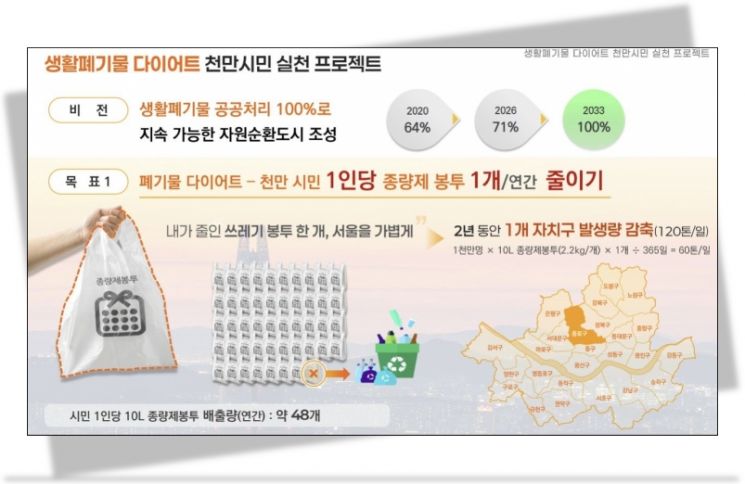
Seoul City is launching an initiative to reduce household waste by the equivalent of one volume-based waste bag per citizen annually. Based on this, the city plans to cut household waste by an amount equivalent to the daily output of one district (approximately 120 tons per day) by 2027.
On January 26, Seoul City announced that it will implement this household waste reduction project in line with the enforcement of the ban on direct landfill of municipal waste.
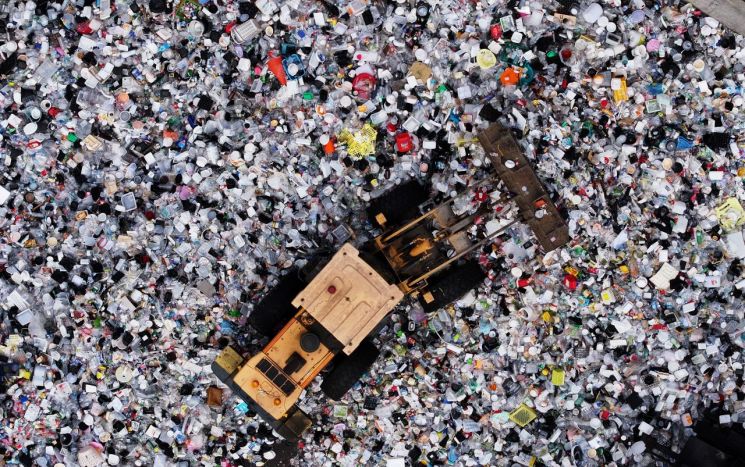 Seoul City is implementing a 'Municipal Waste Reduction Project' to reduce the amount of waste by the equivalent of one volume of a volume-based waste bag per citizen annually. The photo shows a resource circulation center in the metropolitan area. Photo by Yonhap News
Compared to 2020, Seoul City reduced its estimated household waste generation in 2025 to 206 tons per day, which is twice the average daily output of one district (about 120 tons per day). However, in response to resource circulation policies such as the ban on direct landfill, the city has established its own reduction plan.
This year, in the first half, the city will focus on citizen participation programs. These include: ▲separating food waste ▲prohibiting mixing vinyl and plastic with volume-based waste bags ▲separating paper waste ▲prioritizing the use of reusable containers ▲encouraging the use of shopping bags and tumblers. The aim is to promote waste separation in daily life. Starting with Mayor Oh Sehoon, the city is targeting the participation of 100,000 people, including the heads of all 25 district offices and local residents, in a pledge campaign.
Seoul City will also publicly recruit 354 citizens to participate in the "100-Day Household Waste Diet Challenge," a program for individuals to self-diagnose and monitor their daily waste output. The number 354 represents the average daily waste output per Seoul citizen (354 grams).
Participants will use portable scales provided by the city to self-monitor their household waste output for 100 days and record their progress on a daily "reduction practice checklist." Outstanding participants will receive public recognition and Eco Mileage rewards. Recruitment is scheduled for February, and the top participant will receive the Seoul Mayor's Award at the "Environmental Awards Ceremony" in June.
Additionally, the city will publicly recruit 25 apartment complexes to participate in the "Our Apartment Waste Diet 365 Days" program, which measures the amount of recyclable resources generated by each complex and encourages reductions in volume-based waste bag usage. Outstanding complexes will receive Seoul Eco Mileage rewards worth 10 million won and support for projects to improve waste separation environments.
The city will also visit residential areas, traditional markets, and neighborhoods with high foreign resident populations to provide customized waste separation education. In locations vulnerable to improper separation, the city will inspect the contents of volume-based waste bags to check for improper mixing. Through these efforts, Seoul plans to encourage the use of reusable delivery containers in residential areas like villas and apartments, distribute multilingual waste separation guides in areas with many foreign residents, and collaborate with merchant associations in commercial districts to promote the separation of waste vinyl, all tailored to the needs of each site.
Through this reduction project, Seoul City expects to cut approximately 44,000 tons of waste over the next two years. In addition, by constructing and modernizing large-scale resource recovery facilities, the city aims to achieve a public processing capacity of 2,700 tons per day by 2033.
Kwon Min, Director of the Climate and Environment Headquarters of Seoul City, stated, "Reducing household waste, which is the starting point for resource circulation, is a key task that must be pursued in tandem with expanding public processing capacity. By fostering strong citizen engagement in the 'Household Waste Diet,' we will respond to the upcoming direct landfill ban and lay the foundation for a carbon-neutral city by 2050."
© The Asia Business Daily(www.asiae.co.kr). All rights reserved.
![Clutching a Stolen Dior Bag, Saying "I Hate Being Poor but Real"... The Grotesque Con of a "Human Knockoff" [Slate]](https://cwcontent.asiae.co.kr/asiaresize/183/2026021902243444107_1771435474.jpg)
















