As U.S. President Donald Trump increases pressure by mentioning “full access” to Greenland, a Danish territory, the Greenlandic government has drawn a firm line, asserting that the authority to develop minerals does not lie with external parties.
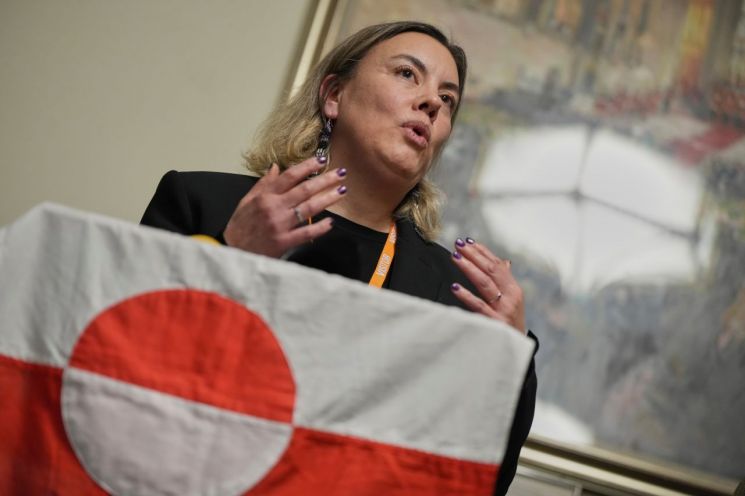 I am Nathan Nielsen, Executive Director of Greenland, Minister of Minerals, Energy, Legal Affairs, and Gender Equality. Photo by AP Yonhap News.
On January 23 (local time), Naaja Nathanielsen, Greenland’s Minister of Business, Minerals, Energy, Justice, and Gender Equality, stated in an interview with Politico Europe, “We will not allow external forces to dictate Greenland’s minerals.” Minister Nathanielsen emphasized, “Mineral development falls under Greenland’s jurisdiction,” warning that “any structure in which a foreign country decides or manages this would be a violation of our sovereignty.”
On January 21, President Trump, after meeting with NATO Secretary General Mark Rutte, mentioned that a negotiation framework regarding Greenland had been established and withdrew his plan for tariffs against Europe. In a media interview on January 22, he further stated his intention to negotiate with Europe to secure full access to Greenland.
This has led to interpretations that the United States is pursuing a broad agreement encompassing both the deployment of the next-generation missile defense system “Golden Dome” and rights to develop strategic minerals such as rare earth elements. According to Politico, a European official said that the negotiation proposal could include the establishment of an international organization to oversee Greenland’s mineral development.
Greenland is a region with the potential to supply about a quarter of global demand for rare earth elements alone. In addition, it is home to reserves of oil, gas, gold, and other critical minerals essential for the transition to clean energy, though many of these resources have yet to be mined.
Minister Nathanielsen reiterated, “We will decide how to utilize our minerals,” and stressed, “We cannot accept any system in which a foreign country controls or supervises Greenland’s minerals.” She added that if such provisions were included, the Greenlandic government would oppose the agreement itself.
However, she did not rule out all possibilities for cooperation. “We are not opposed to strengthening security capabilities at the NATO level or to a certain degree of monitoring,” she said, adding, “We are also open to discussions on advancing the mineral cooperation agreement signed with the United States in 2019.”
Since President Trump dismissed the possibility of using force, Greenland has been closely examining the reality and severity of the security threats raised by the United States. Minister Nathanielsen assessed, “Although anxiety still lingers among the residents, the level of tension in the conflict appears to have somewhat eased.” Nevertheless, she added, “The United States is an ally, but at this very moment, it may be difficult to call them a friend.”
© The Asia Business Daily(www.asiae.co.kr). All rights reserved.
![Clutching a Stolen Dior Bag, Saying "I Hate Being Poor but Real"... The Grotesque Con of a "Human Knockoff" [Slate]](https://cwcontent.asiae.co.kr/asiaresize/183/2026021902243444107_1771435474.jpg)















