Contract with Private Facilities Signed Last September
Preemptive Measures Prevent Initial Confusion
With the direct landfilling ban on municipal solid waste at the Sudokwon Landfill having taken effect from January 1, Dongjak District in Seoul announced on the 23rd that it is receiving attention for its proactive response.
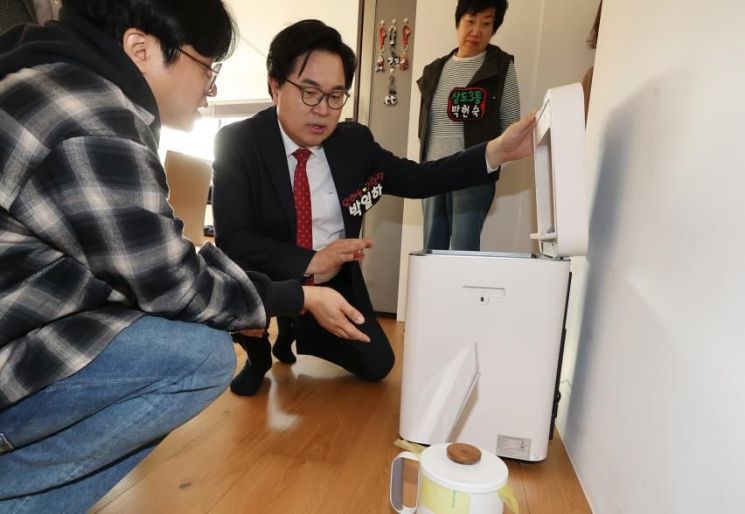 Park Ilha, Mayor of Dongjak District Office, is visiting a household that received support for purchasing a home food waste reducer to listen to residents' opinions. Provided by Dongjak District Office.
The direct landfilling ban, implemented under the Waste Management Act revised in 2021, prohibits sending municipal solid waste contained in standard garbage bags directly to landfills without sorting or incineration. While this is increasing the processing burden across Seoul’s districts, Dongjak District preemptively signed contracts with private specialized processing facilities in September last year, ahead of the implementation, to prevent initial confusion.
Last year, the district signed contracts with private facilities to process 4,700 tons of municipal solid waste, distributing the waste among the Gangnam Resource Recovery Facility, the Sudokwon Landfill, and private processing facilities. Starting this year, in line with the direct landfilling ban at the Sudokwon Landfill, the district increased the volume sent to private facilities to 10,000 tons. In the second half of this year, it plans to further strengthen its processing capacity by contracting an additional 3,700 tons.
When waste is sent to the Sudokwon Landfill, it is simply buried. However, at private processing facilities, the waste is sorted, shredded, and pulverized so it can be recycled as raw material for cement. This method goes beyond simple disposal, realizing resource circulation.
The district is also actively promoting various initiatives to reduce municipal solid waste by making waste separation a part of daily life. These efforts include supporting the purchase of home food waste disposers, converting coffee grounds into feed and fertilizer, implementing a dedicated waste vinyl collection system, operating recycling stations, and introducing a resident waste collection incentive program to encourage community participation.
Meanwhile, to stabilize the local municipal waste management system and prepare for emergencies at public and private facilities, the district plans to sign a contract within January for a technical review of the suitability of the underground waste facility at the Joint Resource Circulation Center. In February, it will sign a feasibility study contract for the underground development of the Noryangjin Environmental Support Center.
Park Ilha, Mayor of Dongjak District, stated, "Thanks to our proactive preparations ahead of the implementation of the Sudokwon Landfill direct landfilling ban, we have been able to operate our municipal waste management system stably. We will continue to thoroughly prepare for waste processing and consistently pursue resource circulation policies to reduce greenhouse gas emissions."
© The Asia Business Daily(www.asiae.co.kr). All rights reserved.
![Clutching a Stolen Dior Bag, Saying "I Hate Being Poor but Real"... The Grotesque Con of a "Human Knockoff" [Slate]](https://cwcontent.asiae.co.kr/asiaresize/183/2026021902243444107_1771435474.jpg)















