"On-site Meeting Regarding the Government Drug Price Reform Plan"
Hyangnam Pharmaceutical Complex Labor and Management: "A Matter of Survival"
There have been claims that even a 10% decrease in sales due to the government’s drug price reduction policy could result in the loss of hundreds of jobs among small and medium-sized pharmaceutical companies.
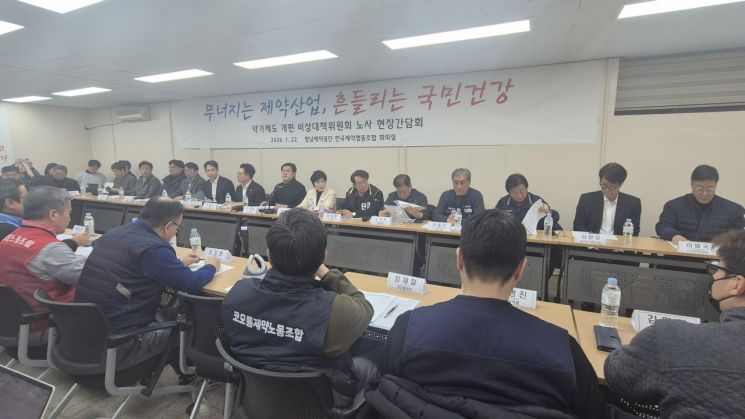 On the 22nd, participants are speaking at the "On-site Meeting Regarding the Government Drug Price Reform Plan" held in the conference room of the Korea Pharmaceutical Cooperative in Hwaseong, Gyeonggi Province. Photo by Park Jungyeon
The "Emergency Committee for Drug Price System Reform for Industrial Development" held an "On-site Meeting Regarding the Government Drug Price Reform Plan" on the 22nd in the conference room of the Korea Pharmaceutical Cooperative in Hwaseong, Gyeonggi Province. The meeting was organized so that the Emergency Committee and the labor-management representatives of the Hyangnam Pharmaceutical Complex could share their sense of crisis regarding the government's policy implementation and discuss future response strategies.
Seo Jeongo, Executive Director of the Korea Pharmaceutical Cooperative, who attended the meeting, stated, "The average operating margin of domestic pharmaceutical companies is already at its limit, ranging from 4% to 8%." He added, "If drug prices are reduced by more than 10%, it is only a matter of time before companies fall into the red, and at that point, investment will inevitably come to a halt." He further explained, "Research and development costs and expenses for upgrading plant facilities will be the first to disappear, which will immediately lead to job insecurity."
Executive Director Seo also presented specific figures regarding the impact of the drug price reform on employment in the pharmaceutical complex. In the Hyangnam Pharmaceutical Complex alone, about 5,000 people are employed, and according to his analysis, even a 10% decrease in sales due to the reform plan could result in at least 500 people losing their jobs. He emphasized, "If we calculate based on a three-person household, the livelihoods of 1,500 people would be directly threatened," and added, "In a situation where it is difficult for companies to survive, reducing production and restructuring become unavoidable choices."
Concerns about health security were also raised. Executive Director Seo pointed out, "If pharmaceutical companies' management is weakened, they will inevitably have to abandon the production of essential medicines that are not profitable," and warned, "This could lead to a decline in drug quality and increased dependence on foreign raw materials, thereby threatening the public’s right to health."
No Yeonhong, Chairman of the Korea Pharmaceutical and Bio-Pharma Manufacturers Association and co-chair of the Emergency Committee, stressed the urgency of dialogue between the government and the industry. He said, "Although the government announced its drug price reform plan in November last year, the final version has not yet been confirmed," and added, "The industry's urgent concerns must be conveyed before the Health Insurance Policy Deliberation Committee makes its decision at the end of February." He further noted, "Once a decision is made, it is difficult to reverse."
Labor-management representatives who attended the meeting unanimously agreed on the need to form a social consultative body to discuss the drug price system reform. One participant stated, "This is not simply a matter of fiscal savings, but a matter of survival for the industry and employment," and added, "There is a consensus that if the voices from the field are not reflected, action will be inevitable."
The government is pursuing a reform of the drug price system based on the judgment that high prices for generic drugs have led to a proliferation of products and excessive competition. Currently, the price calculation rate for generics and off-patent drugs is 53.55% of the original drug’s price, and the government is considering lowering this to 40%, which is in line with major countries. According to the government, as of 2023, 31.3% of finished drug manufacturers had annual production of less than 1 billion won, and among 240 new drugs registered over the past five years, only 13 were developed domestically.
The Hyangnam Pharmaceutical Complex is the largest pharmaceutical production hub in Korea, with 36 companies and 39 business sites employing approximately 4,800 professionals. On site, there are concerns that if drug price reductions become a reality, a freeze on new hiring and a reduction in production lines will be inevitable. Due to the GMP-based production structure centered on skilled personnel, they worry that workforce reductions could directly lead to weakened quality control and a contraction in the production of essential medicines.
© The Asia Business Daily(www.asiae.co.kr). All rights reserved.
![Clutching a Stolen Dior Bag, Saying "I Hate Being Poor but Real"... The Grotesque Con of a "Human Knockoff" [Slate]](https://cwcontent.asiae.co.kr/asiaresize/183/2026021902243444107_1771435474.jpg)















