Roborock and Other Chinese Brands Dominate 70% of Domestic Market
Dyson Launches New 'Spot and Scrub AI'
Pursuing Technological Innovation Over Trends
Dyson, which once shook up the home appliance industry with its stick-type cordless vacuum cleaners, is now seeking to restore its reputation with a robot vacuum cleaner equipped with artificial intelligence (AI) technology. Dyson, which has consistently prioritized technological innovation over fleeting trends, is drawing attention as to whether it can shift the landscape of the robot vacuum cleaner market, which has become dominated by Chinese companies.
"Serious About Cleaning": Dyson Declares Counterattack in Robot Vacuum Market
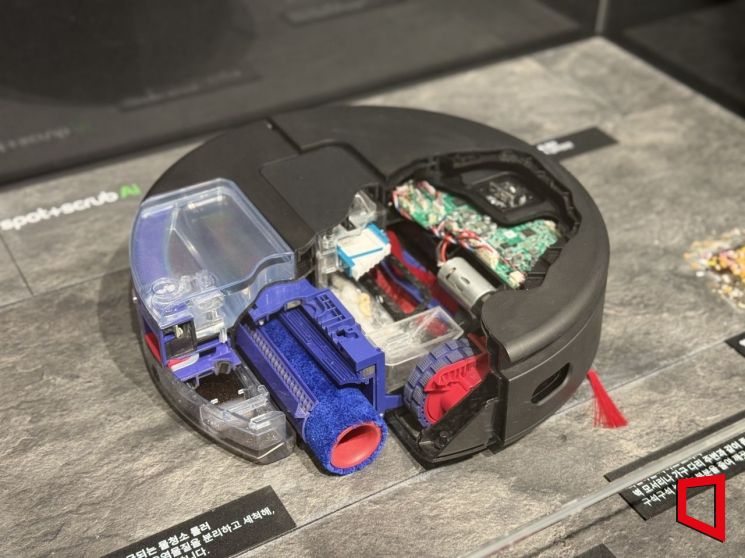 Dyson Korea opened an experiential home appliance pop-up store, 'The Next Home Lab,' on the 22nd at The Hyundai Seoul in Yeouido, Seoul, declaring a counterattack in the robot vacuum cleaner market dominated by Chinese products. A model showcasing the internal structure and technology of the 'Spot & Scrub AI Robot Vacuum Cleaner,' released domestically on the 12th, is displayed at the event. Photo by Heejoon Jang
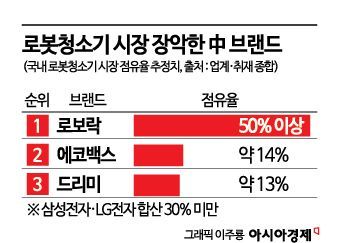
According to the home appliance industry on January 22, the domestic robot vacuum cleaner market is effectively dominated by Chinese brands. Roborock holds an overwhelming lead with a market share of over 50%, followed by Ecovacs (about 14%) and Dreame (about 13%). The combined market share of Chinese brands exceeds 70%, while the combined share of domestic manufacturers Samsung Electronics and LG Electronics is estimated to remain below 30%.
In particular, robot vacuum cleaners, once considered "auxiliary appliances," have recently become essential home appliances due to the increase in dual-income and single-person households, pushing the annual market size beyond 1 trillion won. Chinese companies have taken the lead in the premium market by introducing innovative features such as powerful suction ahead of Samsung Electronics and LG Electronics. Dyson, which sparked a boom with its stick-type cordless vacuum cleaners, also delayed its product launch due to rigorous technology verification.
Amid fierce competition from Chinese products, Dyson Korea declared a counterattack on January 22 by opening the experiential home appliance pop-up store "The Next Home Lab" at The Hyundai Seoul in Yeouido, Seoul. The company unveiled the Spot & Scrub AI Robot Vacuum Cleaner, the Clean & Wash Hygiene Wet Cleaner, and the Hush Jet Compact Air Purifier, all of which were released domestically on January 12, and presented them with various interactive elements such as media art and games.
'Tailored for Korea': All-in-One Wet & Dry Cleaning with Enhanced Intelligence and Hygiene
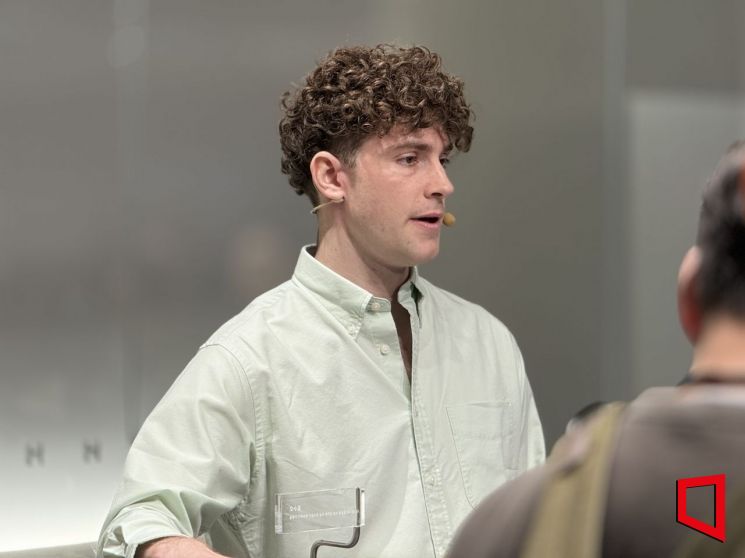 Nathan Lawson McLean, Senior Design Manager of the Dyson Home Research, Design, and Development (RDD) Software Team, is explaining the development process and key new technologies of the robot vacuum cleaner at the experiential home appliance pop-up store "The Next Home Lab" held on the 22nd at The Hyundai Seoul in Yeouido, Seoul. Photo by Heejun Jang
Dyson's Spot & Scrub AI Robot Vacuum Cleaner goes beyond simply vacuuming dust, focusing on "intelligent cleaning" that uses AI technology to directly identify stains and autonomously determine the optimal cleaning method.
At the event, in line with Dyson's philosophy that "the engineer involved in development can introduce the product most accurately," Nathan Lawson McLean, Senior Design Manager of the Dyson Home Research, Design, and Development (RDD) Software Team, and Tom Bishop, Dyson Home Design & Development Engineer, personally demonstrated the technology. They emphasized that these new products have been redesigned to solve recurring problems in consumers' usage environments.
Manager McLean introduced the Spot & Scrub AI Robot Vacuum Cleaner as "a next-generation cleaner that removes even hidden stains with advanced technology and supports both vacuuming and wet cleaning." He explained that while people still have to check and wipe stains or spills on the floor, Dyson's robot vacuum cleaner uses AI technology to identify the type of stain or liquid and is designed to repeat the cleaning process up to 15 times.
In particular, the biggest challenge in developing the wet cleaning function was preventing dirty water used during cleaning from touching the floor again. Manager McLean explained, "With 12 water supply systems, the roller is washed with 60-degree hot water every time it rotates, allowing the floor to be cleaned with fresh water from start to finish." After cleaning, the roller is dried with 40-degree hot air to prevent bacterial growth.
This concern is also reflected in another new product, the Clean & Wash Hygiene Wet Cleaner. According to Dyson's global wet cleaning study conducted last year with 23,311 participants in 28 countries, Koreans spend an average of about one hour cleaning, with 36% of that time dedicated to wet cleaning-a figure higher than the global average of 29%. Manager McLean reiterated Dyson's commitment to technological innovation tailored to customer needs, stating, "Koreans need a more efficient cleaning method that makes wet cleaning easier and more convenient."
'Premium' Dyson: Can It Break the Dominance of Chinese Brands?
Samsung Electronics and LG Electronics, the leading representatives of "K-appliances," are also launching major counterattacks, leveraging "security" and "hygiene" as their main strengths. Samsung Electronics has combined AI-based spatial recognition with its Knox security system to prevent privacy concerns, while LG Electronics has enhanced high-temperature steam sterilization features and is targeting hygiene issues-often cited as weaknesses of Chinese products-through its "Hidden Station" model, which can be built into kitchen furniture.
Industry analysts note that the key issue is how Dyson will extend the brand trust and differentiated user experience it has built in the premium cordless vacuum cleaner market to the field of robot vacuum cleaners. Especially as Chinese companies have rapidly dominated the market by emphasizing price-performance, it remains to be seen whether Dyson's differentiated factors-such as "AI-based cleaning experience" and "user convenience"-will translate into consumer purchases.
James Dyson, founder of Dyson, expressed confidence in the new robot vacuum cleaner, stating, "Dyson engineers have been developing robot vacuum cleaners since the 1990s and have continuously advanced related technologies since unveiling the first model in 2001. With the Dyson robot vacuum cleaner, which is truly persistent, intelligent, and flexible, and supplies clean water from start to finish, there is nowhere for dust to hide."
An industry official commented, "As the robot vacuum cleaner market matures, consumers are starting to consider not just basic functions but also after-sales service, data security, and cleaning precision. Dyson's entry could serve as a catalyst to shift the market's focus, which has been heavily weighted toward Chinese brands, back to the premium segment."
© The Asia Business Daily(www.asiae.co.kr). All rights reserved.
![Clutching a Stolen Dior Bag, Saying "I Hate Being Poor but Real"... The Grotesque Con of a "Human Knockoff" [Slate]](https://cwcontent.asiae.co.kr/asiaresize/183/2026021902243444107_1771435474.jpg)

















