Public Debate on "The Day After AGI" at Davos Forum
"Next Year" vs. "Five to Ten Years" in Direct Confrontation
"Want to Slow Development, but China Makes It Difficult"
Two giants in the field of artificial intelligence (AI), Demis Hassabis, CEO of Google DeepMind, and Dario Amodei, CEO of Anthropic, clashed head-on over the timeline for the arrival of artificial general intelligence (AGI) at the human level. While their perspectives on the pace of development differed, both expressed concern that humanity may enter the AGI era unprepared due to geopolitical competition.
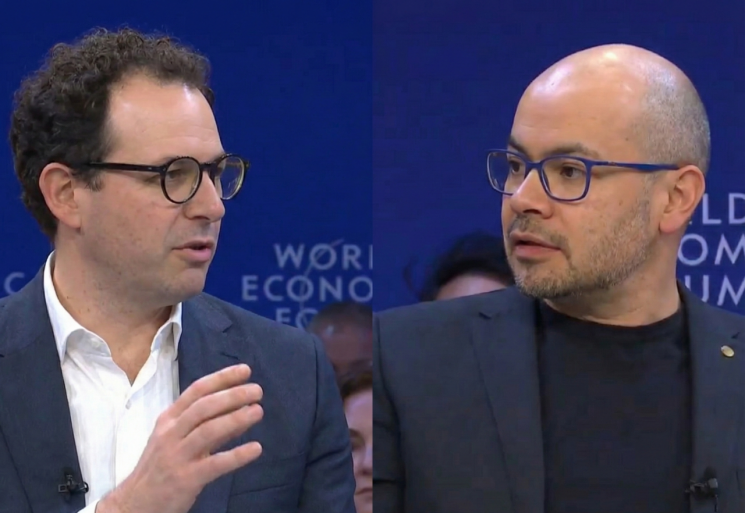 Dario Amodei, CEO of Anthropic, and Demis Hassabis, CEO of Google DeepMind, are having a dialogue at the Davos Forum. YouTube capture
On January 21 (local time) at the World Economic Forum (WEF, Davos Forum) in Davos, Switzerland, the two CEOs participated in a public discussion themed "The Day After AGI." Their approaches diverged. CEO Amodei argued that AGI could become a reality rapidly through coding automation, whereas CEO Hassabis insisted that more time is needed due to scientific verification and physical constraints.
CEO Amodei stated that he has no intention of retracting his previous prediction that "by 2026-2027, a model with Nobel laureate-level intellectual abilities will emerge."
CEO Amodei declared, "Engineers at Anthropic no longer write code themselves," adding, "Within the next 6 to 12 months, AI will perform most of the work of software engineers." He explained that as AI with coding abilities is increasingly deployed to develop the next generation of AI, the pace of technological advancement could accelerate exponentially, moving beyond the scope of human intervention.
CEO Hassabis holds a different view. He believes that at least another five to ten years are needed before AGI arrives, estimating that the earliest possible date is around 2030. CEO Hassabis pointed out, "Automation is rapid for tasks like coding or mathematics, where it is easy to verify correct answers, but designing new compounds or predicting physical laws requires real-world experiments and validation." He emphasized that, unlike the digital environment, the physical world imposes constraints of time and cost. As a Nobel laureate in chemistry, CEO Hassabis is deeply interested in scientific contributions made possible by AI, with the protein analysis AI 'AlphaFold' being a prime example.
CEO Hassabis also stated that there are still "missing ingredients" for AGI, citing world models, continual learning, and robotics. He explained that AI must go beyond generating text or code to understanding physical laws and interacting with the real world through robotic bodies in order to approach true intelligence.
This is seen as a strategy to expand the battlefield beyond the current large language model (LLM)-centered competition to physical AI. Google DeepMind recently agreed to provide AI technology for Hyundai Motor Group's humanoid robot "Atlas." The company aims to realize AGI by connecting generative AI to physical systems in industrial settings.
The two also had contrasting perspectives on the labor market. CEO Amodei claimed, "Within the next one to five years, half of entry-level white-collar jobs could disappear," while CEO Hassabis advised, "Become incredibly proficient with AI tools."
Despite their differing technical approaches, there was one area where both reached the same conclusion. CEO Hassabis said, "I would like to slow down AI development for society's adaptation and safety," and CEO Amodei agreed, but both emphasized that it is 'impossible.' The reason is China.
CEO Amodei drew an analogy, saying, "Selling chips to China for the benefit of American companies is like selling nuclear weapons to North Korea for the benefit of Boeing." His comment revealed that the AI technology race has already shifted from industrial competition to a matter of national security. CEO Hassabis also stated, "Without international consensus, it is impossible for only one side to slow down," and warned in media interviews that the AI technology gap between the United States and China has narrowed to just a few months.
Recognizing the dangers of excessive speed, CEO Amodei advised that humanity has entered a period of "technological adolescence," and that in an era when both the potential and risks of technology are growing, wisdom to avoid self-destruction is more important than speed competition.
© The Asia Business Daily(www.asiae.co.kr). All rights reserved.
![Clutching a Stolen Dior Bag, Saying "I Hate Being Poor but Real"... The Grotesque Con of a "Human Knockoff" [Slate]](https://cwcontent.asiae.co.kr/asiaresize/183/2026021902243444107_1771435474.jpg)















