Interview with Superintendent Im Taehee of Gyeonggi Province
Introduction of a Five-Level Absolute Grading System for CSAT and School Records
Expansion of Essay and Written Assessments... Transition to Growth-Centered Education
"The university admissions system reform initiated by the Gyeonggi Provincial Office of Education has passed the halfway point. Having led educational reform at the forefront, I am determined to see the university admissions system reform through to completion."
Im Taehee, Superintendent of the Gyeonggi Provincial Office of Education and the 18th Superintendent of Gyeonggi, has proposed measures such as expanding absolute grading for the College Scholastic Ability Test (CSAT) and school records, strengthening essay and written assessments, and integrating the CSAT with regular admissions. This stems from the belief that the traditional multiple-choice, problem-solving evaluations cannot foster future talent. He also views changes to the current education system as inevitable to restore the integrity of public education. Last year, he became the first Korean superintendent to deliver a lecture at Harvard University in the United States, addressing issues in Korean education and university admissions system reform. These actions have ignited recent discussions on university admissions reform.
On January 21, during an interview with The Asia Business Daily at the Gyeonggi Provincial Office of Education, Superintendent Im presented his next goal: "Completing the 2032 university admissions system reform." He explained that the real journey toward education reform in Korea is just beginning. Im stated, "If my previous term was about maturing the discussion on university admissions reform, the next challenge is bringing about real change," expressing his commitment to seeing the reform through to the end.
The following is a Q&A with Superintendent Im.
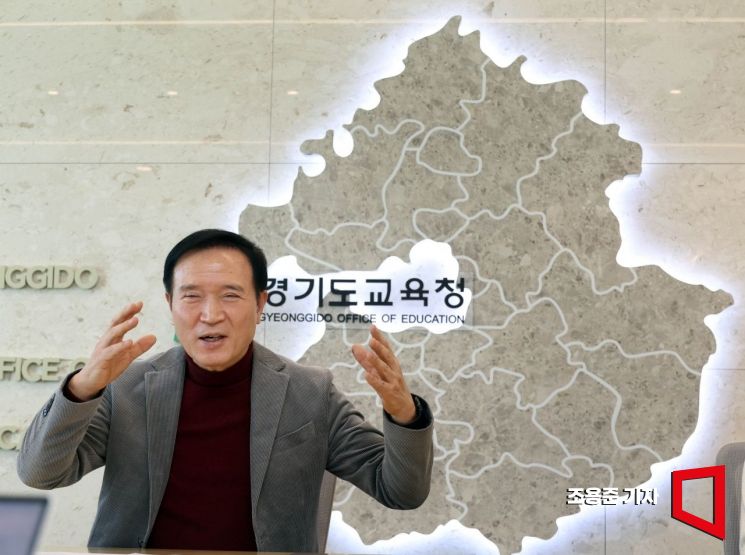 Im Taehee, Superintendent of Gyeonggi Provincial Office of Education, is being interviewed at the Gyeonggi Provincial Office of Education regarding changes in university admission policies. Photo by Jo Yongjun
-This year, you set the direction of education as 'restoring its essence.' Why focus on the 'essence of education' now?
▲When visiting schools, I see that both students and teachers are working extremely hard. However, I have realized that the impact of the 'system' is far greater than individual effort. No matter how much schools try to stay true to the essence of education, if the university admissions structure that ranks students by scores and hierarchy remains unchanged, education will inevitably become distorted. The starting point for restoring the essence of education is reforming the university admissions system. If admissions do not change, school education will ultimately remain subordinate to entrance exams. The current university admissions system evaluates students by a single standard. Under the CSAT-centered relative evaluation system, students’ thinking skills, creativity, and growth processes are not sufficiently respected. With this awareness, the Gyeonggi Provincial Office of Education proposed the '2032 University Admissions Reform.' The idea is to set the goal of education as student 'growth' and to establish a school environment and structure where teachers can fully dedicate themselves to teaching. The starting point is the reform of the university admissions system.
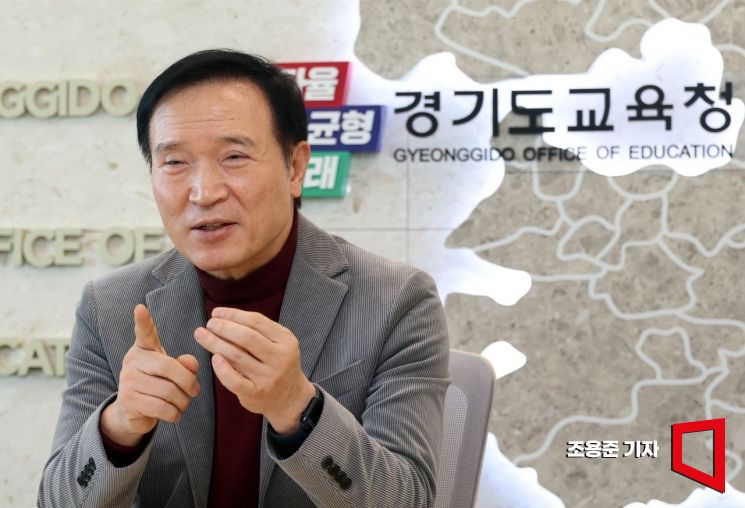 Im Taehee, Superintendent of Gyeonggi Provincial Office of Education, is being interviewed at the Gyeonggi Provincial Office of Education regarding changes in university admission policies. Photo by Jo Yongjun
-What is the direction of the '2032 university admissions reform' you are envisioning?
▲The CSAT should shift from simple memorization of knowledge to a comprehensive evaluation of thinking skills, comprehension, and problem-solving abilities developed through school classes. Moreover, instead of being a test focused on 'differentiation,' it should serve as a 'qualification exam,' as its name-College Scholastic Ability Test-suggests, assessing only whether students are prepared for university studies. This is why I proposed the introduction of a five-level absolute grading system for the CSAT and school records, as well as expanding essay and written assessments.
I am not suggesting the complete abolition of the CSAT. The basic framework should remain, but the role and focus of the CSAT should be adjusted. At this point, universities should be allowed to set the difficulty level of absolute grading. In other words, universities should decide what level of students they will accept.
'School records' and 'university admissions procedures' should also change. School records should switch from relative to absolute evaluation, and expanding essay and written assessments is important to capture students’ achievement levels and growth processes. The key is to ensure that learning and evaluation conducted in school classes are properly respected in admissions. The 'Hi-Learning' platform developed by the Gyeonggi Provincial Office of Education is designed to accumulate and utilize data on students’ overall learning and activities. University admissions procedures also need to be restructured to integrate the currently complex system divided into early and regular admissions, and to comprehensively reflect both student records and the CSAT. In particular, the timing and operation of admissions should be adjusted so that classes for third-year high school students can proceed normally through the second semester.
I have also proposed a plan to divide the CSAT into 'CSAT 1,' which assesses the academic achievement level of all second-year high school students in common subjects, and 'CSAT 2,' which measures integrated thinking skills in elective subjects for third-year students who wish to participate. This is not a dual-track CSAT. CSAT 1 serves as a 'qualification test,' while CSAT 2 provides an additional evaluation of specific competencies required by each university major.
The core of this reform is to move away from ranking students based on a single result and instead focus on what they have understood and the process through which they have grown. The announcement of the 2032 university admissions reform plan should not be delayed. The conclusion should be reached and announced by early 2027, when the relevant cohort enters middle school, to minimize confusion in the field. Procedurally, after adopting an official opinion at the superintendents’ meeting, discussions should be held with the Korean Council for University Education (KCUE), followed by the formation of a four-party working group comprising the KCUE, the National Education Commission, metropolitan and provincial superintendents, and the Ministry of Education to begin detailed planning. If possible, I would like to hold a kickoff meeting by the end of February this year to start the practical work in earnest.
 Im Taehee, Superintendent of Gyeonggi Provincial Office of Education, is being interviewed at the Gyeonggi Provincial Office of Education regarding changes in university admission policies. Photo by Jo Yongjun
-How can the issue of absolute grading difficulty be addressed?
▲The essence of absolute grading is to shift the purpose from being a test that creates rankings by scores to an evaluation that checks whether the necessary competencies have been acquired. Concerns that confusion could arise if the difficulty level is not properly managed are valid. Therefore, absolute grading should not be demanded solely from students; universities must clearly specify the competencies and standards (cut-off scores and requirements) needed for each major.
Rather than maintaining the CSAT as a differentiation-focused test, I believe it can be redesigned to resemble a 'subject-specific qualification exam' based on the level required by universities. For example, if engineering schools require a certain level of mathematics and only minimum standards for other subjects, making the criteria for each major clear will realize the intent of absolute grading.
-How should the outdated university system change?
▲Universities should now be evaluated not by 'whom they select,' but by 'how they nurture their students.' Universities must be able to explain, through their education, what changes students undergo from admission to graduation and what academic and problem-solving abilities they acquire. If this is unclear, no matter how outstanding the incoming students are, the university’s competitiveness will not improve.
Another important change is the specialization of universities. Each university must have clear goals and programs, such as "Our university will provide the highest level of education, research, and industry-academia collaboration in this field." I am well aware that restructuring universities or departments is not easy due to the need for agreement from departments and faculty. Nevertheless, change is unavoidable.
Industry-academia collaboration is also important but not simple. Companies require a certain level of practical skills, but university education often falls short of these expectations, necessitating additional training. Ultimately, universities need to change the content and methods of education and shift toward programs that enable students to demonstrate their competencies immediately after graduation through collaboration with businesses.
-What is needed for the 'creation of 10 Seoul National University-level institutions' to succeed?
▲For policies to foster regional universities to be competitive, an ecosystem must be created where companies and talent gather in the region together. When companies decide where to locate their R&D centers, they consider not only land prices or subsidies but also jobs, housing conditions, healthcare, cultural infrastructure, and educational environments for their children. University investment and the creation of an environment where companies can also enter must be developed as a package. If a specific region is designated for a particular field and it becomes clear that the necessary workforce will be stably produced in that field, companies will establish R&D centers there, leading to a virtuous cycle that extends to production facilities.
-What education policies should we focus on this year?
▲The most important change in future education policy is the shift from 'selection-based education' to 'growth-based education.' We must move away from judging students solely by scores and outcomes and instead create a structure that values the experiences and competencies students build through school education. To achieve this, policies must be designed so that classes, evaluation, records, career guidance, and college admissions are seamlessly connected as one continuous process.
The policy I want to emphasize this year is to complete this flow. The expansion of absolute grading, the introduction of essay and written assessments, and the normalization of high school classes have already been sufficiently discussed; now is the time to move to the implementation stage so that these changes can be felt in the field. I will steadfastly pursue the reform of the university admissions system, which is the starting point for restoring the essence of education.
© The Asia Business Daily(www.asiae.co.kr). All rights reserved.
![Clutching a Stolen Dior Bag, Saying "I Hate Being Poor but Real"... The Grotesque Con of a "Human Knockoff" [Slate]](https://cwcontent.asiae.co.kr/asiaresize/183/2026021902243444107_1771435474.jpg)

















