The bidding war for the "Canadian Patrol Submarine Project (CPSP)," valued at up to 60 trillion won, has evolved into a competition centered on offset trade, with the South Korean government sending out an 'SOS' to the business community as it makes a decisive move.
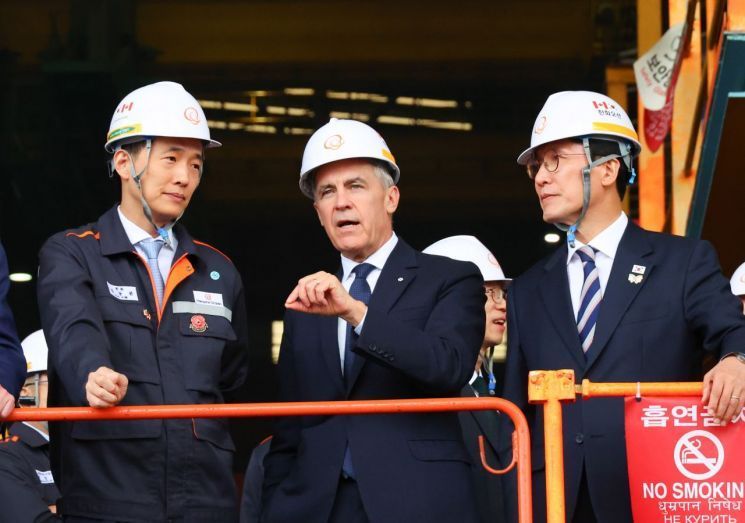 From the left, Dongkwan Kim, Vice Chairman of Hanwha Group; Mark Carney, Prime Minister of Canada; and Minseok Kim, Prime Minister, are inspecting the assembly plant at Hanwha Ocean Geoje Shipyard in Geoje, Gyeongnam, last October. Photo by Yonhap News
According to industry sources on January 21, the defense industry special delegation led by Kang Hoonshik, Chief Presidential Secretary, has requested participation in the CPSP bid from Hanwha Ocean and HD Hyundai-the main players in the project-as well as from Hyundai Motor Group and Korean Air. The delegation is preparing to visit Canada next week to support the CPSP bid.
The CPSP is a large-scale project to build up to 12 diesel submarines. Including up to 20 trillion won for submarine construction and up to 40 trillion won for maintenance, repair, and operations (MRO) over 30 years after delivery, the total project value reaches up to 60 trillion won. Currently, the Hanwha Ocean and HD Hyundai Heavy Industries "One Team" consortium is shortlisted alongside Germany's Thyssenkrupp Marine Systems (TKMS), with the final selection announcement scheduled for June.
Canada has required both South Korea and Germany, the shortlisted bidders, to establish infrastructure for submarine maintenance on the Canadian coast. In addition, Canada has reportedly requested Hyundai Motor Group to build a local plant as a condition for South Korea, and Volkswagen to expand its facilities as a condition for Germany.
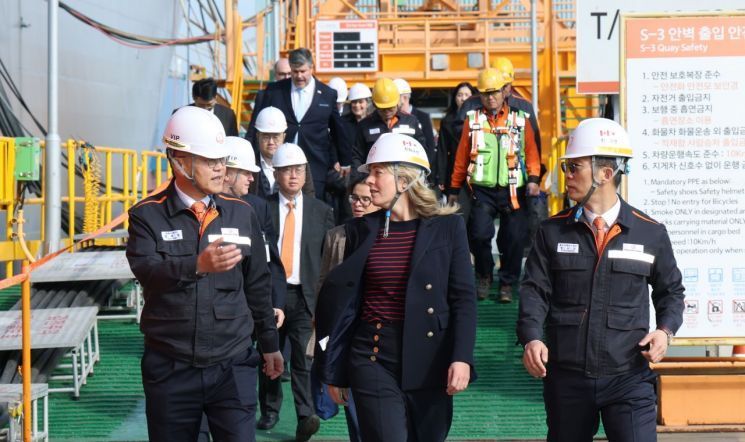 In November last year, Heechul Kim, CEO of Hanwha Ocean (front row, first from the left), explained the special ship berth at Hanwha Ocean's Geoje plant to Melanie Joly, Canadian Minister of Industry (front row, center). Hanwha Ocean
In the case of Hyundai Motor Group, the establishment of a finished vehicle plant, reportedly requested by Canada, is expected to be carefully considered. Industry observers note that since Hyundai Motor Group has already established a North American production network centered on the United States and Mexico, it would be realistically difficult to build a new finished vehicle plant in Canada. Hyundai Motor Group previously built a plant in Bromont, Canada, with an annual capacity of 100,000 units in 1989, but withdrew from the facility after just four years.
However, some analysts suggest that Hyundai Motor Group, with its diverse industrial portfolio-including robotics, hydrogen, advanced air mobility (AAM), and defense-could propose investments or cooperation in areas other than finished vehicles.
Korean Air, which is cooperating with Canada in the military aircraft sector, is also considered a key party in the offset trade proposals. The consortium of Korean Air and LIG Nex1 has secured contracts for four electronic warfare aircraft and four airborne command and control aircraft from the Defense Acquisition Program Administration, with the Bombardier Global 6500 business jet from Canada set to serve as the basic platform. The expected total purchase is eight aircraft, and there is speculation about possible additional military aircraft purchases in connection with this project.
Furthermore, Korean Air possesses technological expertise and know-how in defense sectors such as military aircraft maintenance, civil aircraft structure manufacturing, and unmanned aerial vehicle development. The Canadian government is reportedly interested in Korean Air's experience in establishing and operating airborne surveillance and command and control systems.
© The Asia Business Daily(www.asiae.co.kr). All rights reserved.
![Clutching a Stolen Dior Bag, Saying "I Hate Being Poor but Real"... The Grotesque Con of a "Human Knockoff" [Slate]](https://cwcontent.asiae.co.kr/asiaresize/183/2026021902243444107_1771435474.jpg)
















