Minister Ahn Gyu-baek Receives First Work Report of the Year from Each Military Branch and the Marine Corps
The Marine Corps will establish a joint task force (TF) with the Joint Chiefs of Staff to address the issue of transferring operational control, as part of its transition to a quasi-four-branch military system.
During a Ministry of National Defense work report held at Gyeryongdae on the morning of January 19, the Marine Corps announced, "The Marine Corps 1st Division aims to complete the transfer of operational control within this year, and the 2nd Division by 2028. To achieve this, a joint TF with the Joint Chiefs of Staff will be formed to ensure swift progress."
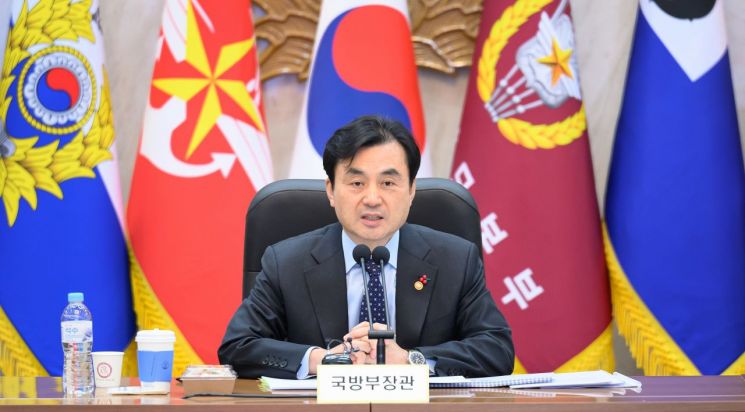
Minister of National Defense Ahn Gyu-baek previously stated at a press conference late last year, "To transition the Marine Corps to a quasi-four-branch system, operational control of the 1st Marine Division, which is currently under the operational command of the Army's 2nd Operations Command, will be returned to the Marine Corps by the end of this year. Operational control of the 2nd Marine Division, currently under the Army Capital Corps, will be returned to the Marine Corps by 2028."
Regarding this, the Marine Corps stated, "The reorganization of the Marine Corps into a quasi-four-branch system will be carried out in close coordination with the Ministry of National Defense and the Joint Chiefs of Staff, including legal amendments such as the National Armed Forces Organization Act, the transfer of operational control for the 1st and 2nd Divisions, and the establishment of the Marine Operations Command."
Additionally, the Marine Corps plans to enhance its amphibious operation capabilities this year by sequentially deploying key assets such as the K2 tank, the KAAV-II amphibious assault vehicle, and amphibious attack helicopters. Furthermore, to improve the welfare and treatment of service members, the Marine Corps will guarantee single-occupancy rooms for officers, expand overtime allowances, and upgrade outdated water supply facilities.
The Army, Navy, and Air Force also presented their main plans for the year during the work report. The Army outlined: ▲ The evolutionary development of an advanced science and technology force to lead future multi-domain operations (Army TIGER+), ▲ The advancement of an AI-based scientific surveillance system, and ▲ Improvements to frontline unit conditions and spatial capabilities. The Navy presented: ▲ The construction of naval power based on AI and advanced science and technology, and ▲ Securing and fostering talent as its main tasks.
The Air Force also reported eight key initiatives, focusing on: ▲ Building advanced AI-based capabilities, and ▲ Promoting Air Force reform in line with national defense reforms. The Air Force plans to concentrate all efforts on the stable deployment of the KF-21 Boramae, scheduled for initial delivery early this year, and the second phase of the F-35A project.
Meanwhile, during the work report held at Gyeryongdae, Minister Ahn stated, "Without the trust of the people, the military is merely a house built on sand," emphasizing, "Both peace and dialogue must be based on overwhelming strength." This work report was the first to be conducted with the newly reorganized leadership of each branch and the Marine Corps following the recent general officer appointments. In particular, the Ministry of National Defense noted the significance of this being the first work report received at Gyeryongdae by a civilian defense minister since the illegal 12·3 emergency martial law incident.
During the work report, key topics discussed included: ▲ Establishing military readiness, ▲ Progress on restructuring the 2040 military organization, ▲ Building an elite, advanced military force by training 500,000 drone warriors, and ▲ Progress on groundbreaking improvements to military treatment and welfare. Regarding military restructuring, Minister Ahn stated, "Restructuring the military is not a choice, but a necessity," and urged, "With utmost determination, pursue this restructuring so that, in 15 years, we can hand over a prepared military to our successors. Each branch and the Marine Corps must work as one team and demonstrate collective intelligence."
Minister Ahn also reviewed the progress on the initiative to train 500,000 drone warriors. The work report discussed thorough project management for the mass procurement of training drones, the training of specialized drone instructors, and the establishment of systematic training models tailored to the mission characteristics of each branch.
Minister Ahn especially emphasized the improvement of treatment for junior officers, instructing the chiefs of each branch and the Marine Corps Commandant to "sincerely prepare policies that service members can truly feel, and actively promote them so that all units are fully aware." He stressed, "Improving treatment is a matter of utmost importance, to the extent that those who leave the military should regret it deeply. It must be pursued with absolute commitment."
© The Asia Business Daily(www.asiae.co.kr). All rights reserved.
![Clutching a Stolen Dior Bag, Saying "I Hate Being Poor but Real"... The Grotesque Con of a "Human Knockoff" [Slate]](https://cwcontent.asiae.co.kr/asiaresize/183/2026021902243444107_1771435474.jpg)















