Responding to the Serious Accidents Punishment Act, Commercial Act, and Yellow Envelope Act
Companies Expanding Risk Management Spending
Legislation Proposed Affecting Ongoing Trials
Concerns Over Legislative Power Infringing on Judicial Authority
Following the Serious Accidents Punishment Act, a series of legislative changes-including amendments to the Commercial Act and the Yellow Envelope Act (the amendment to the Labor Union and Labor Relations Adjustment Act)-have shifted the primary risk factors for corporate activities from judicial risk to legislative risk. Companies are increasing their advisory spending to respond from the earliest stages of legislative amendments. There are growing concerns that legislative developments, which can even affect ongoing trials, are infringing upon judicial authority and increasing management uncertainty. Some critics argue that "legislative risk is greater than judicial risk."
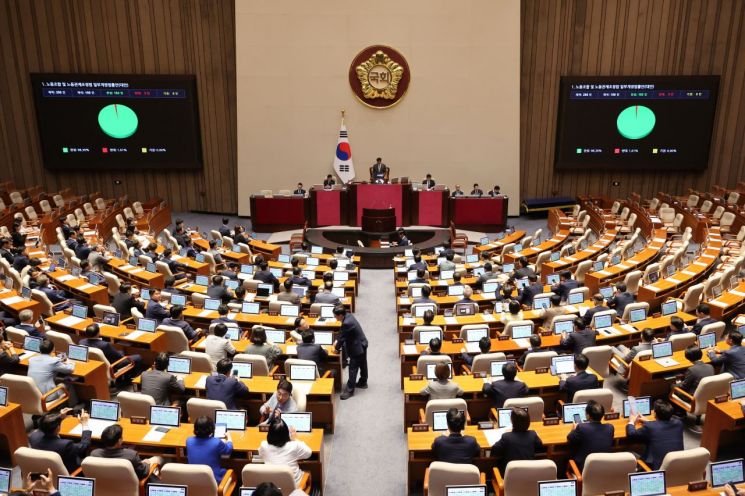 On August 24 last year, the National Assembly plenary session passed the "Partial Amendment to the Labor Union and Labor Relations Adjustment Act (Yellow Envelope Act)." Photo by Yonhap News Agency
On January 14, the law firm Bae, Kim & Lee held a seminar titled "Strategies for Responding to Strengthened Shareholder Activism Following the Commercial Act Amendment" on the third floor of its headquarters in Jongno-gu, Seoul. Registration for the 150-person seminar closed just 30 minutes after it opened, demonstrating the high level of interest among companies seeking to strengthen the response capabilities of their boards and management. Nearly 20 participants who could not secure seats attended the seminar standing.
The situation is similar regarding the Yellow Envelope Act. At a webinar on January 7 hosted by the law firm Lee & Ko, which covered interpretation guidelines for the Yellow Envelope Act, more than 700 corporate legal, HR, and labor affairs professionals participated. The high turnout reflected strong demand to address key issues such as user status, the unification of bargaining channels, and outlooks on interpretation guidelines and enforcement decrees.
With the Serious Accidents Punishment Act in effect since 2022, there have been cases where violating business owners have been sentenced to prison, keeping corporate officials on high alert.
An attorney from a major law firm stated, "As legislative risk originating from the political sphere increases, companies are allocating more resources to respond and seek advice at the legislative stage rather than relying solely on judicial defense," adding, "It is now a reality that legislative risk must be managed first." Multiple law firm industry insiders agreed, saying, "The consecutive amendments to laws directly impacting business activities, such as the Commercial Act and Yellow Envelope Act in 2025, have positively affected corporate advisory performance, especially among major law firms."
Changing the Law During Ongoing Trials?
Recently, concerns have been raised that legislative power may infringe upon judicial authority, as amendments to laws that could apply to ongoing cases have been proposed. The "Passenger Transport Service Act Amendment," sponsored by Assemblyman Park Yonggap of the Democratic Party and others, passed the National Assembly's Legislation and Judiciary Committee on December 18, 2025. The amendment prohibits taxi platform franchise operators from charging commissions on street-hailing fares or on fares from other ride-hailing apps.
The issue is that the content of the amendment is at the center of an ongoing court case. Previously, the Korea Fair Trade Commission fined KM Solution, the franchise headquarters of Kakao T Blue, for abusing its business position by charging commissions on street-hailing fares. KM Solution objected to the Fair Trade Commission's decision, arguing that even in the case of street-hailing, the platform provides various functions such as dispatch control and demand mapping, and filed an administrative lawsuit. This case is scheduled for a hearing at the Seoul High Court on January 22.
There is always a possibility that administrative decisions will be overturned in court. In May last year, the Seoul High Court ruled that the penalty imposed by the Fair Trade Commission on Kakao Mobility over alleged "call allocation" was to be completely revoked. This is an example of a court reaching a conclusion opposite to that of the authorities. Legal experts warn that since the interpretation and application of laws are within the court's domain, preemptive regulation by the National Assembly may blur the boundaries of judicial decision-making.
An attorney who previously served as a presiding judge commented, "If legislation is about creating 'preemptive norms,' then the judiciary's role is a 'post-hoc review' to determine whether those norms are legitimate. Forcing a conclusion through legislation before the judiciary's review process is complete is dangerous." A representative of a major corporation said, "When the National Assembly creates new legal standards before the court has ruled, it appears to be an abuse of legislative power. For companies awaiting judgment, this effectively nullifies their right to defense." A National Assembly official also noted, "If the legislature amends the law before the judiciary has ruled, the newly revised law will inevitably apply to ongoing trials. Regardless of the outcome of administrative litigation, if the law is amended first, judicial decisions may become largely meaningless."
Woo Bin, Kim Jihyun, The Law Times
※This article is based on content supplied by Law Times.
© The Asia Business Daily(www.asiae.co.kr). All rights reserved.
![Clutching a Stolen Dior Bag, Saying "I Hate Being Poor but Real"... The Grotesque Con of a "Human Knockoff" [Slate]](https://cwcontent.asiae.co.kr/asiaresize/183/2026021902243444107_1771435474.jpg)















