Calls for Institutionalization of Special Accounting for Towns and Townships in Urban-Rural Complex Cities
and Legal Designation as Depopulation Areas
Members of the Jeonnam Provincial Assembly have insisted that institutional safeguards are absolutely necessary to prevent the marginalization of towns and townships in urban-rural complex cities amid the administrative integration of Gwangju and Jeonnam.
On January 19, Assembly members Jeong Younggyun (Suncheon 1), Choi Dongik (Yeosu Proportional), and Lim Hyungseok (Gwangyang 1) held a joint press conference at the Eastern Government Complex of Jeonnam Province. They stated, "The success of the integration hinges on whether towns and townships in urban-rural complex cities can share in its benefits," and emphasized, "The special administrative integration law must include clear safeguards to address rural finances and population decline."
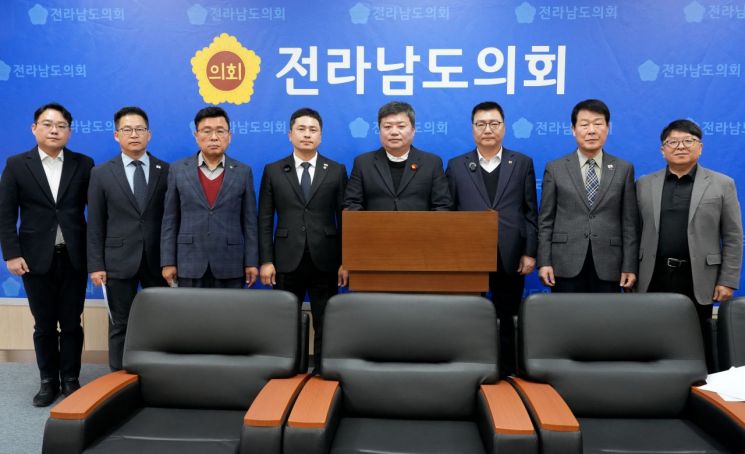 Jeong Younggyun, Choi Dongik, and Lim Hyungsuk, former members of the Jeonnam Provincial Assembly, held a joint press conference regarding the administrative integration of Gwangju and Jeonnam. Provided by Jeonnam Provincial Assembly
The assembly members said, "The administrative integration of Jeonnam and Gwangju is an important opportunity to enhance regional competitiveness and overcome the structural crises of population decline and industrial stagnation." However, they stressed, "If integration only brings opportunities to certain areas while resulting in losses for rural regions, it cannot be considered a success."
They continued, "Nearly 30 years have passed since the introduction of the urban-rural complex city system in 1995, yet towns and townships remain marginalized rather than beneficiaries of integration." They pointed out, "As administration, finances, public services, and industrial policies have been designed and implemented with a focus on urban areas, population decline and regional hollowing-out have accelerated."
They warned, "If the administrative integration of Jeonnam and Gwangju proceeds without addressing this structural imbalance, the concentration of administrative, financial, and industrial functions in major cities is likely to intensify even further." They added, "Even after the launch of the special city, unless there are separate institutional mechanisms, towns and townships within urban-rural complex cities may face the risk of extinction without experiencing any tangible benefits from integration."
The assembly members, while supporting administrative integration, proposed institutional alternatives to ensure meaningful outcomes from the integration. Their suggestions included: ▲ special accounting provisions for towns and townships in urban-rural complex cities; ▲ a requirement that more than 50% of the city-county autonomous account under the Regional Development Special Account be allocated to projects in these towns and townships; and ▲ establishing a legal basis to designate these areas as depopulation zones.
They stated, "These are not privileges, but rather the minimum standards needed to address long-standing structural disparities." They added, "Only when these measures lead to the expansion of living SOC, the strengthening of public medical and educational infrastructure, and the creation of jobs tailored to local characteristics, will rural areas also be able to share in the benefits of integration."
Furthermore, they emphasized, "The administrative integration of Jeonnam and Gwangju is not a matter of pros and cons, but of how it is designed." They said, "True integration means building a structure where both cities and rural areas can withstand challenges and grow together, rather than integration that simply enlarges cities while shrinking rural communities."
They concluded, "Throughout the discussions on administrative integration, we will fulfill our responsibility to ensure that the realities and voices of residents in towns and townships of urban-rural complex cities are fully reflected." They also called on the government, Jeonnam Province, and Gwangju City to actively engage in the practical and detailed institutional design needed to make this integration a model case for balanced regional development."
© The Asia Business Daily(www.asiae.co.kr). All rights reserved.
![Clutching a Stolen Dior Bag, Saying "I Hate Being Poor but Real"... The Grotesque Con of a "Human Knockoff" [Slate]](https://cwcontent.asiae.co.kr/asiaresize/183/2026021902243444107_1771435474.jpg)















