Euro and Pound Recover After Initial Drop
Yen Strengthens on Safe-Haven Demand
U.S. Stock Index Futures Fall Across the Board
U.S. President Donald Trump's tariff threats against eight European countries have emerged as a new variable in the global financial markets. Concerns are growing over a potential rekindling of a trade war between the United States and the European Union (EU), causing U.S. stock index futures to fall across the board. Analysts warn that, in the mid- to long-term, this could also put selling pressure on U.S. assets such as the dollar.
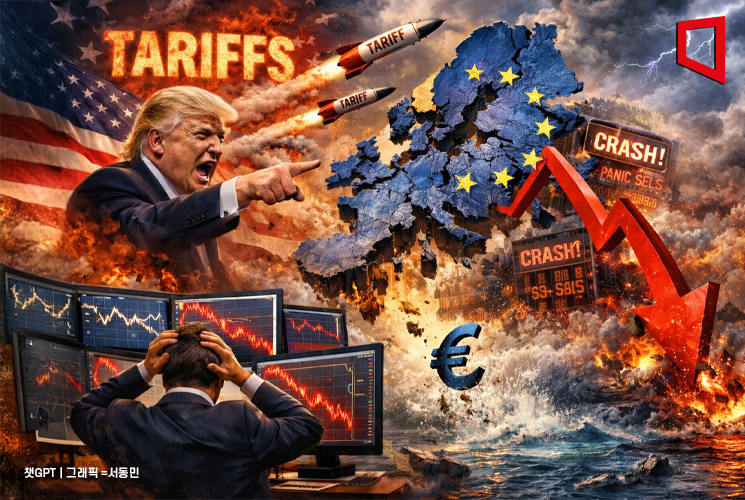
Euro and Pound Rebound Amid Trump’s Tariff Threats, Dollar Value Drops
According to Reuters on the 18th (local time), in early trading on the 19th as the Asia-Pacific markets opened, the euro was down 0.2% at $1.1572 against the dollar, marking its lowest level since November last year. The euro then rebounded by 0.19% to trade at $1.16189. The British pound also fell to its lowest level in a month but recovered by 0.17% to $1.3398, Reuters reported. The dollar index dropped by 0.19% to 99.18. The yen strengthened against the dollar, supported by safe-haven demand.
This is a result of President Trump's tariff pressure weighing on the dollar. Reuters noted that while the dollar is still considered a safe-haven asset, as seen last April, if Washington becomes the center of geopolitical conflict, the dollar could also be affected. Phil Hunt’s Column Chief Economist Pickering said, "Given President Trump's recent attacks on the Federal Reserve, concerns are growing that if tensions with Europe escalate, the credibility of U.S. policy could be seriously undermined, putting additional pressure on the dollar." He added, "Especially if capital repatriation to Europe and moves to avoid U.S. assets intensify, this could pose downside risks to the highly valued U.S. tech stocks."
Some See Limited Market Impact, but Geopolitical Risks Boost European Defense Stocks
Some analysts suggest that President Trump's tariff dispute has entered a new phase. Holger Schmieding, Chief Economist at Berenberg in Germany, said, "Expectations that the tariff issue would calm down this year have now been shattered," adding, "We are back in a situation similar to last spring." Last April, President Trump shocked financial markets by announcing reciprocal tariffs against countries worldwide. The situation seemed to be contained as the U.S. reached agreements with the EU, Japan, South Korea, and others. However, with the renewed declaration of tariffs against Europe, fears of a rekindled trade war are growing, causing a sharp decline in the futures market.
As of 8:25 p.m. Eastern Time, Dow Jones 30 futures were down 0.64% at 49,232.00. The S&P 500 futures index plunged 0.74% to 6,925.25, and Nasdaq 100 futures dropped 0.95% to 25,444.75.
Last week, the Nasdaq 100 futures index fell 0.68% when the U.S. Department of Justice issued a subpoena to Federal Reserve Chair Jerome Powell. A nearly 1% drop is interpreted as investors viewing the Greenland situation as particularly serious.
Some observers note that the immediate market impact of the Greenland-driven geopolitical risk may be limited, given that investor sentiment remained more resilient than expected and global economic growth was sustained last year. Indeed, Bitcoin, a risk asset that trades even on weekends, remained relatively stable, trading around $95,330.
European stock markets are still hovering near all-time highs. The German DAX index and the UK FTSE index have risen more than 3% this month, outpacing the 1.3% gain of the U.S. S&P 500 index over the same period. However, in the short term, there are signs that investors are closely watching rising geopolitical tensions. According to CNBC, the pan-European Stoxx 600 index closed down 0.1% on the 16th, with major markets and sectors showing mixed performance.
Amid heightened geopolitical tensions, European defense stocks have emerged as beneficiaries. The Stoxx Europe Aerospace and Defense Index, a pan-European defense stock indicator, has surged about 15% this month. This exceeds a quarter of last year’s record annual gain. By company, Sweden’s Saab soared 32%, Germany’s Rheinmetall rose 22%, and the UK’s BAE Systems gained 22%. The Financial Times (FT) reported, "With the U.S. mentioning the possibility of controlling Greenland and tensions reigniting around Venezuela, European defense stocks are off to a very strong start this year," adding, "The defense rally, one of last year’s hottest sectors, has reignited."
In addition to the Greenland dispute, concerns over the Iran situation and threats to central bank independence stemming from the indictment of Federal Reserve Chair Powell have combined to keep gold, a safe-haven asset, trading near record highs. On the New York Mercantile Exchange, February gold futures were trading around $4,671 per ounce as of 9:21 a.m. Korean time on the 19th.
© The Asia Business Daily(www.asiae.co.kr). All rights reserved.
![Clutching a Stolen Dior Bag, Saying "I Hate Being Poor but Real"... The Grotesque Con of a "Human Knockoff" [Slate]](https://cwcontent.asiae.co.kr/asiaresize/183/2026021902243444107_1771435474.jpg)


















