"As rapidly as technology transforms society, we need philosophy to reflect on its meaning and direction. In this context, the KAIST Artificial Intelligence (AI) Philosophy Research Center will serve as a key hub for designing human-centered technological development and a responsible future society." This is how Kwanghyung Lee, President of KAIST, defined the significance of establishing the AI Philosophy Research Center.
On January 21, KAIST announced that it will hold an international symposium at its Daejeon main campus to commemorate the opening of the AI Philosophy Research Center. The center was established to diagnose the challenges facing humanity through the convergence of philosophy and AI science and technology, and to propose feasible future visions and response strategies.
The international symposium is designed to fundamentally reconsider human values such as autonomy, freedom, and dignity, as well as social values like justice, equality, and labor in the post-AI era. It will also serve as a venue to discuss research on the convergence of philosophy and science and technology, as well as industry-academia collaboration strategies that can contribute to the prosperity of humanity.
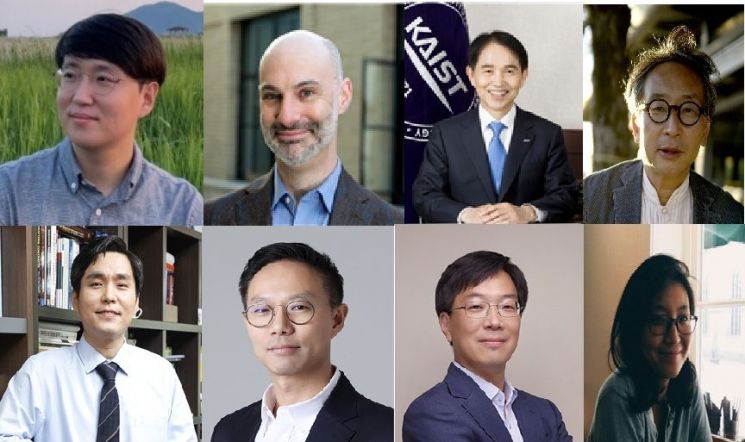 Key speakers participating in the symposium. (Top row from left) Dongwoo Kim, Professor at KAIST; Agustin Rayo, Professor at MIT; Kwanghyung Lee, President of KAIST; Yasuo Deguchi, Director of Kyoto Institute of Philosophy. (Bottom row from left) Sungpil Park, Professor at KAIST; Nicholas Jang Lee, Professor at Yonsei University; Jeong Kim, Professor at KAIST; Hyeyoung Kim, Researcher at Paris Higher Normal School. Provided by KAIST
The event will begin with an opening address by Dongwoo Kim, Director of the KAIST AI Philosophy Research Center, followed by a congratulatory speech from Kwanghyung Lee, President of KAIST, a video message from Agustin Rayo, Dean of the School of Humanities, Arts, and Social Sciences at MIT, and an online keynote speech by Yasuo Deguchi, Director of the Kyoto Institute of Philosophy. The program will continue with presentations by leading scholars from Korea and abroad, a comprehensive panel discussion, and a Q&A session for in-depth dialogue.
Yasuo Deguchi, Director of the Kyoto Institute of Philosophy and keynote speaker, will propose a shift from "I" to "we" based on human sociality under the theme "Toward a Multi-Layered Value Society." He also plans to redefine the relationships among humans, non-humans, and artificial entities, and to present models for coexistence and technological design based on the concept of empty-centeredness.
Kwanghyung Lee, President of KAIST, will propose "Humanism 2.0" as a new ideology to redefine the boundaries between humans and machines in response to advances in AI, robotics, brain-computer interfaces, and genetic engineering.
Sungpil Park, Dean of the Moon Soul Graduate School of Future Strategy at KAIST, will emphasize the need for talent with philosophical reflection skills, beyond a simple understanding of technology, for the human-centered design and application of AI. He will also introduce the research and educational strategies of the KAIST AI College.
Jeong Kim, Professor in the Department of Mechanical Engineering at KAIST, will point out that the convergence of AI and robotics is transforming traditional paradigms in mechanical engineering and system design. He will suggest the need to establish human-centered design principles that reflect human requirements such as safety, reliability, and interactivity, beyond performance- and efficiency-oriented design.
Hyeyoung Kim, Researcher at the Husserl Archive at Paris Higher Normal School, will participate online to argue for the need to move beyond individualism and to newly conceptualize the coexistence of humans and machines through social relationships, seeking a philosophical transformation.
Dongwoo Kim, Director of the KAIST AI Philosophy Research Center, stated, "A deep understanding of humanity is essential for the proper development and utilization of machines that act and think like humans. The AI Philosophy Research Center will serve as a platform for presenting feasible future visions for society through collaboration among industry, academia, and research."
Meanwhile, attendance at this event is available on a pre-registration basis. The registration deadline is noon on January 20. Simultaneous interpretation services will be provided, and the symposium proceedings can also be viewed via the KAIST YouTube channel.
© The Asia Business Daily(www.asiae.co.kr). All rights reserved.
![Clutching a Stolen Dior Bag, Saying "I Hate Being Poor but Real"... The Grotesque Con of a "Human Knockoff" [Slate]](https://cwcontent.asiae.co.kr/asiaresize/183/2026021902243444107_1771435474.jpg)















