As the Bank of Korea removed references to a rate cut, effectively signaling the end of the rate-cutting cycle, market interest rates and loan rates have entered an upward phase. Concerns are mounting that the interest burden on so-called "Yeongkkeul" (all-in mortgage borrowers) will continue to increase.
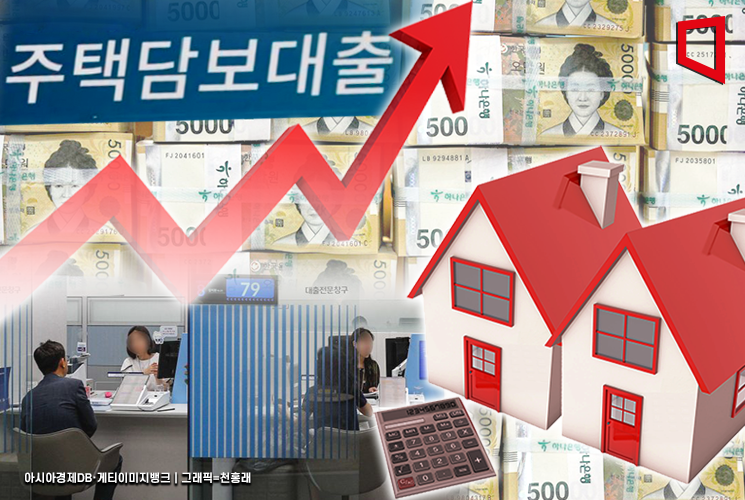
According to the financial sector on January 18, the fixed-rate (five-year bank bond basis) for mortgage loans at KB Kookmin, Shinhan, Hana, and Woori Banks stood at 4.130% to 6.297% per annum as of January 16. Compared to December 5 of last year (4.120% to 6.200% per annum), the lower end rose by 0.010 percentage points and the upper end by 0.097 percentage points.
For the upper end of the fixed-rate range, it surpassed 6% for the first time in about two years in mid-November last year, and within just over two months, it has now reached the mid-6% range.
In contrast, variable mortgage rates (based on new COFIX, 3.760% to 5.640% per annum) have slightly declined over the same period. While the main benchmark rate, COFIX, rose by as much as 0.320 percentage points, this is interpreted as banks having reduced their discretionary spreads or increased preferential rates.
The lower end, 3.760%, is Shinhan Bank’s minimum rate, which offers a 0.5 percentage point discount to exemplary taxpayers in Seoul as the bank operates Seoul City’s treasury. In reality, most financial consumers are unlikely to secure a mortgage rate in the 3% range at the four major commercial banks. The minimum rates at the other three banks are between 4.070% and 4.340%.
Banks believe that the upward trend in lending rates will be difficult to reverse in the near future. Notably, KB Kookmin Bank will raise its fixed and hybrid mortgage rates by an additional 0.15 percentage points, reflecting the recent increase in the benchmark five-year bank bond rate, starting January 19. Other banks such as Woori Bank, which update market rates weekly, also plan to reflect the latest market rate increases in their mortgage rates this week.
Previously, when the Bank of Korea’s Monetary Policy Board froze the base rate on January 15 and removed the mention of a "possible rate cut" from its statement, expectations grew in the market that the rate-cutting cycle had ended and that a full-fledged interest rate hike phase had begun.
© The Asia Business Daily(www.asiae.co.kr). All rights reserved.
![Clutching a Stolen Dior Bag, Saying "I Hate Being Poor but Real"... The Grotesque Con of a "Human Knockoff" [Slate]](https://cwcontent.asiae.co.kr/asiaresize/183/2026021902243444107_1771435474.jpg)















