Only Official Titles Such as "President of the People’s Republic of China" Mentioned
Brief Coverage Groups China with Vietnam and Other Countries
According to Yonhap News Agency, citing the Korean Central News Agency on January 18, North Korean leader Kim Jongun sent New Year’s greeting cards to Chinese President Xi Jinping and other heads of state and key figures from various countries.
The report listed the recipients of the greeting cards by their official titles only, without mentioning names, such as “the President of the People’s Republic of China and General Secretary of the Central Committee of the Communist Party of China and his wife,” and “the General Secretary of the Central Committee of the Communist Party of Vietnam.” The report briefly stated that Chairman Kim sent New Year’s cards to the heads of state of China, Vietnam, Singapore, Tajikistan, Turkmenistan, Azerbaijan, Indonesia, Belarus, and Algeria. As was the case when it was reported on the 1st of this month that President Xi and his wife sent a New Year’s card to Chairman Kim, the content of the cards was not disclosed this time either.
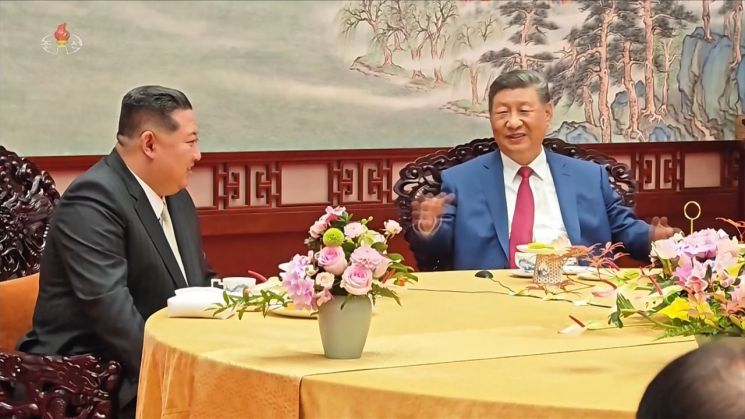 Last September, following the North Korea-China summit between Chairman Kim Jong Un and Chinese President Xi Jinping, the two leaders attended a banquet hosted by President Xi. Photo by Korean Central TV, Yonhap News Agency
This stands in contrast to the detailed coverage of the congratulatory letters exchanged between Chairman Kim and Russian President Vladimir Putin.
On December 27, North Korea reported that Chairman Kim sent a New Year’s card to President Putin, and the full text of the message was published on the front page of the Rodong Sinmun, the official newspaper of the Workers’ Party. Earlier, on December 18, President Putin sent a congratulatory message to Chairman Kim. Chairman Kim also sent New Year’s cards to the chairman of United Russia, Russia’s largest political party, the chairman of the Russian Peace and Unity Party, and the head of the Russian 21st Century Orchestra.
The content of reports by North Korean media serves as an indirect indicator of the leader’s intentions. Although last year’s North Korea-China summit in Beijing was seen as a turning point in restoring bilateral relations, the manner in which the exchange of New Year’s cards is reported shows that nothing has changed compared to a year ago.
Im Eulchul, a professor at the Institute for Far Eastern Studies at Kyungnam University, told Yonhap News Agency that this is “a signal that Kim Jongun’s dissatisfaction with China is considerable.” Professor Im added, “North Korea’s current attitude is a strong indicator that China’s influence over North Korea is more limited and less effective than in the past,” and predicted, “Whether or not a high-level Chinese delegation is dispatched to the 9th Party Congress, expected early this year, could be a turning point in resolving political tensions.”
© The Asia Business Daily(www.asiae.co.kr). All rights reserved.
![Clutching a Stolen Dior Bag, Saying "I Hate Being Poor but Real"... The Grotesque Con of a "Human Knockoff" [Slate]](https://cwcontent.asiae.co.kr/asiaresize/183/2026021902243444107_1771435474.jpg)
















