Support for Educational Integration and Special Superintendent,
But Superintendents Differ on Election Timing
Numerous Issues Remain, Including Educational Autonomy and Personnel Stability
Included in the Special Law, But Subject to Change
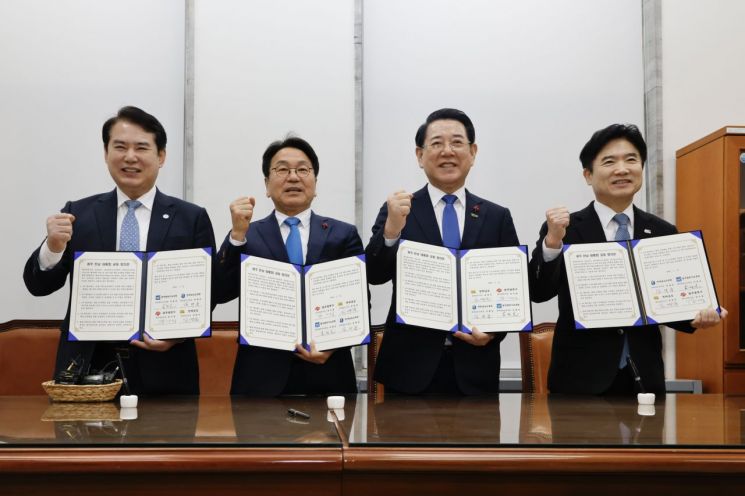 Gwangju Mayor Kang Gijeong attended the meeting between provincial governors and superintendents related to the administrative integration of Gwangju and Jeonnam held at the National Assembly main building on the 14th and took a commemorative photo after announcing the "Gwangju-Jeonnam Grand Integration Joint Agreement." From the left in the photo are Lee Jeongseon, Gwangju Superintendent of Education; Kang Gijeong, Gwangju Mayor; Kim Youngrok, Governor of Jeollanam-do; and Kim Daejung, Jeonnam Superintendent of Education. Provided by Gwangju City
There is growing attention on whether a "Unified Superintendent of Education" for Gwangju and Jeonnam will be elected in the upcoming local elections in June. As the administrative integration of Gwangju and Jeonnam accelerates, the push for educational integration has gained momentum. However, numerous challenges such as personnel stability and the guarantee of educational autonomy remain, and the two superintendents have shown subtle differences in their views.
On January 16, according to the Gwangju Metropolitan Office of Education and the Jeonnam Office of Education, both Lee Jeongseon, Superintendent of Gwangju Metropolitan Office of Education, and Kim Daejung, Superintendent of Jeonnam Office of Education, have expressed their agreement with the purpose of the integration and their intention to actively promote educational integration.
Accordingly, the two offices of education have established integration task forces and have begun gathering opinions from the education sector and preparing for the integration. Regarding the election of a unified superintendent, which is one of the major issues in the integration process, there is currently no significant disagreement between the two offices.
The draft of the special law for the establishment of the Gwangju-Jeonnam Special City, which was made public the previous day, stipulates that an election for the superintendent of the special city will be held in the local elections in June.
However, the two superintendents have shown differing reactions regarding the timing of the election, depending on their positions and the circumstances within their respective local education sectors, leaving variables in the actual election of a unified superintendent.
Kim Daejung, Superintendent of Jeonnam Office of Education, supports electing the unified superintendent together with the unified head of the new administrative entity in the June elections. In a New Year's press conference on January 6, Superintendent Kim stated, "It is desirable to elect the unified superintendent at the same time as the head of the new administrative entity," expressing an active stance.
On the other hand, Lee Jeongseon, Superintendent of Gwangju Metropolitan Office of Education, has expressed support for the election of a unified superintendent, but has taken a cautious approach regarding the timing. Superintendent Lee believes that finding solutions to address job security and employment concerns for teachers is more important for educational integration than the timing of the unified superintendent's election.
An official from the Gwangju Office of Education stated, "There is no disagreement about educational integration or the election of a unified superintendent, but we are prioritizing concerns about personnel stability and the guarantee of educational autonomy among Gwangju's educational community."
In fact, within the Gwangju education sector, there are concerns that the rapid pace of educational integration may undermine educational autonomy and personnel stability. While the draft special law barely addresses personnel stability, it still contains many educational agenda items.
The Gwangju branch of the Korean Teachers and Education Workers' Union issued a press release on this day, stating, "The special law must include a bill guaranteeing educational autonomy that reflects a 'Gwangju-Jeonnam-style educational vision,' not just the standards of other regions. The educational autonomy of our region, which shares a noble history of democracy from the Yeosu-Suncheon Rebellion to the May Uprising, must be centered on 'democratic citizenship education.'"
The union added, "Special provisions hidden throughout the bill, such as the establishment of gifted schools, international high schools, and the relaxation of admission requirements for foreign schools, do not strengthen public education. Instead, they open the door to 'privileged education,' which could deepen educational inequality. The solution lies in drastically reducing the number of students per class by securing a stable number of teachers and enhancing the public nature of private schools to create a transparent educational environment."
They also emphasized, "A democratic decision-making structure to check the powers of the superintendent must be guaranteed," and urged, "Substantial deliberative bodies and veto rights should be ensured, allowing teachers' organizations and civil society to participate in major policy decision-making processes."
The political circles leading the enactment of the special law for administrative integration seem to interpret the formation of a four-party consultative body and the announcement of a joint agreement as support for the election of a unified superintendent in June, but they clarify that nothing has been finalized.
A member of the integration task force stated, "We are considering including the election of the unified superintendent together with the unified head of the new administrative entity in the supplementary provisions of the special law. As this is still a draft, we will incorporate feedback from the education sector into the special law as it is collected."
© The Asia Business Daily(www.asiae.co.kr). All rights reserved.
![Clutching a Stolen Dior Bag, Saying "I Hate Being Poor but Real"... The Grotesque Con of a "Human Knockoff" [Slate]](https://cwcontent.asiae.co.kr/asiaresize/183/2026021902243444107_1771435474.jpg)















