Remote Locations Far from Downtown, No Consideration for Accessibility
Closed After 6 p.m., No Refuge from the Cold at Night
Neglected Due to Lack of Management Budget... Facilities Covered in Dust
Unmanned 24-Hour Facilities Are Essential for Real Rest
Despite the ongoing extreme cold wave, there are criticisms that shelters for mobile workers in Gwangju are effectively "useless" due to poor accessibility and limited operating hours. Gwangju City has designated 34 shelters, mainly in public institutions, but there are complaints that these are nothing more than "token administrative measures" since most are either closed or difficult to find during the nighttime hours when work is most concentrated.
Delivery worker Mr. A (40), whom we met in a busy district of Dong-gu, Gwangju, had a face flushed red from the cold. He kept exhaling visible breaths through his helmet and could not take his eyes off his smartphone screen.
"Even when it's cold, there's nowhere to go. I can't even think about going into a coffee shop or somewhere indoors. I never know when I'll get a job, so I might have to leave as soon as I enter. I can't order a coffee that costs thousands of won every time. I live day to day, so if I keep spending money just because it's cold, there's nothing left for me."
For mobile workers like Mr. A, the harsh winter cold is a threat to survival. "Mobile workers"-a term that includes delivery and courier drivers, substitute drivers, quick service workers, as well as home-study teachers and appliance repair technicians who frequently work outdoors due to the nature of their work-are left in a blind spot when it comes to their basic right to rest.
A Shelter in a Broadcast Station's Third-Floor Corner? ... Accessibility 'Zero'
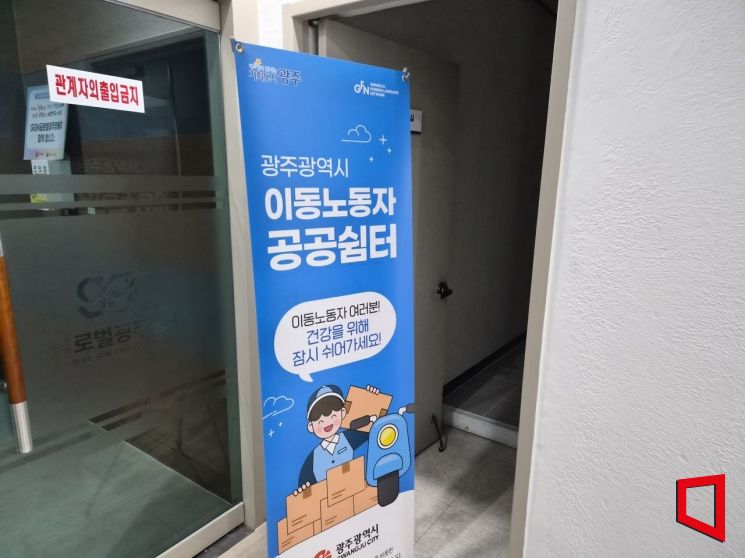 Public Rest Area for Mobile Workers in Yangnim-dong, Nam-gu, Gwangju Metropolitan City, located inside GGN Global Gwangju Broadcasting. Photo by Min Hyunki
There are a total of 34 mobile worker shelters designated and operated by Gwangju City. However, a closer look reveals that these are little more than window dressing. The shelter inside GGN Global Gwangju Broadcasting in Yangnim-dong, Nam-gu, which we visited on the morning of the 16th, is a prime example.
This shelter is located on the third floor of a broadcasting building, somewhat removed from downtown or residential areas. There was even a clear sign in the hallway stating, "No Entry for Outsiders." It seemed highly unlikely that mobile workers, who are pressed for every minute and second, would park their motorcycles and walk deep into the building just to rest.
Upon inspection, the shelter was dark and silent, with thick dust covering the tables and chairs, showing clear signs that it had not been used for a long time. Mr. A also laughed wryly, saying, "I didn't even know there was a shelter there, and even if I did, how could I get inside the broadcasting building?"
Overnight Work, but Shelters Close at 6 p.m.
The situation is not much different for shelters inside subway stations. Although shelters have been set up in major stations on Gwangju Metro Line 1, such as Nongseong, Ssangchon, and Sangmu, their underground locations make them very difficult to access for workers on motorcycles. Furthermore, these spaces are shared with "heat shelters" for the general public, so they cannot be considered independent rest areas exclusively for mobile workers.
The most serious issue is the "operating hours." Since most shelters operated by Gwangju City are inside public institutions, they close tightly after 6 p.m. when public employees leave work. For substitute drivers or night delivery workers who have to endure the cold during the night, these shelters are essentially "out of reach."
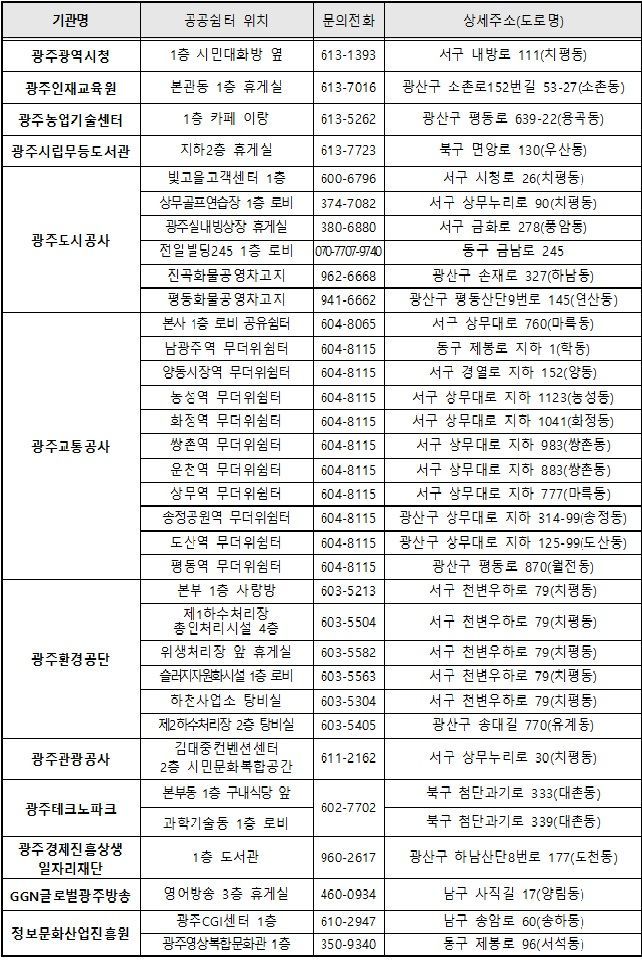
The root cause of this poorly managed system is a "lack of budget." Gwangju City only secured space from public institutions in the area, but did not allocate any budget for shelter management. Without budget support, the institutions providing the space have neglected shelter management, leading to a vicious cycle of poor publicity and facility neglect.
In contrast, the "Shwiso" shelter operated by the Gwangju Labor Rights Center presents a starkly different picture. Opened in July last year, this shelter operates unmanned, 24 hours a day, 365 days a year. A manager inspects the facility daily to maintain a pleasant environment.
It is not just a matter of providing a space. Essential items for workers-such as safety vests for night workers, hot packs to withstand the cold, and bottled water to quench thirst-are provided, and the results are clear in the numbers. In just six months since opening, more than 5,200 mobile workers have used the shelter. This is the result of accurately identifying what workers truly need.
An official from Gwangju City said, "We inspect the mobile worker shelters once a year, but we acknowledge that they are not being properly operated," adding, "We will review institutional improvements to ensure that mobile workers' right to rest is guaranteed."
© The Asia Business Daily(www.asiae.co.kr). All rights reserved.
![Clutching a Stolen Dior Bag, Saying "I Hate Being Poor but Real"... The Grotesque Con of a "Human Knockoff" [Slate]](https://cwcontent.asiae.co.kr/asiaresize/183/2026021902243444107_1771435474.jpg)
















