Tax Benefits Extended to Dividends from Companies with Zero or Negative Net Income
IMA Income from Major Securities Firms Classified as "Dividend Income"
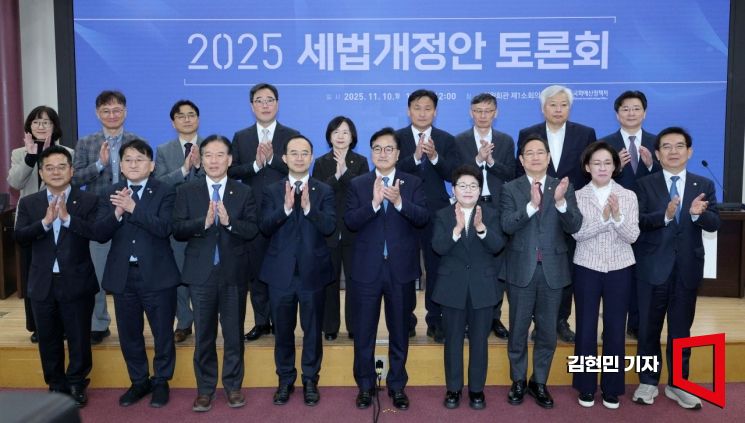 Attendees including Woo Wonshik, Speaker of the National Assembly, pose for a commemorative photo at the 2025 Tax Law Amendment Bill discussion held at the National Assembly on November 10, 2025. Photo by Kim Hyunmin
The government has decided to allow shareholders of companies that distributed dividends even without making a profit to also benefit from the separate taxation of dividend income. However, products such as funds and REITs (Real Estate Investment Trusts) are excluded from this tax benefit, so the separate taxation of dividend income will only apply to investors in individual listed companies with high dividend yields.
The Ministry of Economy and Finance announced on January 16 the "2025 Tax Reform Follow-up Enforcement Decree Amendment," which includes these measures. The separate taxation of dividend income is a system that taxes dividends received from high-dividend companies-those with a dividend payout ratio of 40% or higher, or a payout ratio of at least 25% and a dividend amount that has increased by more than 10%-at a separate tax rate, rather than including them in comprehensive income.
Given that the low dividend payout ratio of domestic companies has been cited as a major cause of the "Korea Discount" (the undervaluation of the Korean stock market), this measure is strongly intended as a tax incentive to encourage dividend increases. According to the tax reform plan announced by the Ministry of Economy and Finance at the end of July last year, the separate taxation rates for dividend income are 14% for amounts up to 20 million won, 20% for amounts up to 300 million won, and 35% for amounts exceeding 300 million won.
This amendment to the enforcement decree clarifies the scope of dividend income and the requirements for high-dividend companies. The government has decided that only cash dividends will be eligible for separate taxation, including interim, quarterly, special, and final dividends. Securitization companies such as funds and REITs are excluded from the scope of separate taxation. Exchange-traded funds (ETFs) and both public and private equity funds (PEFs) are also not eligible for this benefit.
For loss-making companies with net income of zero or less that pay dividends, the government has opened the door to limited inclusion. However, for such companies to be eligible for separate taxation, two conditions must be met: ▲ the dividend must have increased by more than 10% compared to the previous year, and ▲ the debt-to-equity ratio must be 200% or less. This is to ensure that only companies with a certain level of financial soundness are granted exceptions. The standard for calculating the dividend payout ratio for high-dividend companies receiving tax benefits has been unified to consolidated financial statements. This measure is intended to prevent companies from calculating the payout ratio based on individual financial statements that exclude affiliate profits in order to receive tax benefits.
The amendment also includes a provision to classify the income from Integrated Management Accounts (IMA) as "dividend income." IMAs are accounts managed by large securities firms designated as comprehensive financial investment service providers (with assets of 8 trillion won or more), where the firm is obligated to guarantee the principal and invests client deposits to generate returns. Since the structure involves the securities firm distributing profits earned from managing client deposits through corporate loans, bonds, etc., the income is considered similar to dividends. Accordingly, IMA income will generally be subject to a 15.4% withholding tax, and if annual financial income exceeds 20 million won, it will be included in comprehensive taxation. The head of the tax policy division stated, "We have already communicated sufficiently with the industry and classified it as dividend income," and added, "We are not considering any additional tax benefits at this time."
The government also revised the Investment and Mutual Growth Promotion Tax System (retained earnings tax system). Under this system, if large companies do not reinvest their earnings into investment, wage increases, or mutual growth expenditures and instead retain them internally, an additional 20% corporate tax is imposed on the undistributed income. Since "dividends" were added as a reinvestment item in last July's tax law amendment, the mandatory reinvestment ratios for companies have been raised. For companies that include investment (such as manufacturers), the ratio has increased from 70% to 80%, and for those that do not (such as financial companies), from 15% to 30%.
Additionally, the government has expanded the scope of national strategic technologies and new growth and fundamental technologies eligible for R&D tax credits. The number of national strategic technologies has increased from 78 in 8 fields to 81. In the semiconductor sector, next-generation packaging technologies have been added; in the hydrogen sector, turquoise hydrogen technology is now included. In the future transportation and mobility sector, new technologies for the transportation and propulsion of eco-friendly advanced ships have been established.
© The Asia Business Daily(www.asiae.co.kr). All rights reserved.
![Clutching a Stolen Dior Bag, Saying "I Hate Being Poor but Real"... The Grotesque Con of a "Human Knockoff" [Slate]](https://cwcontent.asiae.co.kr/asiaresize/183/2026021902243444107_1771435474.jpg)















