First Phase Evaluation Shakes Up National AI Project
Results to Be Finalized After 10-Day Objection Period
"'Lack of Originality'?Naver's Explanation Not Considered During Evaluation"
Additional Elite Team to Be Recruited, Including Disqualified Teams
Second Phase Evaluation to Conclude Between June and July
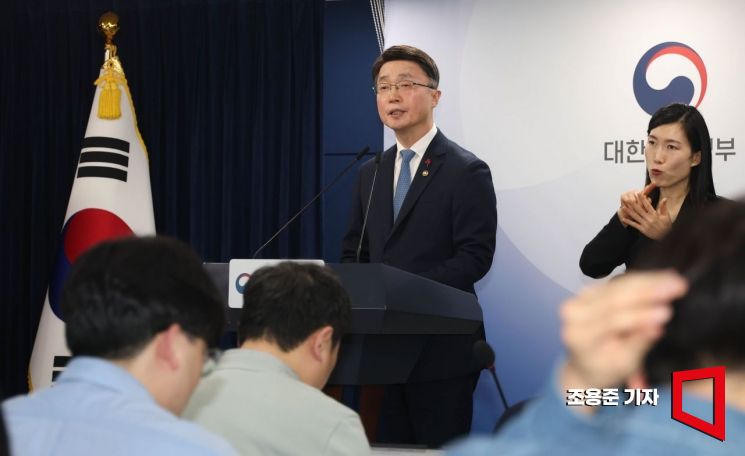 Ryu Jemyung, Vice Minister of Science and ICT, is announcing the "First Phase Evaluation Results of the Independent AI Foundation Model Project" at the Government Seoul Office in Jongno-gu, Seoul on January 15, 2026. Photo by Jo Yongjun
Contrary to initial expectations that only one team would be eliminated in the first phase evaluation of the Independent AI Foundation Model Project, both Naver Cloud and NC AI were unexpectedly disqualified. The government will maintain a competitive structure by holding an additional recruitment to fill the now-vacant spot.
The government conducted the first phase evaluation based on benchmarks (40 points), expert assessment (35 points), and user feedback (25 points), comprehensively evaluating performance, field applicability, cost efficiency, and impact. As a result, SK Telecom, Upstage, and LG AI Research were selected to advance. At a briefing on January 15, Ryu Jemyung, Vice Minister of Science and ICT, stated that LG AI Research received the highest overall score of 90.2, with the average score among the five elite teams being 79.7. He said, "While the evaluation criteria and process will be transparently disclosed, we will refrain from revealing the specific scores of individual companies in consideration of potential direct and indirect harm to them." However, he added that each company will be fully informed of their evaluation results and the reasons for advancing to or being eliminated from the second phase.
Even if a team scored highly, the final decision was determined by whether the team met the core requirement of "originality" set for this project. In response to questions regarding Naver Cloud's disqualification, Vice Minister Ryu explained, "The problematic video and audio encoders were mentioned in the technical report. Even if open source is used, the process of 'completely clearing the weights' and retraining with self-acquired data must be verified; however, it was confirmed that Naver Cloud used the weights as they were, which we considered insufficient to meet the requirements." He added that while it is true that open source without licensing issues was used, the project required "designing and training from scratch," which was not satisfied.
When asked whether the Naver Cloud consortium had inquired in advance about using the encoders, he replied, "As far as I know, there was no prior inquiry from the company." The government stated that the project guidelines included relevant expressions and examples, and the meaning of an independent AI foundation model was explained during information sessions. Although Naver submitted an explanatory statement after the controversy arose, "the evaluation was already underway at that point, and since the explanation was not provided before the project ended or before the evaluation, it was not reflected in the assessment." In their statement, Naver argued that they possessed their own encoder and that its share within the project was minor, but the government found that there were differences from the expert perspective and made a comprehensive judgment.
The additional recruitment process will be finalized after a 10-day objection period. Vice Minister Ryu stated, "Participating companies may file objections to the evaluation results, and after receiving objections for 10 days, the results will be finalized. If there are objections, the process will take that time; if not, we will proceed with the recruitment immediately to minimize administrative delay."
The government plans to maintain the overall structure of the second phase evaluation but will further specify criteria such as "from scratch." Vice Minister Ryu said, "We will gather opinions from academia and industry on the 'from scratch' issue and prepare more detailed guidelines, such as differentiated scoring, to ensure development under the same standards." He explained that the evaluation criteria were developed in consultation with participating companies, and since the project was designed to reflect the characteristics of each consortium, there were limits to assessing only with a common benchmark (test set), so individual benchmarks were also included by agreement. He added, "There were concerns that individual benchmarks might favor certain companies, but it was confirmed that this was not the case."
The government will have the three advancing teams begin the second phase immediately and will have the additional selected team join as quickly as possible. Vice Minister Ryu stated, "We are providing leased GPUs, and if the three companies wait for the additional selection, the leased GPU resources would be idle, leading to budget waste. Therefore, the three companies will start right away, and we will expedite administrative procedures for the additional selection, but the total project duration and the scale of GPU and data support will be the same for the additional team."
Regarding the timing for selecting the final two elite teams, he explained, "Within the overall project plan running through 2027, we will intensively allocate resources to narrow it down to two teams by the end of 2026. The conclusion of the second evaluation phase will be managed flexibly, depending on the situation, sometime between June and July."
© The Asia Business Daily(www.asiae.co.kr). All rights reserved.
![Clutching a Stolen Dior Bag, Saying "I Hate Being Poor but Real"... The Grotesque Con of a "Human Knockoff" [Slate]](https://cwcontent.asiae.co.kr/asiaresize/183/2026021902243444107_1771435474.jpg)
















