Final Agreement Reached in Seoul City Bus Labor-Management Talks
2.9% Wage Increase and Retirement Age Extended to 65
Core Issue of "Wage System Reform" Remains Unresolved
Calls Grow for Reforming Quasi-Public System Amid Fiscal Burden
The wage and collective bargaining agreement negotiations between labor and management for Seoul city buses have been settled. This comes just two days after the union began a full-scale strike. However, only issues such as the wage increase for 2025 and other pending matters have been agreed upon, leaving core issues such as the restructuring of the wage system unresolved. The Seoul Metropolitan Government now faces the challenge of addressing structural problems, including the reform of the quasi-public bus system and the resulting fiscal burden.
According to the Seoul Metropolitan Government on January 15, the Seoul City Bus Labor Union and the management side, Seoul City Bus Transportation Business Association, reached a final agreement on the wage and collective bargaining adjustment plan at 11:50 PM the previous night. Labor and management participated in the second post-mediation meeting of the Special Mediation Committee related to the wage and collective bargaining agreement at the Seoul Regional Labor Relations Commission from 3 PM that day, and after nearly nine hours of negotiations, accepted the mediation proposal from the public interest members.
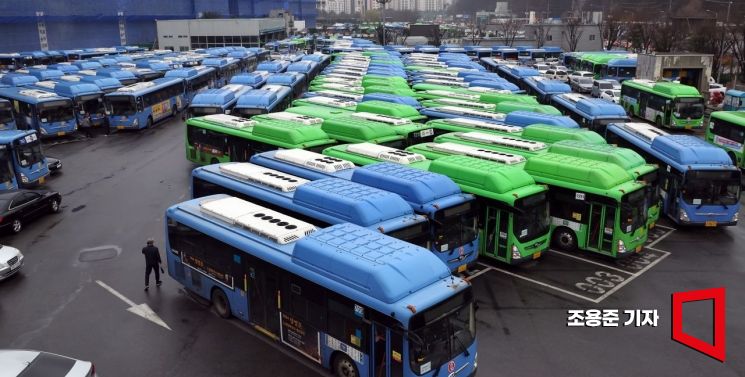 The Seoul City Bus Labor Union and the Seoul City Bus Transportation Business Association, representing the management side, reached a final agreement on the wage and collective bargaining adjustment plan at around 11:50 p.m. on the 14th. The photo shows a bus depot in Eunpyeong-gu, Seoul. Photo by The Asia Business Daily
The mediation proposal agreed upon by both labor and management includes a 2.9% wage increase and a phased extension of the retirement age to 65, accommodating most of the union's demands. Starting in July this year, the retirement age will be raised to 64, and from next year, it will increase to 65. The union had demanded a 3.0% wage increase, matching the rate for Seoul Metro, and an extension of the retirement age to 65, the same as in Gyeonggi Province. A union representative stated, "We do not believe our demands are excessive, as we are simply asking for normalization of areas where we lag behind other regions."
Regarding the "operation status inspection system," which the union sought to improve, labor, management, and government agreed to form a task force to discuss the issue. The union argues that the Seoul Metropolitan Government monitors work conditions by secretly boarding buses under the pretext of "operation status inspections," effectively acting as "mobile CCTV," and evaluates workers without objective standards.
However, the core issue of restructuring the wage system was omitted from the mediation proposal. Both labor and management, who have appealed the second-instance ruling in the Donga Transportation case, are expected to revisit discussions on wage system reform after the Supreme Court delivers its verdict.
On October 29 last year, the Seoul High Court, in the appellate trial for Donga Transportation's ordinary wage case, ruled that regular bonuses should be included in ordinary wages and recognized 176 hours per month as the standard calculation time. In contrast, management argues that the standard should be 209 hours per month, which includes 40 working hours per week plus 8 paid weekly holiday hours. Among the seven local governments operating city buses under a quasi-public system, Seoul is the only one that has not reformed its wage system.
The union intends to address the scope of ordinary wage inclusion and the resulting unpaid wage issues through civil litigation. It is reported that claims for principal, delayed interest, and damages are being prepared for unpaid wages for November and December 2025, as well as January 2026. The revised Labor Standards Act applies an annual 20% delayed interest rate to unpaid wages for current employees and allows for up to three times the damages for wage arrears exceeding three months.
This strike may also prompt a review of the structural issues surrounding the quasi-public bus system. The quasi-public system allows private operators to run city buses, with local governments covering deficits. Introduced in Seoul in 2004-the first in the country-the system aimed to ensure stable operations even on less profitable routes.
However, there has been ongoing criticism that market competition has weakened because losses are covered by taxes, even when operational efficiency is low. During the COVID-19 period, 811.4 billion won was spent in 2022 and 891.5 billion won in 2023, while 400 billion won and 457.5 billion won of public funds were allocated in 2024 and the previous year, respectively.
Calls for reforming the quasi-public system are already growing within and outside the Seoul Metropolitan Government. Jeong Wonoh, Mayor of Seongdong-gu and a leading candidate for Seoul Mayor from the ruling party, stated, "The operating deficit of 64 city bus companies has continued to reach about 500 billion won annually over the past five years," adding, "A fundamental review of the city bus quasi-public system itself is necessary."
The standard for "essential operational personnel deployment" for city buses is also likely to be reviewed. While the law requires subways to retain essential maintenance staff even during strikes, there is no minimum operation requirement for buses, resulting in direct inconvenience for citizens. On the first day of the strike alone, 6,540 buses, or 93.2% of all city buses, stopped operating. The remaining 478 buses, or 6.8%, were operated by non-union drivers or some union members who did not participate in the strike for the convenience of citizens.
The additional fiscal burden that arises with every strike is also an issue. Due to the two-day bus union strike, the city spent approximately 2 billion won on emergency transportation measures. On the 13th, 677 chartered buses were hired, and on the 14th, 763 were used, with the city covering all costs-including rental fees, fuel, and labor-amounting to 1 billion won per day.
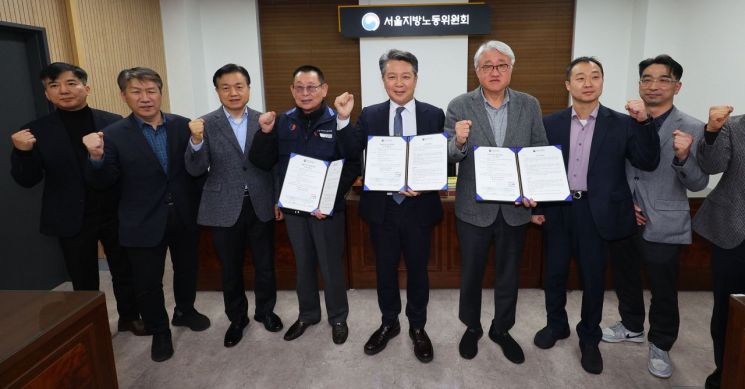 On the 15th, at the 2nd post-adjustment meeting of the Special Mediation Committee held at the Seoul Regional Labor Relations Commission, Park Jeomgon, Chairman of the Seoul City Bus Labor Union, and Kim Junghwan, Chairman of the Seoul City Bus Transportation Business Association, along with other attendees from both labor and management, completed a labor-management agreement and took a commemorative photo. Photo by Yonhap News Agency
© The Asia Business Daily(www.asiae.co.kr). All rights reserved.
![Clutching a Stolen Dior Bag, Saying "I Hate Being Poor but Real"... The Grotesque Con of a "Human Knockoff" [Slate]](https://cwcontent.asiae.co.kr/asiaresize/183/2026021902243444107_1771435474.jpg)
















