Bank of Korea Holds Base Rate at 2.50% on January 15
Won-Dollar Exchange Rate Surges Again to High 1,400s Despite Stabilization Efforts
Persistent Real Estate Expectations and Inflationary Pressures from High Exchange Rate Factored In
On January 15, the Monetary Policy Board of the Bank of Korea decided to keep the base interest rate unchanged at 2.50% per annum. This decision took into account several factors: the ongoing surge of the won-dollar exchange rate, which has climbed back up to the high 1,400-won range despite stabilization efforts by the foreign exchange authorities; persistent expectations of rising real estate prices; and concerns over inflationary pressures resulting from the high exchange rate.
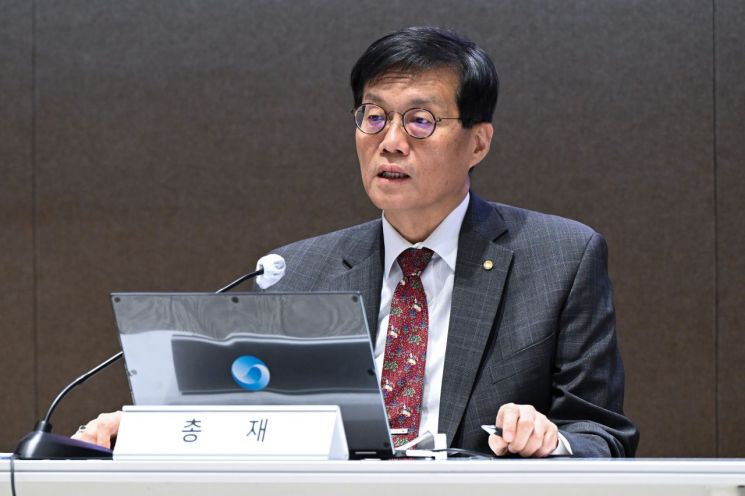 Lee Changyong, Governor of the Bank of Korea, is speaking at the briefing session on the status of inflation targeting held on December 17 last year at the Bank of Korea in Jung-gu, Seoul. Photo by Yonhap News, Joint Coverage
The Monetary Policy Board announced during its meeting on the direction of monetary policy, held at the Bank of Korea’s main building in Jung-gu, Seoul, that the base rate would remain at 2.50% per annum. This marks the fifth consecutive freeze following similar decisions in July, August, October, and November of last year, aligning with market expectations. In a recent survey of experts by The Asia Business Daily, all 13 respondents predicted that the rate would be held steady this month.
The main factor behind this month’s decision to freeze the rate is exchange rate instability. At the end of last year, the won-dollar exchange rate soared above 1,480 won. While the foreign exchange authorities introduced comprehensive stabilization measures, which seemed to temporarily calm the market, the rate resumed its upward trend with the start of the new year, once again surpassing the 1,460-won mark. On December 22-23 last year, the exchange rate exceeded 1,480 won, prompting the authorities to intervene forcefully on the 24th. As a result, the rate recorded its largest single-day drop in three years and one month, falling below 1,450 won within a day and reaching as low as 1,429.8 won on the 29th. However, with the new year, the scale of investments by individual Korean investors in overseas stocks increased, and foreign investors sold off domestic stocks, pushing the weekly closing rate up to 1,477.5 won as of the previous day. Although the rate fell back to the 1,460-won range on the morning of the 15th, concerns over the high exchange rate persist.
If the base rate were to be lowered while the exchange rate remains high, the interest rate gap between Korea and the United States would widen further, potentially prompting foreign investors to move their funds in search of higher returns elsewhere, thereby further weakening the value of the won. The current U.S. policy rate stands at 3.50-3.75%, which is 1.25 percentage points higher than Korea’s rate at the upper end. Many in the market expect the next U.S. policy rate cut to occur after March. Considering recently released U.S. growth and inflation data, there is a strong view that the Federal Reserve is more likely to pause and observe the situation rather than proceed with additional cuts. The Monetary Policy Board stated that, given the continued risks to financial stability-including the exchange rate-it will maintain the current base rate while closely monitoring both domestic and international policy conditions.
Alongside the exchange rate, rising import prices have pushed the consumer price inflation rate above the Bank of Korea’s inflation target of 2.0%, further supporting the decision to freeze the rate. In December last year, the Consumer Price Index reached 117.57 (2020=100), up 2.3% from a year earlier. This marks the fourth consecutive month of inflation above 2%, following 2.1% in September, 2.4% in October, and 2.4% in November. Although the annual inflation rate is expected to remain stable at a slightly higher level of 2.1% this year, thanks in part to falling international oil prices, caution remains high since the end of last year.
Concerns also persist regarding the housing market and household debt. While the government’s October 15 measures and the banking sector’s management of household loan growth have slowed the increase in household debt, some point out that this could be a temporary pause caused by strong regulations, given that expectations for further price increases remain. According to the Korea Real Estate Board, the average selling price of apartments in Seoul rose by 0.18% in the first week of January this year (based on the survey conducted on the 5th) compared to the previous week. This marks the 48th consecutive week of increases since the first week of February last year.
Expert opinions are sharply divided on the timing of the next rate cut. Some believe that a further cut is likely, citing the potential for weaker growth momentum in the second half of the year. Others argue that, given the overall trend of economic improvement, the Monetary Policy Board may prioritize financial stability, leading to a prolonged pause in monetary policy adjustments. Baek Yoonmin, a researcher at Kyobo Securities, stated, "Considering the strong base effect for growth and the possibility of weaker growth momentum in the second half, the need for an additional rate cut in the third quarter of this year could become more pronounced." Heo Moonjong, head of the research center at Woori Financial Management Research Institute, also predicted, "Although growth is expected to recover this year, it will still fall slightly short of the potential trend. The Bank of Korea is likely to cut rates further in the second or third quarter, balancing financial stability with support for economic recovery."
On the other hand, there are also many who expect the rate to remain unchanged throughout the year. Yoon Yeosam, a researcher at Meritz Securities, said, "If the semiconductor supercycle slows in the second half of the year and the 2027 budget is reduced to within 5% of the medium-term balance, the need for renewed monetary easing may emerge as the fiscal-driven growth trend weakens." He predicted that an additional rate cut could occur in the first quarter of next year. Jung Sungtae, a researcher at Samsung Securities, also forecast a rate freeze for the rest of the year, citing improved growth, a rising exchange rate, and increasing inflationary pressures.
© The Asia Business Daily(www.asiae.co.kr). All rights reserved.
![Clutching a Stolen Dior Bag, Saying "I Hate Being Poor but Real"... The Grotesque Con of a "Human Knockoff" [Slate]](https://cwcontent.asiae.co.kr/asiaresize/183/2026021902243444107_1771435474.jpg)















