Won-Dollar Exchange Rate Fluctuates Near 1,480
Continuous Rise in the New Year Amid Persistent Dollar Outflows
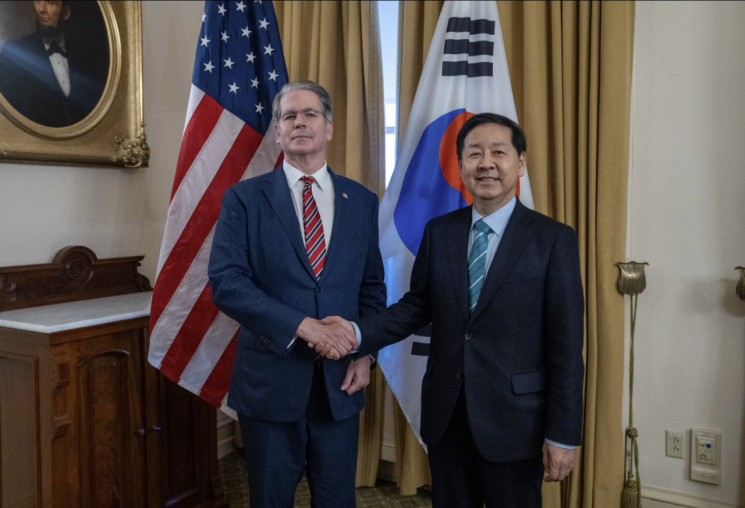 Scott Bessent, Secretary of the Treasury (left), and Koo Yoon-chul, Deputy Prime Minister and Minister of Economy and Finance, are taking a commemorative photo during their meeting in Washington DC on the 12th (local time). (Photo by X)
Scott Bessent, Secretary of the Treasury of the United States, recently stated that the sharp depreciation of the Korean won does not align with the fundamentals of the Korean economy. The won-dollar exchange rate has risen for ten consecutive days since the start of the new year, approaching 1,480 won.
According to the Ministry of Economy and Finance on January 14, Koo Yoon-chul, Deputy Prime Minister and Minister of Economy and Finance, met with Secretary Bessent in Washington, D.C. on the 12th (local time) to discuss the recent situation in Korea's foreign exchange market. The bilateral meeting took place on the sidelines of the Group of Seven (G7) Core Minerals Finance Ministers' Meeting held on the same day.
After the meeting, Secretary Bessent posted on the social media platform X (formerly Twitter), pointing out that the recent decline in the value of the won "does not correspond with Korea's strong economic fundamentals," and emphasized that "excessive volatility in the foreign exchange market is undesirable."
His remarks suggest that the recent weakness of the won is more attributable to market volatility than to concerns about the fundamentals of the Korean economy.
He also reaffirmed that "Korea's strong economic performance in key industrial sectors supporting the U.S. economy makes Korea a core partner for the United States in Asia."
Previously, it was suggested that the presence of foreign exchange policy working-level officials accompanying Deputy Prime Minister Koo on his trip to the United States indicated possible discussions aimed at addressing the recent surge in the exchange rate.
Since the end of last year, the government has introduced several foreign exchange market stabilization measures, including promoting dollar exchanges by export companies, mobilizing the National Pension Service for foreign exchange hedging, reducing capital gains tax for returning overseas retail investors, and exempting foreign exchange soundness charges. However, these measures have not been able to curb the upward trend of the exchange rate.
On this day, the won-dollar exchange rate closed at 1,477.5 won in weekly trading, up 3.8 won from the previous trading day.
© The Asia Business Daily(www.asiae.co.kr). All rights reserved.
![Clutching a Stolen Dior Bag, Saying "I Hate Being Poor but Real"... The Grotesque Con of a "Human Knockoff" [Slate]](https://cwcontent.asiae.co.kr/asiaresize/183/2026021902243444107_1771435474.jpg)















