Four-Party Consultative Body Launched at National Assembly
Cooperation for Passage of Special Act in February
Unified Commitment to Guarantee Educational Autonomy
Gwangju Metropolitan City, Jeollanam-do Province, and the Gwangju and Jeonnam Offices of Education have agreed to jointly promote the administrative integration of Gwangju and Jeonnam.
On the afternoon of January 14, Kang Gijeong, Mayor of Gwangju; Kim Youngrok, Governor of Jeollanam-do; Lee Jeongseon, Superintendent of Gwangju City Office of Education; and Kim Daejung, Superintendent of Jeonnam Provincial Office of Education, held a "Four-Party Consultative Meeting" at the National Assembly. They announced the "Joint Agreement for the Grand Integration of Gwangju and Jeonnam," aiming for the launch of a unified special city and a unified special city office of education.
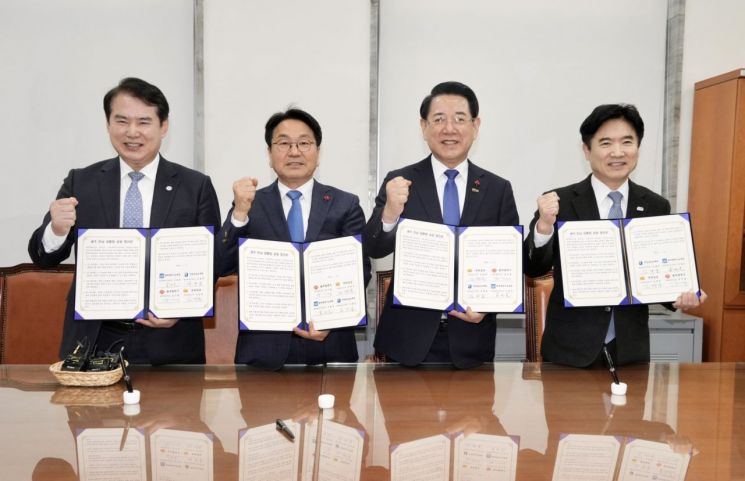 Kang Gijeong, Mayor of Gwangju Metropolitan City, attended the meeting between provincial governors and superintendents of education regarding the administrative integration of Gwangju and Jeonnam held at the National Assembly Main Building on the 14th, and after announcing the "Joint Agreement on the Grand Integration of Gwangju and Jeonnam," took a commemorative photo. From the left in the photo are Lee Jeongseon, Superintendent of Gwangju Metropolitan Office of Education; Kang Gijeong, Mayor of Gwangju Metropolitan City; Kim Youngrok, Governor of Jeollanam-do; and Kim Daejung, Superintendent of Jeonnam Office of Education. Provided by Gwangju City
In the joint agreement, the four institutions recognized that launching an integrated metropolitan government and metropolitan office of education for Gwangju and Jeonnam is a task of both historical and contemporary significance. They agreed to develop the optimal integration plan based on mutual respect and trust.
According to the agreement, the "Four-Party Consultative Body" will work closely to ensure that the "Special Act for the Establishment of the (tentatively named) Gwangju-Jeonnam Special City" passes the National Assembly in February. In addition, together with the city and provincial councils, they will hold public hearings, including briefing sessions, discussion forums, and meetings by city, county, and district, to build public consensus among local residents.
Even after the integration of administrative and educational administration, the four parties will work together to preserve the identities of Gwangju’s five autonomous districts and Jeonnam’s 22 cities and counties. They reaffirmed that education is a key foundation for regional development and agreed to guarantee educational autonomy during the integration process. The agreement also stipulates that civil servants appointed before the establishment of the unified special city and special city office of education will continue to work within the jurisdictions of the former Gwangju City and Jeonnam Province.
The Four-Party Consultative Body also agreed to jointly develop long-term strategies for the (tentatively named) Gwangju-Jeonnam Special City, including administrative systems, fiscal structures, organizational restructuring, balanced regional development strategies by area, and educational autonomy after the integration.
Kang Gijeong, Mayor of Gwangju, stated, "It is highly significant that both education offices of Gwangju and Jeonnam have come together with a unified voice. During the process of enacting the special law, we will firmly guarantee the independence and neutrality of educational autonomy to ensure the successful integration of administrative and educational administration."
Kim Youngrok, Governor of Jeollanam-do, said, "The participation of the education community in the grand integration process, which is being promoted in response to the wishes of city and provincial residents, will enhance the completeness of the integration. We will meticulously ensure that none of the 27 cities, counties, districts, or any occupational groups are excluded or disadvantaged."
Lee Jeongseon, Superintendent of Gwangju City Office of Education, commented, "Even during the integration process, we will steadfastly uphold the value of educational autonomy and prioritize stability in the field to ensure that educational staff are not disadvantaged in personnel matters."
Kim Daejung, Superintendent of Jeonnam Provincial Office of Education, remarked, "Gwangju and Jeonnam share common roots, and this integration will serve as a turning point to enhance both regional competitiveness and the quality of education. Substantial support, including special provisions for rural and small schools, must follow to address the decline in the school-age population."
© The Asia Business Daily(www.asiae.co.kr). All rights reserved.
![Clutching a Stolen Dior Bag, Saying "I Hate Being Poor but Real"... The Grotesque Con of a "Human Knockoff" [Slate]](https://cwcontent.asiae.co.kr/asiaresize/183/2026021902243444107_1771435474.jpg)















