134-square-meter Facility at GIDC in Iljik-dong
Education for Citizens and Businesses, Linking Employment and Startups
Park Seungwon: "Building a City that Improves Citizens' Lives with Smart City Technologies"
Gwangmyeong City in Gyeonggi Province has established a hub for innovation toward a carbon-neutral smart city.
On January 14, Gwangmyeong City held the opening ceremony for the "G-Smart Hub" at the Gwangmyeong International Design Cluster (GIDC) in Iljik-dong.
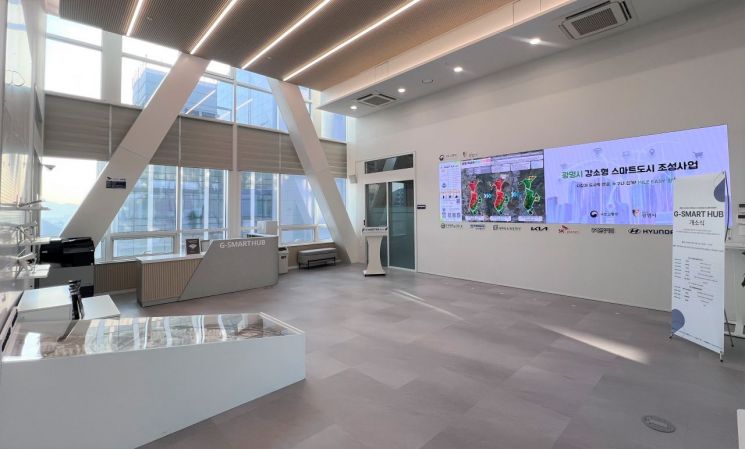 Gwangmyeong City opened the 'G-Smart Hub' at GIDC in Iljik-dong on the 14th. It will serve as a base for the city's implementation of a carbon-neutral smart city. Provided by Gwangmyeong City
This facility will serve as a key base for the realization of a carbon-neutral smart city, a project being promoted by the city after being selected for the Ministry of Land, Infrastructure and Transport’s "Small-Scale Smart City Development Project."
The hub will enable citizens, businesses, universities, and public institutions to identify urban issues encountered in daily life, and to demonstrate and disseminate solutions using smart technologies and policies. Through this center, the city aims to establish a virtuous cycle for smart city development, where ideas from citizens and businesses are implemented in the urban environment and their outcomes lead to employment, entrepreneurship, and regional growth.
The 134-square-meter center includes a lobby, workspaces, a citizen communication space, and a data zone.
The center plans to operate a range of programs in stages, including: "Smart Citizen Education" to strengthen the smart capabilities of citizens and businesses; "Living Lab" to collaboratively address urban issues focused on daily life; "Open Lab," which links employment and entrepreneurship through cooperation between the Hanyang University ERICA Industry-Academic Cooperation Foundation and the city’s Startup Support Center; and foundational research for the transition to a carbon-neutral smart city.
The Hanyang University ERICA Industry-Academic Cooperation Foundation will oversee the center’s operation, with Professor Kim Hwanyong of the Department of Architecture at Hanyang University ERICA Campus serving as director. A "G-Smart Hub Operations Council," consisting of nine members including experts, citizens, public officials, and representatives from related organizations, has also been formed to regularly review the center’s direction and major projects, and to discuss cooperation strategies.
The center operates from 9 a.m. to 6 p.m. on weekdays and is closed on weekends and public holidays.
Park Seungwon, Mayor of Gwangmyeong City, stated, "We will ensure that smart city technologies take root in the region through this center and create a city where they have a positive impact on citizens’ lives."
In addition to operating the center, the city is also pursuing various smart city initiatives, including the establishment of renewable energy resource power plants; operation of renewable energy virtual trading services; construction of eco-friendly green IoT walls; development of a spatial intelligence-based IoT integrated flood and inundation control system; operation of eco-friendly delivery services; operation of electric vehicle sharing services; establishment of an electric bus-based eco-friendly demand-responsive transport (DRT) system; creation of a carbon trading platform; and the development of a data station and integrated platform.
© The Asia Business Daily(www.asiae.co.kr). All rights reserved.
![Clutching a Stolen Dior Bag, Saying "I Hate Being Poor but Real"... The Grotesque Con of a "Human Knockoff" [Slate]](https://cwcontent.asiae.co.kr/asiaresize/183/2026021902243444107_1771435474.jpg)















