Real-Time Public Feedback Incorporated
Deputy Prime Minister to Personally Oversee Follow-Up Tasks
The government has openly shared with the public both the process and concerns involved in driving Korea’s major transformation, led by science and technology and artificial intelligence (AI). The Ministry of Science and ICT announced that from January 12 to January 14, Deputy Prime Minister and Minister of Science and ICT Baek Kyung-hoon presided over public business reports from 55 organizations, including the Space Aviation Agency, affiliated and public institutions, and related agencies.
This round of business reports was organized to review the specific implementation plans for the Ministry of Science and ICT’s 2026 work agenda and to coordinate strategies among the ministry and its subordinate agencies as a unified team under the policy goal of “A Great Leap Forward for Korea Through Science, Technology, and AI.” All reports were broadcast live via the Ministry’s YouTube channel and KTV, and public opinions submitted online were discussed in real time on-site, with institutions providing direct responses.
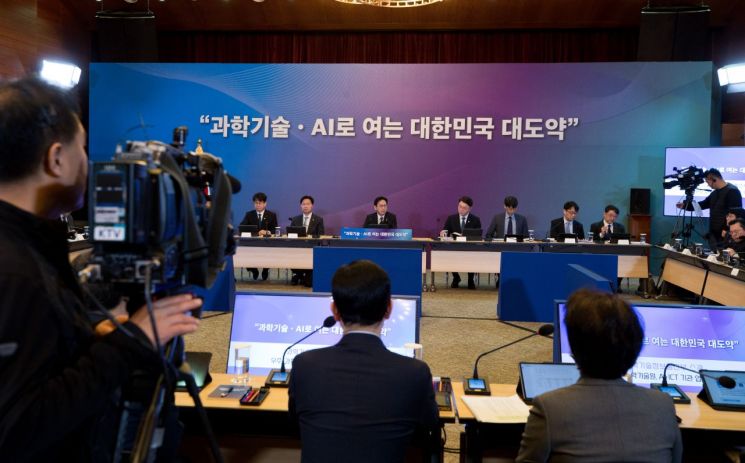 Deputy Prime Minister and Minister of Science and ICT Baek Kyung-hoon is speaking at the 'Space Aviation Agency, Institute of Science and Technology, and Information and Communication Technology Sector Work Report' held on the 14th at Seoul Central Post Office in Jung-gu, Seoul. Photo by Yonhap News
Government-funded Research Institutes and Public Institutions: "Redefining Roles in the AI Transformation Era"
On January 12, 28 organizations, including government-funded research institutes and public institutions in the science and technology sector, participated in the business report session. The discussions focused on AI-driven scientific and technological innovation, redefining the unique missions of each institution, and strengthening industry-academia-research collaboration, in line with the AI transformation and the abolition of the Project-Based System (PBS).
In the quantum sector, the formation of a national consultative body to consolidate scattered research across institutions was discussed. In the physical AI sector, strategies for building collaborative frameworks between institutions and companies were addressed, encompassing research data, specialized AI models, and hardware such as actuators. The business report from R&D planning and management agencies emphasized the need to strengthen management capabilities to ensure the expanded R&D budget is properly executed in the field, while also reaffirming the principles of fostering a culture that tolerates failure and strictly addressing misconduct.
Deputy Prime Minister Baek stated, “As projects with significant impact, like the United States’ Genesis Mission, emerge, we too must set clear goals,” adding, “If each institution acts independently, the results will inevitably remain limited.” He emphasized, “Government-funded research institutes should establish joint objectives with universities and companies from an overall institutional perspective and enhance fragmented data into high-quality, learnable datasets.”
He also referenced public feedback about researchers having to repeatedly enter the same information into multiple systems, urging a swift integration and interconnection of data across research management systems.
On January 13, 12 public institutions in the fields of science culture and postal services delivered their business reports. In the science culture sector, expanding public access to science museums and establishing an information-sharing platform centered around the National Science Museum were discussed. Deputy Prime Minister Baek requested that science museums serve as hubs for AI education to improve AI literacy.
Regarding public feedback that science museum programs fill up too quickly, the ministry decided to review ways to expand these programs. In the postal sector, he called for the identification of new delegated public welfare and administrative services, as well as the development of measures to prevent financial fraud targeting vulnerable groups.
Space, AI, and ICT: "Defining Organizational Culture and Roles as a Source of Competitiveness"
On January 14, 15 organizations-including the Space Aviation Agency, space research institutes, the four major Institutes of Science and Technology, and public institutions in the AI and ICT sectors-continued with their business reports. Deputy Prime Minister Baek commended the efforts of researchers and participating companies for the successful fourth launch of the Nuri rocket, highlighting the importance of improving working conditions and establishing a positive organizational culture.
Regarding next-generation launch vehicle development, discussions included bridging technological gaps, systematic management of component production, and strategies for subsequent launches. The need to clarify the division of roles between the Space Aviation Agency and research institutes was also raised. For AI and ICT public institutions, he called for a broader role that goes beyond GPU supply and AI model development, to encompass the entire national AI ecosystem.
The Ministry of Science and ICT plans to formalize follow-up measures identified during these business reports as specific tasks, with Deputy Prime Minister Baek personally monitoring their implementation. The Ministry stated, “We will mobilize the full capabilities of all 55 organizations to bring about tangible changes that the public can truly feel.”
© The Asia Business Daily(www.asiae.co.kr). All rights reserved.
![Clutching a Stolen Dior Bag, Saying "I Hate Being Poor but Real"... The Grotesque Con of a "Human Knockoff" [Slate]](https://cwcontent.asiae.co.kr/asiaresize/183/2026021902243444107_1771435474.jpg)















