Work Reports from Energy Sector Agencies under the Ministry of Climate, Energy and Environment
KEPCO to Establish Technology Holding Company for Technology Transfer
Coal Power Plant Sites to Be Repurposed as Offshore Wind Power Clusters
KHNP Aims to Raise Nuclear Power Plant Utilization Rate to 89%
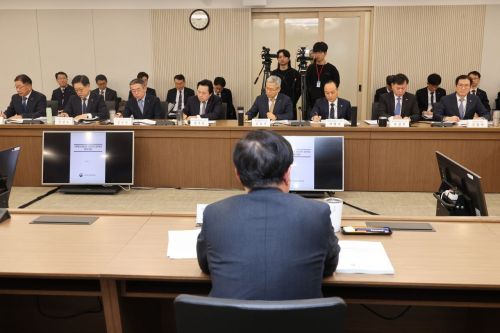 Kim Sung-hwan, Minister of Climate, Energy and Environment, is speaking ahead of receiving a business report from energy sector affiliated organizations including Korea Electric Power Data Network at the Government Sejong Complex on January 12, 2026. Photo by Yonhap News.
Korea Electric Power Corporation (KEPCO) has decided to move up the completion date for seven energy superhighway construction projects, originally scheduled for 2031, to 2030. In addition, it will establish a technology holding company to transfer core technologies to the private sector. KEPCO’s power generation subsidiaries, which were previously focused on coal-fired power, will be transformed into renewable energy companies. Closed coal power plants will be repurposed as sites for renewable energy such as offshore wind power and energy storage systems (ESS). Korea Hydro & Nuclear Power (KHNP) plans to raise the nuclear power plant utilization rate to 89%.
On January 12, the Ministry of Climate, Energy and Environment announced that it had received work reports from 10 public institutions in the power sector and 11 in the nuclear and other energy sectors at the Government Sejong Complex, where these plans were discussed.
KEPCO discussed plans to accelerate the construction of energy superhighways, expand grid connection infrastructure in line with the growth of renewable energy, and foster venture companies and startups through the establishment of a technology holding company.
KEPCO decided to complete seven out of 25 construction projects for the West Coast Energy Superhighway, originally set for completion in 2031, by 2030. As a result, it aims to secure the capacity to accommodate up to 39GW of renewable energy in the Honam region by connecting an additional 27GW by 2030.
KEPCO will establish a technology holding company to promote the transfer of core technologies to the private sector and provide demonstration infrastructure to nurture innovative companies. Its first strategic project will be the development of a next-generation Korean solar inverter.
The five power generation subsidiaries-Namdong Power, Nambu Power, Dongseo Power, Seobu Power, and Jungbu Power-reviewed ways to ensure a just transition from coal-fired power and to utilize idle power grids from decommissioned coal plants. In line with the government's renewable energy goals, they also decided to actively promote the deployment of renewables such as wind and solar power.
Lee Hoyoun, the Second Vice Minister of the Ministry of Climate, Energy and Environment, explained, "This year, we are targeting an expansion of solar power by more than 7.5GW, and there was a discussion that the public sector should play a leading role through aggregation and planned site development." There is also an expectation that large-scale procurement of solar modules by the public sector could lower solar power prices through economies of scale.
Specifically, Namdong Power will build a 400MW solar power complex utilizing reclaimed saline land in Haenam. It will also develop an offshore wind power cluster on the site of the Samcheonpo coal-fired power plant and establish a Northeast Asia hydrogen trading hub to promote 3GW of hydrogen fuel cell power generation.
Korea Midland Power plans to pursue 3.9GW of offshore wind power through public-private or public-led initiatives and to build solar power plants at Hwaseong Industrial Complex (50MW), Ulsan Industrial Complex (20MW), and reclaimed dredged soil sites (100MW). It also plans to newly develop 500MW of pumped-storage hydroelectric power in Bungwha and Gurye.
Korea Western Power will develop large-scale offshore wind farms totaling 6.4GW in the Taean and Southwest regions and promote solar power generation at reclaimed saline farmland in Iwon, Ganwol Lake, and Hapcheon Dam.
Korea Southern Power will install 11MW of highway solar power and pursue 228MW of floating solar power at Naju Lake and other locations. Dongseo Power plans to develop onshore wind power at Yangsan (37MW), Maemakjae (40MW), Gadeoksan (36MW), and Smile (49MW).
Regarding the closure of coal-fired power plants, the government plans to establish a just transition roadmap by the first half of this year. On this, Vice Minister Lee Hoyoun stated, "We intensively discussed ways to develop alternative industries that maximize the use of existing infrastructure while preventing the local economy from shrinking." It was also reported that there were discussions on the integration of power generation public enterprises on this day.
Meanwhile, Korea Power Exchange reviewed the establishment of the 12th Basic Plan for Electricity Supply and Demand, stable supply management measures for the summer, winter, and off-peak seasons, and reported on power market design and operation plans such as timely expansion of ESS in line with the transition to renewables as the main power source.
Korea Hydro & Nuclear Power reviewed the status of the restart of Kori Unit 2, preparations for the new operation of Saeul Unit 3, and the progress of developing the innovative small modular reactor (i-SMR) technology.
KHNP announced plans to optimize the safety and economic efficiency of nuclear power plants, aiming to increase the nuclear power plant utilization rate from 84.6% in 2025 to 89% this year. If this target is achieved, the utilization rate will reach its highest level in 15 years, since 2011 (90.7%).
During the work report, Kim Sung-hwan, Minister of Climate, Energy and Environment, emphasized, "In the past, we established the Basic Plan for Electricity Supply and Demand first and then created transmission and transformation plans, but now I believe these must be addressed almost simultaneously. Electricity must develop into a new industry, and we must foster unicorn companies related to the power sector."
© The Asia Business Daily(www.asiae.co.kr). All rights reserved.
![Clutching a Stolen Dior Bag, Saying "I Hate Being Poor but Real"... The Grotesque Con of a "Human Knockoff" [Slate]](https://cwcontent.asiae.co.kr/asiaresize/183/2026021902243444107_1771435474.jpg)















